

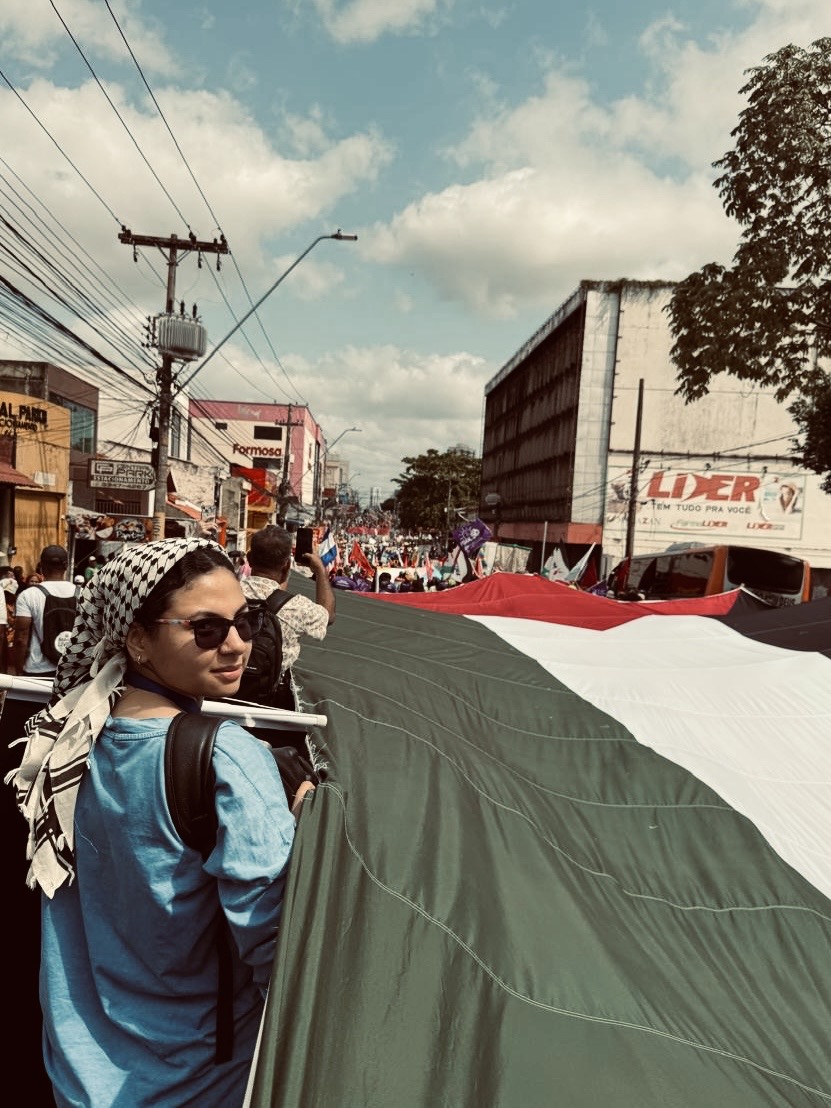
In the heart of the Amazonia, people called the COP30 different names, “COP of truth”, “COP of indigenous people”, “COP of forests”, but what they never called it was “COP of brackets”, the ultimate thing that will never change, we say, they hear, they ignore, AGAIN!
Forests (Almost) Had a Moment
This year, the COP30 Presidency tried something new: they gathered topics not formally addressed in previous COP agendas and compiled them into a single agreement. Because each COP has to have a branded outcome to be carried into the text, so now we have the Global Mutirão: Uniting humanity in a global mobilization against climate change. This document pulled together issues often sidelined -forests, food systems, community-based resilience- and gave them a place at the table. At least, at first. In the first draft we had ambition in mentioning Forest, in brackets, as an option but still we celebrated this win, but not in the final text, we downgraded from the bold tone on deforestation, much of it in bracketed or optional form that was ultimately removed. For example, Paragraph 35 (Option 2) of the Presidency’s 18 November 2025 draft proposed convening a high-level ministerial round table to support national “transition roadmaps, including to… progressively overcome dependency on fossil fuels and towards halting and reversing deforestation”.1 This text was bracketed/contested (with an “Option 3: no text” alternative), and in the end no deforestation roadmap was agreed – Option 3 (dropping the paragraph) prevailed,2 this too was watered down in negotiations. By the final text, all explicit operational directives to halt or reverse deforestation had vanished, leaving only the lone preambular reference noted above. The fact that such language was bracketed in the draft highlights that some Parties resisted a strong deforestation commitment, resulting in its dilution.
Even Elsewhere, Forests Were Just a Footnote
Beyond the Mutirão, forests didn’t fare much better.deforestation only appears in passing elsewhere in the COP30 decisions. In the outcome of the Sharm el-Sheikh Mitigation Work Programme (another COP30 decision on accelerating emissions cuts), Parties “note… the challenges in addressing drivers of deforestation and forest degradation, taking into account the need to be mindful of pursuing sustainable development and food security”.3 This final text (unbracketed) acknowledges forest loss only as a challenge/trade-off – couched with caveats about development and food security – and lists it alongside other climate risks (wildfires, drought, pests) to be managed via “sustainable…forest management”.4 Importantly, it does not call for “halting” or “reversing” deforestation at all, merely recognizing the difficulty of tackling its drivers. This cautious wording further underscores that COP30 avoided any binding language to stop deforestation, reflecting deference to countries with agriculture and land-use interests.
Reversal Without a Halt? A Dangerous Loophole
Notably, throughout the COP30 texts the term “reversing deforestation” never appears without “halting.”1 In both the draft and final documents, “halting and reversing deforestation” are paired as a combined objective. We found no instance of “reversing deforestation” standing alone in the decision language. This pairing suggests an intent to address both stopping ongoing forest loss (halt) and restoring forests (reverse) together, in line with the widely endorsed 2030 goal. However, as discussed, framing it as “halt and reverse by 2030” especially in a non-binding context, can be interpreted to allow a balance of continued deforestation with offsetting reforestation. In practice, countries could meet a net “reverse” outcome by 2030 without ever formally agreeing to immediately cease deforesting. Critics point out that this phrasing and the absence of near-term commitments mean COP30’s forest pledge is largely symbolic. It “provides neither a map nor a path for… the end of deforestation by 2030” effectively sidestepping any enforceable action and leaving forests protected only by voluntary initiatives and future promises rather than concrete, accountable measures.
Money Talks, But Not for Forests
While COP30 sidestepped binding commitments, it also failed to confront the financial imbalance at the heart of deforestation. Between 2022 and 2024, public finance for forest protection totaled just $5.7 billion, while governments continued to pour over $409 billion per year into agricultural subsidies, many of them directly tied to deforestation and industrial farming.5 This gap reveals the real priorities behind the brackets.
Brazil’s much-hailed Tropical Forest Forever Fund, championed by President Lula, was promoted as a breakthrough mechanism. But the Fund is still voluntary, lacks transparency on disbursement, and remains untethered to any enforcement mechanism within the COP30 text. Without clear safeguards, such initiatives risk becoming a green façade for business-as-usual.
Feminist and Indigenous groups have long argued that forest finance must support rights-based, community-driven stewardship, not offset schemes or donor-driven programs. But COP30 left these voices out of the financial architecture.
COP30 happened in the lungs of the Earth. But its decisions left forests gasping.. As long as the climate agenda treats forests as carbon ledgers, rather than living territories defended by women and Indigenous peoples, finance will remain a tool of delay, not justice.
Forests were mentioned; but not defended. An opportunity was named; then bracketed; then erased. Forests, like before. But this time, we watched them vanish in real time.
Footnotes:
- https://unfccc.int/sites/default/files/resource/DT_-cop30-01.pdf
- https://unfccc.int/sites/default/files/resource/Mutir%C3%A3o_cop30.pdf
- https://unfccc.int/sites/default/files/resource/MWP_cop30_4.pdf
- https://unfccc.int/sites/default/files/resource/cma2025_L08E.pdf
- https://cop30.br/en/news-about-cop30/lula-announces-1-billion-contribution-to-the-tropical-forests-forever-fund-brazil-will-lead-by-example