

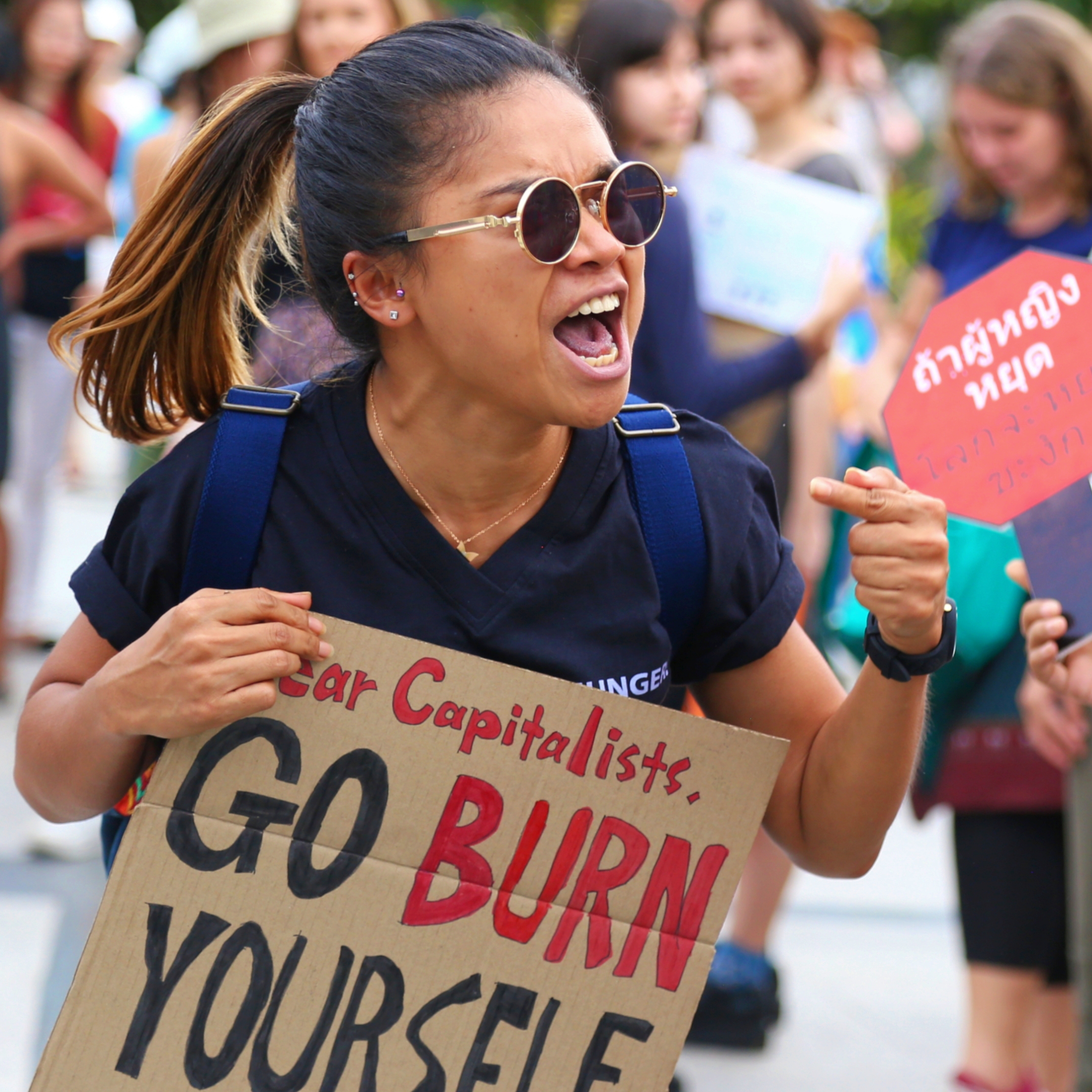
Reflecting on the 30th UNFCCC COP, it is somehow not surprising to me that after three decades there is still no real pathway to end fossil fuel dependence. Belém was my fourth COP and the real voice for climate justice I could hear so far was in the hallways, small side circles or the daily political conversations where feminists and movements for climate justice and liberation hold each other through rage and exhaustion from the negotiations.
I grew up in an Indigenous Melanesian fisherfolk community in the far eastern part of Indonesia. The coastline there shifts every year along with the far more violent storms, and it made my community rebuild over and over because the world’s biggest polluters shamelessly continue burning the planet including flooding COP with their lobbyists to block a future free from fossil fuel addictions.
The slow violence of the global climate negotiations
Every COP I attend reminds me of the brutal disconnect between peoples’ realities and global politics. The Loss and Damage Fund, celebrated as a breakthrough in Sharm el-Sheikh, was not born from diplomatic generosity, but from decades of cross-movement organising and peoples’ resistance. And yet, in Belém, that “victory” feels painfully hollow, as only roughly €21 million pledged during COP30 while Global South countries face an estimated US$400 billion in climate-related losses this year alone. And still, we are forced into exhausting debates on whether frontline communities even deserve direct access to the funds meant to address the destruction they did not cause.
Implementation of real climate action crawls in Belém. Instead of carving out a concrete pathway to a fossil-fuel-free future, countries chose to postpone responsibility and have yet another set of conferences. The newly adopted Just Transition Action Mechanism will also be another empty promise unless finance actually flows from the Global North to the Global South. Communities’ lands, waters, livelihoods, and the systems of collective care held together by women are disappearing rapidly. Meanwhile in Belém, COP cannot even agree on the most basic human rights language, or that gender diverse people, like many other historically oppressed communities, have rights. Let alone to reaffirm the world’s highest courts rulings that States must be held accountable for climate destruction and the rights of future generations.
Extractivism, militarism, and the illegitimate architecture of debt
On small islands like mine, climate chaos is not a projection. It is the tide that eats our shorelines and the salt that climbs into our drinking water. Meanwhile, the Global North, whose prosperity was built on subjugations, refuses to act with the urgency needed to stop themselves from breaching yet another planetary boundary. COP30 promises to triple adaptation finance by 2035 as if communities can wait another decade while the impacts of climate crisis already outrun anything the world can adapt to.
The “just energy transition” was everywhere at COP, as if adding the word just magically makes it real. For the Global South, this corporate-driven transition is simply colonialism repainted green. Critical minerals extraction is accelerating violently. In Asia, Latin America and Africa, lithium extractions, nickel and cobalt rush, are labelled as contributions to national prosperity, for which territories and resources of Indigenous and rural communities are used as factories and dumping grounds for the North’s green rush. Frontline communities across the Global South shoulder the heaviest costs so the North can glide in “clean” cars, congratulating themselves with the delusion that they’re “doing the right thing”.
Debt and militarism are two sides of the same trap. Illegitimate debt strips public services bare and forces governments to prioritise creditors over communities. Even the wealth extracted from communities’ lands leaks out through debt repayments and investor profits. In 2023 alone, Global South countries were drained of a record US$1.4 trillion just to service their foreign debt. By mid 2025, their debts have ballooned past US$109 trillion, leaving more than half on the brink of bankruptcy. The illegitimate architecture of the debt itself is a political weapon, enslaving the global majority and concentrating the power in the hands of a few in the Global North.
At the same time, the global military-industrial complex consumes what is left of the planet. So, to talk about climate justice without naming militarism is to overlook a machinery of grave human rights abuses and ecological destruction. Militarism is not an abstract policy; it is the bombs in Gaza that have already massacred well over 100,000 people, the F-35s that burn more fuel in an hour than a small island village uses in a month, and the fossil-fuelled regime of illegal occupation that destroys lives and lands. Palestine’s struggle is a climate justice struggle. A global space that allows corporate capture, state complicity, war crimes, and genocide cannot claim to pursue climate justice.
What COP Really Means: A Politically Personal Take
Sometimes I ask myself: what does COP even mean for my community in Maluku or for countless communities who do not even know it exists? For the women who fish at dawn, or for families trapped in poverty, rebuilding after each of the climate induced disasters they experience? Let me be clear: poverty is not an accident, but a product deliberately designed and sustained by global capitalist and neoliberal systems.
Many people (including myself) say they don’t belong at COP. And they’re right. These spaces are built to exclude. They speak a language meant to distance negotiations from lived realities, a language that tells frontline communities their knowledge is worthless and have no space in the negotiations.
But this is also why many of us still go to COP.
We go there to hold the line, reclaim our collective power, and insist that we do belong. We go there because feminist, Indigenous, and grassroots movements have always been and should continue to be at the centre of climate politics. We go to COP to bring the voices of our islands, villages, and frontline communities into a space that pretends not to see them.
For me, climate justice is an inheritance shaped by the coastal living community that raised me, the peoples’ movements that politicized me, the histories of colonial violence that still structure the current global economic and political orders.
My politics is shaped by the women in my community who rebuild, resist, and refuse to disappear. I believe that the climate crisis demands more than negotiations. COP must address patriarchy that fuels historical injustices, power relations rooted in capitalism and imperialism. Unless COP addresses these root causes, it will continue to fail the peoples it claims to protect.
Many of us keep showing up, not because we believe in COP, but because we believe in each other. Our peoples deserve a future where justice is not a narrative but a daily reality. We will always fight back and will always do so loudly because we are the climate resistance!