
Background Paper: The IMF & World Bank’s Grip on MENA
Written by Shady Hassan
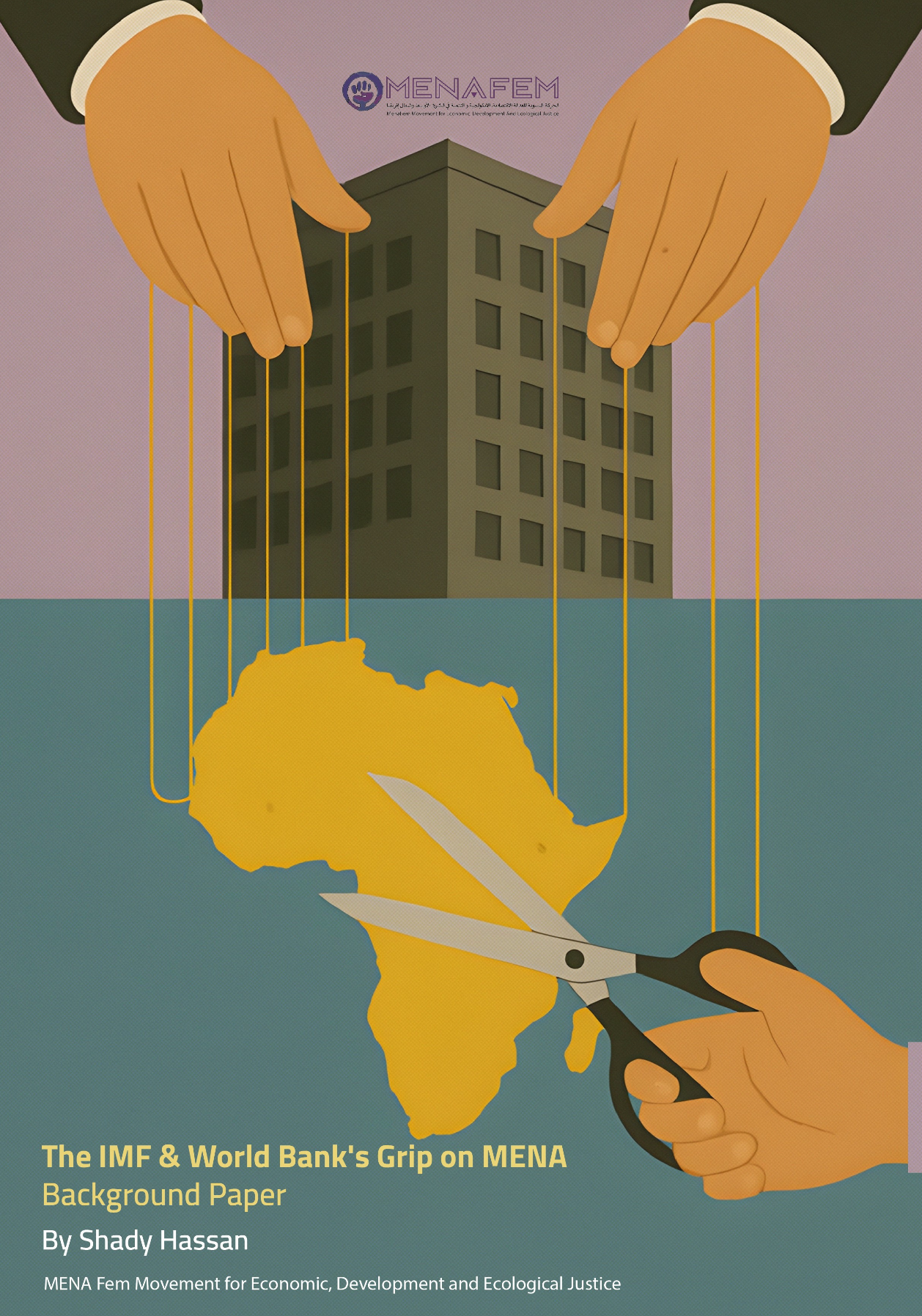
The Middle East and North Africa (MENA) region is entering a new phase of debt dependency that is reshaping its political, social, and economic landscape. Our new background paper, The IMF & World Bank’s Grip on MENA, uncovers how lower- and middle-income Arab countries have become increasingly reliant on the International Monetary Fund (IMF) and the World Bank—not merely for financing, but in ways that allow these institutions to impose far-reaching conditions on domestic policymaking. Over the last 15 years alone, IMF and World Bank lending programs have attached more than 1,365 policy conditions to the region, transforming everything from fiscal policy to social protection systems. This level of conditionality represents not technical expertise, but a powerful ideological project that prioritizes austerity, privatization, deregulation, and political containment.
The paper reveals how these conditionalities—whether framed as budget reforms, climate measures, or governance improvements—carry profound social consequences. They consistently shift the burden of global crises onto the region’s most vulnerable groups, including people living in poverty, informal workers, and especially women. From regressive fuel price reforms in Egypt and Morocco, to surcharges that drain public budgets in Jordan and Tunisia, to flawed debt metrics that distort crisis narratives in Lebanon, the report shows how IFIs reinforce inequality while concentrating economic decision-making in the hands of a small elite. In several countries, the debt service owed to IFIs now consumes a significant share of public resources, crowding out essential services like healthcare, education, and social protection.
Ultimately, the findings demonstrate that the influence of the IMF and World Bank extends far beyond economics—it reshapes social contracts, restructures economies away from people’s needs, and deepens gendered and structural inequalities. At a moment of overlapping global and regional crises, IFIs are using debt as leverage to expand their authority, entrench austerity, and delay the development of sovereign, fair, and climate-just alternatives. This paper calls on civil society, feminist movements, and advocates for economic justice to challenge this financial colonialism and to demand policies rooted in economic sovereignty, transparency, and gender equality.
READ THE FULL PAPER HERE ⬇️
The IMF & World Bank’s Grip on MENA