Workshop: “Energy Transition and Green Hydrogen: Accountability and Just Transformations” – MENAFem Movement
The workshop “Energy Transition and Green Hydrogen: Accountability and Just Transformations” was held at a moment marked by layered regional challenges: escalating climate pressures, the rapid expansion of clean energy models, and the deep entanglement between economic policymaking, international finance, and the rights of local communities. The workshop provided a rare space for in-depth discussion among researchers, activists, and experts from across the region on what the energy transition actually means on the ground, beyond the technical and specialized language that often frames these shifts as inevitable and beyond critique. Across its sessions, the workshop sought to unpack the relationship between energy transition pathways, green hydrogen projects, the role of international financial institutions, and the possibilities for popular and community-based accountability, placing questions of justice at the center of every discussion.
I. Energy Transition and the Reconfiguration of State–Society Relations
Shereen Talaat, Founder and Director of MENAFem Movement, opened the workshop with a presentation framing the energy transition as a political and social process rather than merely a “green” technological shift. She highlighted how dominant narratives around the transition to clean energy obscure underlying power relations, whether at the level of the state or of international financial institutions that shape energy policies through financing mechanisms and conditionalities. The presentation emphasized that renewable energy projects in the region, including green hydrogen, are often designed to meet external market demands rather than the priorities of local communities, rendering the energy transition an extension of existing structures of economic domination. In this sense, Shereen laid out a theoretical framework linking energy transition, social justice, and the capacity to hold financiers and project implementers accountable.
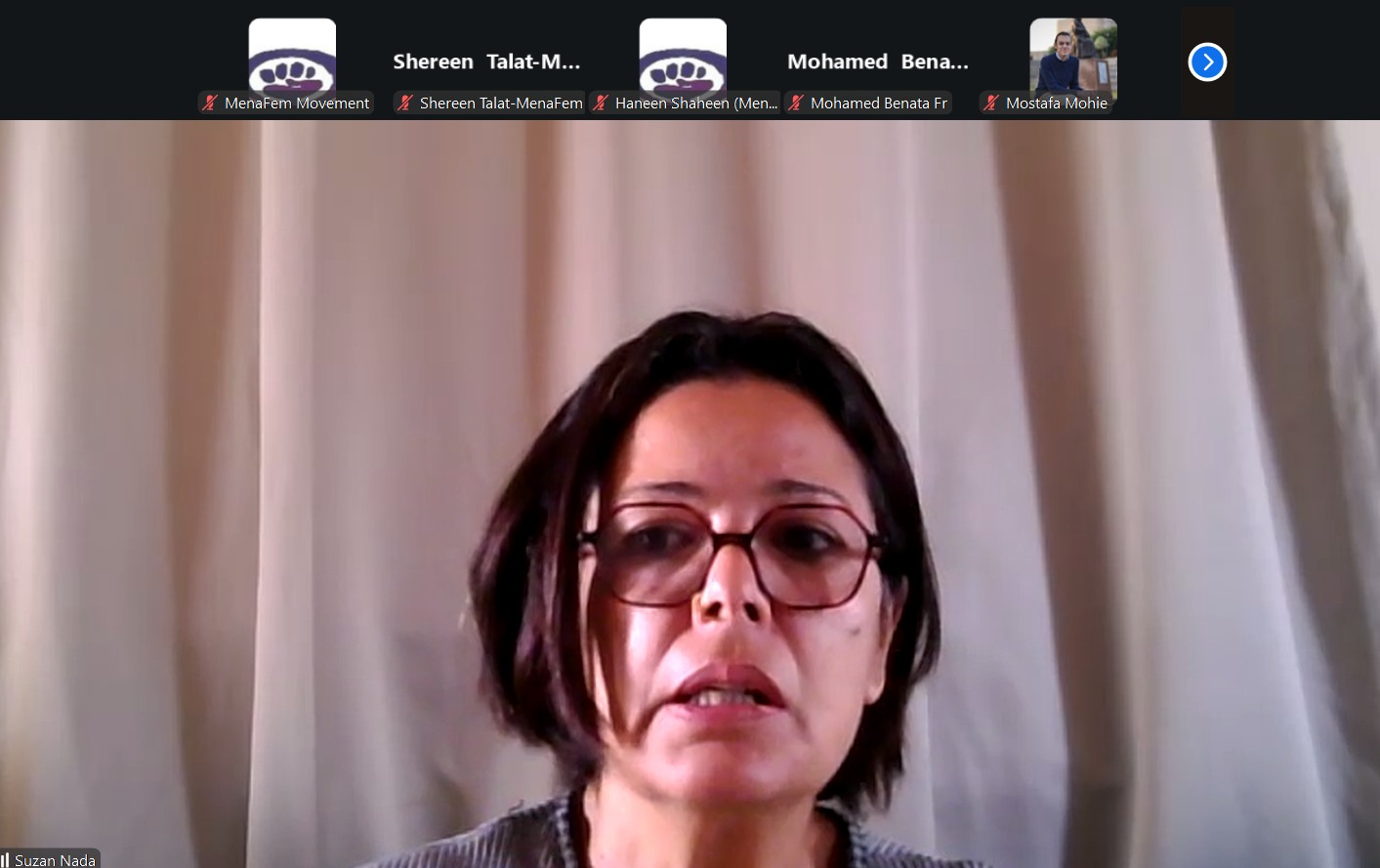
Suzan Nada, a lawyer and member of MENAFem’s Board of Trustees, then grounded this analysis in a concrete Egyptian case through her presentation on the Titan Cement case in Wadi Al-Qamar. She explained how industrial emissions have caused widespread health damage among residents, while their attempts to seek judicial remedies or compensation have faced prolonged obstruction, even as industrial operations continued in the absence of effective oversight. This case illustrated the vulnerability of communities when local complaints and accountability mechanisms fail to protect people, and exposed the deep imbalance of power between large corporations and affected residents, revealing environmental violence as a structural feature of production rather than a mere side effect.
Together, these interventions established the political foundation of the workshop: that energy transition is not inherently just, and that justice does not automatically emerge from technology, but rather from the policies and structures that govern it.
II. Green Hydrogen: Morocco as a Case Study
In its second session, the workshop turned to Morocco as one of the most prominent arenas of the green hydrogen race in the region. Mostafa Mohie, a PhD researcher at Rice University specializing in the anthropology of energy, presented an analysis combining historical, technological, and political perspectives. He demonstrated that hydrogen is less a “fuel of the future” than a long-standing technology that is repeatedly reactivated whenever the global system seeks to reorganize energy markets. From the 1973 oil crisis, to the Paris Agreement in 2015, and most recently the Russia–Ukraine war, the technology itself has remained largely unchanged, while the contexts driving its revival have shifted.
With the European Union’s ambitious targets for importing green hydrogen, Morocco has emerged as a key site for meeting European demand, supported by a national roadmap that places exports at the heart of its strategy, partnerships with multinational corporations, and large-scale projects requiring vast tracts of land. However, as the presentation made clear, this trajectory is riddled with sharp contradictions. A country already experiencing water scarcity is channeling massive water resources into projects serving external markets, while producing one kilogram of hydrogen requires nine liters of purified water. Planned projects in Morocco are expected to consume water equivalent to the annual use of more than 100,000 people, at a time when per-capita water availability is approaching the threshold of water poverty.
Employment dynamics further compound these challenges. Green hydrogen is a highly capital- and technology-intensive sector that demands specialized skills and generates limited employment opportunities for local communities, raising serious questions about the tangible benefits people receive in exchange for environmental and social trade-offs. In its current form, green hydrogen thus appears closer to a new extractive economy, different from oil and gas in raw material, yet reproducing the same underlying logic: transforming land and resources into assets for external users, while local vulnerability deepens rather than recedes.
III. Cross-Border Accountability Mechanisms and the Role of International Financial Institutions
One of the workshop’s most significant sessions was delivered by the team of the European Investment Bank Complaints Mechanism (EIB-CM), as it shed light on how large-scale, cross-border projects are governed, and how affected communities, even under restrictive political conditions, may find pathways to accountability. The presentation clarified that the mechanism is not a judicial body, but it enjoys a degree of independence that enables it to open complaints against the Bank itself in cases of non-compliance with its environmental and social policies. A key feature of the mechanism is its low threshold for admissibility: any individual, from anywhere, can submit a complaint without proving a direct contractual relationship to the project. This is particularly significant in the Arab region, where civic space is often constrained, access to information is limited, and influencing decision-making processes is exceptionally difficult.
The team presented two pivotal case studies. The first, from Sri Lanka, involved a sanitation project that led to structural damage to homes, pollution, and severe odors, ultimately resulting in a formal mediation process and the resettlement of affected families. The second, from Morocco, concerned the Zenata project, which revealed profound social vulnerability among families forcibly displaced from their homes, including loss of livelihoods, rising living costs, and the absence of adequate transitional support. The compliance review demonstrated that non-compliance was not merely an administrative lapse, but a pattern of structural harm disproportionately borne by the most marginalized groups.
The session also addressed the issue of retaliation against complainants as one of the most destabilizing risks to accountability processes. The EIB-CM team emphasized that protecting complainants is a core component of any effective accountability mechanism, and that intimidation or retaliation fundamentally undermines the very possibility of justice. This concern resonates deeply within the regional context, where filing a complaint can itself be a risky act.
IV. Reflections on the Future of a Just Energy Transition in the Region
The workshop concluded with an open reflection session that invited participants to revisit the questions raised throughout the day. It became clear that the current trajectory of the energy transition could lead the region down one of two paths: either a historic opportunity to rebuild a more balanced relationship between people and resources, or the reproduction of inequality and precarity under the banner of sustainability.
Overall, the workshop underscored that the future of green hydrogen in the region is not merely a technical question, but a sovereign, social, and environmental one. Between state ambitions to integrate into the green economy, European market pressures, resource scarcity, and a long history of inequality, the shape of the coming transition is being actively determined. This workshop opens the door to a new phase of thinking and action, one that re-centers communities in the debate and insists that sustainability cannot be achieved without accountability, and cannot truly be “green” unless it is just.
🎥 Workshop recording (Zoom):
https://shorturl.at/sHoHG
Passcode: ps!c2Q&3