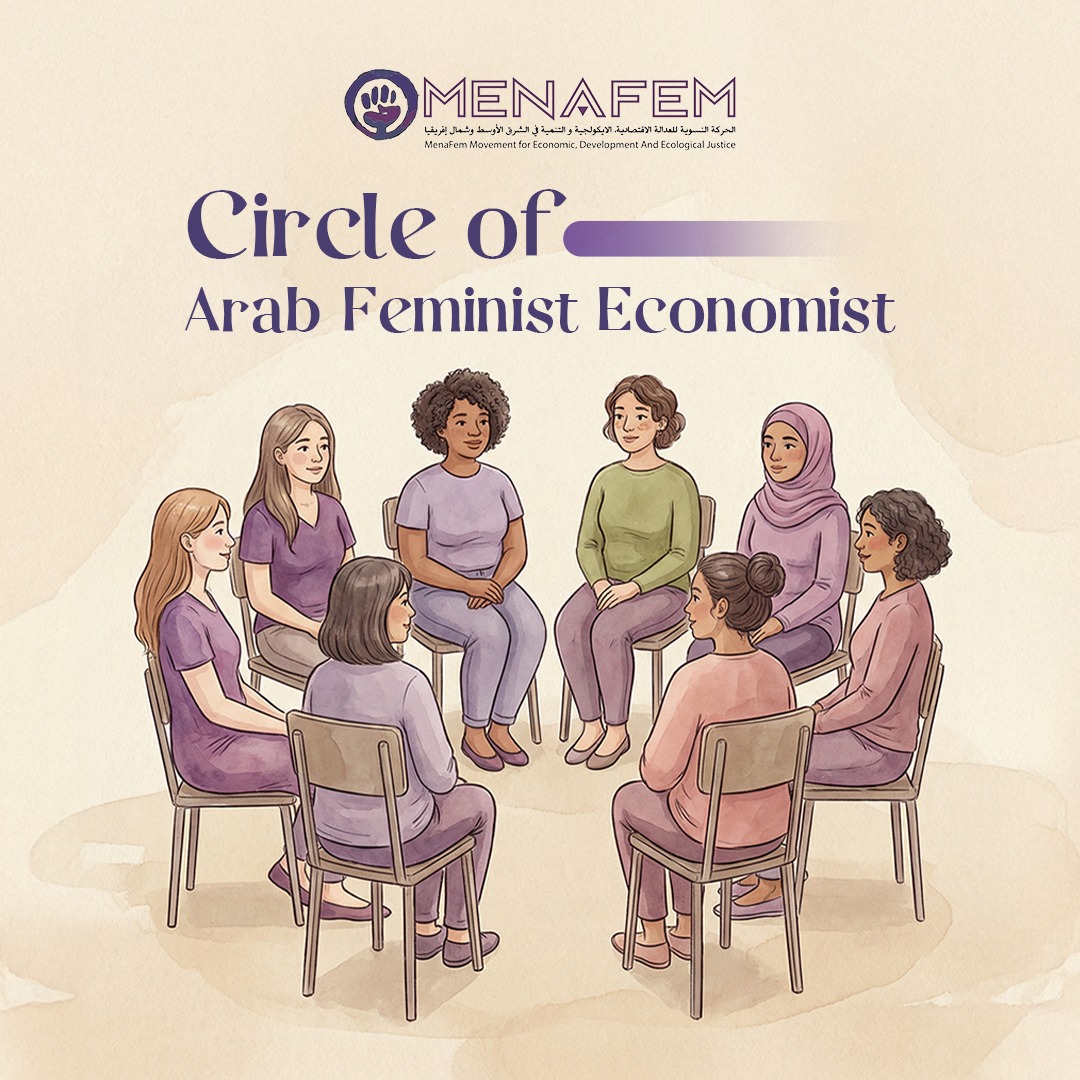
Circle of Arab Feminist Economist
The MENAFem Circle of Arab Feminist Economists was created in October 2023 in Marrakech as an informal space of solidarity during the IMF and World Bank Annual Meetings. While the group initially formed around reflections on international financial institutions, it has since grown into a broader feminist economic space. Today, the Circle engages with a wider landscape of feminist economic issues, including care economies, beyond GDP debates, Financing for Development, alternative development models, ecological justice, and the everyday political economy shaping people’s lives across the region. Its evolution reflects a collective shift toward deeper and more expansive feminist economic thinking.
The Circle understands the Arab region not as a racial or ethnic identity but as a shared horizon shaped by language, memory, and lived experience. Arabness here is an open, fluid, and inclusive concept rooted in a common linguistic and cultural space rather than a fixed identity. The Circle welcomes people from the Arabic-speaking region, including those who do not personally identify as Arab but who think, engage, and produce knowledge in Arabic. In this context, language is not a limit but a bridge that enables collective reasoning and shared political imagination.
Why the Circle?
Economic debates in the region are often dominated by technocratic and depoliticized frameworks that obscure power, inequality, and violence. Feminist economic analysis, particularly when produced in Arabic and connected to movement struggles, remains fragmented, marginalized, and under-resourced.
The Circle exists to address this gap. It provides a collective space where feminist economists and activists can think together, organize together, and develop analysis that links political economy to everyday life, resistance, and social transformation.
Our Vision
We envision a feminist economic community grounded in the lived realities of the region and committed to producing transformative knowledge. This vision is inseparable from the political context in which we live and organize. The ongoing genocide in Gaza and the broader structures of occupation, settler colonialism, and militarized violence remind us that economic systems are never neutral, but deeply entangled with extractivism, dispossession, and the commodification of land, bodies, labour, and life itself. The Circle holds space for feminist economic analysis that names these realities, stands in solidarity with struggles for liberation, and challenges economic models that sustain violence, exploitation, and ecological destruction.
Our vision is also informed by collective feminist convenings such as the Rabat feminist gathering that produced the Rabat Declaration and Roadmap — A Collective Feminist Agenda for People and Planet. This agenda, deeply rooted in the experiences of activists from the South West Asia and North Africa region, insists that economics and climate change cannot be separated from politics, nor justice from liberation from militarism and extractivism. It places struggles across Palestine, Sudan, Yemen, and beyond at the heart of the fight against colonialism and militarism, and calls for accountability from international financial institutions including the IMF and World Bank. The Rabat Roadmap holds that ending policies of austerity, challenging extractive economic orders, and centring collective feminist economic justice are essential to building a world free from domination and exploitation.
Our Objectives
The Circle aims to build a community of solidarity among feminist economists and activists working on economic justice. It seeks to deepen the collective accumulation of feminist economic knowledge rooted in the region’s contexts and struggles. The Circle offers a space for critical thinking and shared learning where research, activism, and lived experience come together. It enables collective reflection on feminist alternatives that confront extractive economies, racialized hierarchies, militarism, and systems of accumulation that prioritise profit over life.
Structure and Organization
The Circle brings together individual feminist economists and activists, as well as members representing organisations and collectives from across the region. Participation is voluntary and guided by principles of care, mutual respect, and shared responsibility. MENAFem provides coordination and logistical support to ensure accessibility and to reduce administrative burdens on members. A feminist economics professor accompanies the Circle as a scientific advisor, supporting intellectual depth while honouring the group’s activist spirit.
Activities and Collective Spaces
The Circle meets twice a year and continues to broaden its activities. It hosts reading circles focused on feminist economics, political economy, extractivism, and critical development thought. Members regularly share reflections on national and regional dynamics, as well as major global governance processes such as the United Nations, Financing for Development, international financial institutions, and other political spaces shaping economic realities. The Circle also organises collective feminist reflections around global and regional moments such as the Commission on the Status of Women, the Financing for Development process, the IMF and World Bank Meetings, climate negotiations, and major political events affecting the region. Webinars connect prominent feminist economists from around the world with feminist economists and activists in the region, creating opportunities for mutual learning, dialogue, and collective analysis rooted in solidarity and political accountability.
Joining the Circle
As the Circle grows, it is ready to welcome two new members who share its commitment to feminist economic justice and collective knowledge-building. If this space resonates with your work, your politics, and your commitment to resisting extractivism, dispossession, and economic violence, and if you are inspired by collective feminist agendas like the Rabat Roadmap, we warmly invite you to express your interest. Please fill in the form if you wish to join this evolving and deeply collaborative community.
Join us and fill out this FORM before May 31.