

What Do We Mean by Justice?
When international institutions speak about “access to justice for women and girls,” the discussion is often limited to legal reform, improving court systems, and expanding legal aid. Yet this narrow definition hides a fundamental reality: the injustices women experience are not simply the result of missing laws, but of entire political, economic, and social structures that organize the distribution of power and resources within society.
Justice, in its true sense, does not only mean holding perpetrators accountable. It also requires understanding the conditions that made these violations possible in the first place. Violence cannot be understood as an isolated act, but rather as the product of unequal power relations and political and economic systems that continuously reproduce discrimination and exclusion.
Historical experience has shown that traditional justice systems have often failed to see the full reality of victims, particularly women. In many international cases, the gendered dimensions of crimes have been ignored or minimized. Sexual violence in armed conflict, for example, was long treated as a by-product of war rather than as a systematic crime targeting women, their bodies, and their social standing. Other crimes, such as enforced disappearance, displacement, or arbitrary detention, have often been addressed legally without recognizing their distinct impacts on women, children, and the social fabric of communities.
However, the violence women face cannot be separated from broader political and economic contexts. In many parts of the world, armed conflicts intersect with economic crises, austerity policies, and mounting debt. These dynamics erode public services and weaken systems of social protection.
When these systems collapse, the cost of survival is transferred into households, where women carry the greatest burden through unpaid care work and the daily management of family life.
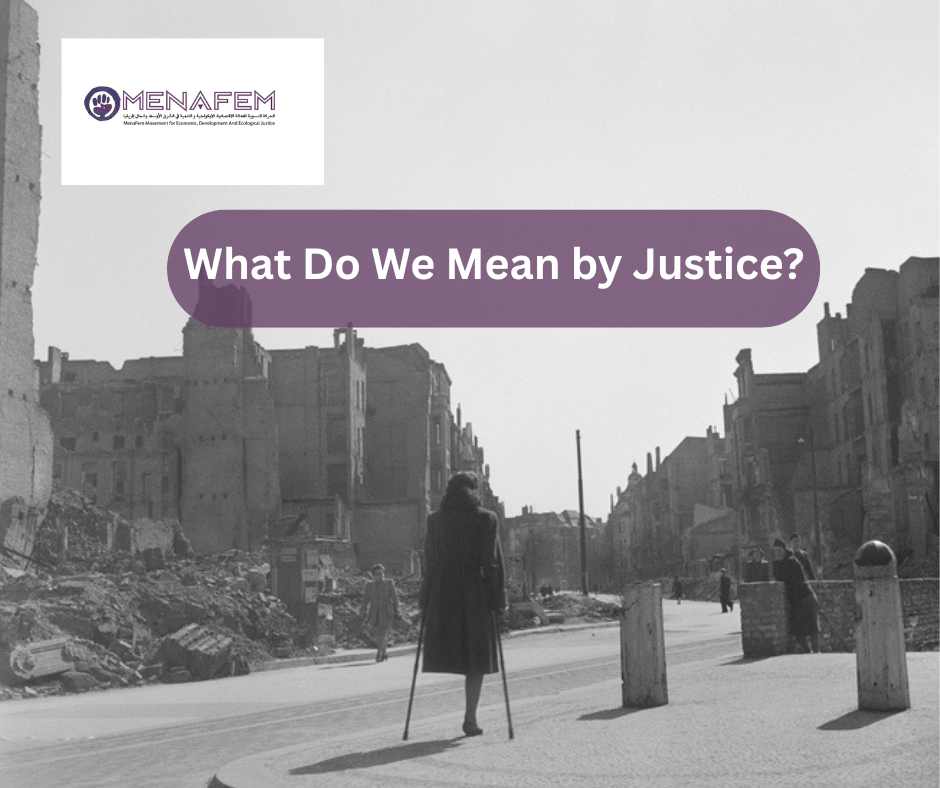
In contexts of war and conflict, this burden grows dramatically. As infrastructure is destroyed and essential services disappear, care responsibilities become a matter of survival, carried out under dangerous conditions. The more unpaid labor women are forced to assume in these circumstances, the more they are exposed to multiple forms of violence and violations — both within the private sphere and in public spaces connected to securing basic needs. Women, therefore, pay a double price for war: not only as victims of direct violence, but also as those who bear the hidden burden of sustaining life in the midst of collapse.
Comprehensive feminist justice, therefore, goes beyond punishing perpetrators, although accountability remains essential. It also requires full recognition of the harm suffered by victims, meaningful reparations, and the reconstruction of societies in ways that prevent future violations. Above all, it means ensuring that no victim is excluded from justice processes and that no form of harm is ignored simply because it remains invisible within traditional legal frameworks.
Recent years have shown that struggles for justice can produce meaningful progress even under the most difficult circumstances. Thanks to the efforts of survivors, human rights organizations, and feminist movements, international and national courts have increasingly recognized crimes such as torture and sexual violence as crimes against humanity. Yet these achievements, important as they are, cannot turn back time or erase the suffering endured by victims.
The justice we need today is a justice that excludes no one. A justice that recognizes all victims and acknowledges the experiences of women and girls that have long remained outside official narratives. A justice that understands violence not as an isolated event but as the outcome of systems of oppression and discrimination that must be dismantled.
The struggle for justice is therefore a long political and social struggle — a struggle for truth, for dignity, and for a world in which victims are not left alone to face injustice.