Beyond Bangkok: Who Controls Finance, Resources and Our Futures?
MENAFem reflections on the IMF and World Bank Annual Meetings | October2026
A crisis of legitimacy, not a shortage of solutions
The IMF and World Bank Annual Meetings in Bangkok exposed a crisis of legitimacy in the international financial architecture. At a moment of war, ecological destruction, debt distress and deepening inequality, the institutions kept offering familiar answers: fiscal consolidation, risk management and the mobilisation of private capital. Their language has adapted. The distribution of economic power has not.
The defensive posture of the Bretton Woods institutions was one of the strongest impressions we took home. They acknowledge overlapping crises, but that acknowledgement has not led them to reconsider creditor power, austerity or the way public resources are shared.
Shereen Talaat, Director of MENAFem Movement, put it this way: “We cannot replace the Washington Consensus with another consensus built around private capital and extraction. South–South cooperation must change the economic model, not simply the geography of power.”
World Bank President Ajay Banga told the opening plenary on 16 October that the Bank mobilised $112 billion in private capital last year, against roughly $35 billion in FY2022. He summed up the approach as “Public money where markets can’t yet reach”, with private capital taking over where it can create jobs and scale. His own figures show where that model runs out: in low-income countries, where commercial capital is hardest to attract, mobilisation stayed at about $3 billion. Our partners and Coullegues Eurodad’s policy team points out that the Bank offered no evidence at the meetings on the number or quality of jobs created, and argues that the focus on creating financial assets for institutional investors shifts risk onto public balance sheets that are already strained. This formulation raises a political question. Why should public finance be defined by where markets do not go, rather than by democratically determined development needs?
Artificial intelligence: a growth story told without its distribution
Artificial intelligence was the most visible new theme in Bangkok. IMF Managing Director Kristalina Georgieva told participants on the opening day that the AI investment boom is what keeps the world economy growing at around 3 percent despite the energy supply shock. The World Bank presented AI as a jobs strategy. Banga distinguished between “Big AI”, whose computing power, energy, data and skills put frontier models beyond the immediate reach of many developing countries, and “small AI” for farmers, teachers, health workers and small entrepreneurs. He said the Bank is helping countries build the electricity, connectivity, devices and safeguards needed to use it, against a projected gap of 1.2 billion young people entering the labour market for about 400 million jobs. A public session titled “Small AI: More and Better Jobs” opened the programme on 12 October.
What the institutions said about the risks matters as much. According to Eurodad, they acknowledged that rising debt in advanced economies, higher interest rates and the AI investment boom are draining capital from the Global South, and still presented AI investment as a path to growth. The same boom is therefore described as the engine of the global economy and as a drain on the countries that most need finance.
For MENAFem, the questions that remain open concern ownership and distribution. Who owns the data, the models and the infrastructure that “small AI” depends on? Who pays for the electricity and connectivity, and on what terms? The Bank’s new strategy for micro, small and medium enterprises relies on digital records to improve access to finance; who governs those records? And what will AI do to the paid and unpaid work that women carry, in a region where public services are already being cut? Nobody in the official programme answered these questions. We call for gender and human rights impact assessments of AI-related lending and policy advice before they are scaled, and for transparent data on the jobs they are meant to create.
Climate and gender were sidelined from the political centre
“Bangkok exposed a contradiction in the global development agenda. Climate finance is increasingly discussed through private investment, critical minerals and green industrialisation, while public finance, ecological justice and community ownership remain marginal. A transition that reproduces extraction, increases debt and transfers risks to communities cannot be called just.”
— Haneen Shaheen, Campaigns and Ecological Justice Lead at MENAFem Movement
Climate and gender were not entirely absent from Bangkok. Civil society raised them repeatedly. But they were not organising priorities of the highest-level institutional agenda, even as debt, conflict and ecological shocks increasingly reinforce one another. Eurodad noted that the IMF stayed silent on how its renewed push for austerity deepens inequalities and increases women’s unpaid care burden, and that the least developed countries have asked clearly for more climate grants, less debt, simpler access and faster disbursement. The World Bank, for its part, reported $96 billion in climate co-benefits last year, of which $48 billion came from private capital.
Austerity shifts the costs of care from public systems onto households, disproportionately onto women. Debt servicing reduces fiscal space for health, education and adaptation. Climate finance structured as loans can deepen the very debt vulnerability it claims to address. Gender inclusion programmes cannot compensate for macroeconomic policies that erode public services.
This gap between social commitments and macroeconomic policy cannot be closed through targeted programmes alone. The real test is whether debt sustainability assessments, IMF surveillance and conditionality protect public services, unpaid care, ecological resilience and rights. Climate and gender must shape fiscal decisions instead of remaining parallel discussions.
IMF surcharges: the reform that did not go far enough
The IMF’s surcharge policy shows how countries in financial distress can face additional costs precisely when they need fiscal space. In October 2024 the Fund’s Executive Board approved a reform package expected to lower members’ borrowing costs by about $1.2 billion a year, or 36 percent, and to reduce the number of countries subject to surcharges in fiscal year 2026 from 20 to 13. The Fund kept the surcharge framework, describing charges and surcharges as an essential part of its lending and risk management, and the Board agreed to review the policy every five years; a few Directors would have preferred more fundamental changes. Academics and civil society groups had asked for complete abolition, and the reform fell short of that. It should not be mistaken for the end of the policy.
On that we are lunches a new website on Ifis ,Read MenaFem IFIs paper on Surcharges
The Surcharge Burden :A Hidden Cost and Illegitimate Debt
A briefing the Center for Economic and Social Rights released during the Bangkok meetings estimates that 12 countries will pay about $1.7 billion in surcharges in 2026, an amount it says could fully vaccinate 23 million children. Drawing on evidence from Argentina, Ecuador, Egypt, Jordan and Pakistan, it documents how IMF-backed austerity squeezes public services, fuels unrest and creates conditions in which governments turn to restrictions on protest. These are resources that could support social protection and essential services.
MENAFem calls for the complete abolition of surcharges. We also demand independent human rights and gender impact assessments of IMF programmes and a rethinking of debt sustainability that prioritises people’s rights, not simply creditor repayment.
South–South cooperation: a political opening, with open questions
The first Governing Council of the Borrowers’ Platform, held in Bangkok on 12 October, was an important development. The Platform was launched in April 2026 with UNCTAD as its secretariat, and Eurodad reports that 31 countries have joined. It gives borrowers a dedicated space for exchange and collective voice. Creditors have long coordinated while borrowers have often negotiated separately, and the Platform addresses that imbalance.
Read MenaFem paper Published in: Development Journals with the Society for International Development (Springer Nature)
By Shady Hassan The Borrowers’ Platform as Global South Politics of Hope: Decolonizing Debt and the New Multilateralism
But it is not yet a mechanism for collective debt restructuring or bargaining. The mandate set out in the Sevilla Commitment speaks of discussing technical issues, sharing experiences, building capacity, coordinating approaches and strengthening borrowers’ voices. At the Council, Pakistan’s finance minister Muhammad Aurangzeb accepted the chair, acknowledged the leadership of Egypt, which had led the preparatory work, and said the Platform should promote mutual learning and technical cooperation rather than serve as a collective bargaining or crisis-management mechanism. That is one government’s reading, and it shows how much is still to be decided: common negotiating positions, independent analysis, and political leverage over debt rules. Civil society pointed to the African Credit Rating Agency, launched in Mauritius days before the meetings, as another example of borrowing countries building their own tools.
We must also resist the assumption that every South–South initiative is emancipatory. We do not need another BRICS-style arrangement that changes the geography of finance while keeping its dependence on private capital, extractive exports and investor-led growth. Multipolarity is not redistribution, and new lenders can reproduce old hierarchies.
Our test is simple. Does cooperation expand public finance and policy space? Does it democratise decisions? Does it support debt cancellation, fair restructuring and public ownership? Does it include feminist movements, workers and affected communities? Without these commitments, South–South solidarity risks becoming another elite bargain.
African industrialisation must not reproduce extraction
At the Development Committee, African Union Commission Deputy Chairperson Selma Malika Haddadi asked for more World Bank financing for Africa, including through IDA22, with emphasis on regional integration, cross-border infrastructure, industrialisation, regional value chains and the African Continental Free Trade Area, while also stressing the need to scale up private capital mobilisation. These priorities open an essential debate: will African economic transformation build public capacity and control, or deepen dependence on investor returns?
Banga announced plans to quintuple the Bank’s critical-minerals business within five years. The first country compacts, launched that week with other development banks, are meant to build local industries and keep more jobs and value in the producing countries, and the Bank has identified 20 potential partner countries. Local processing matters, but value addition alone does not guarantee democratic ownership, labour rights, ecological protection or public revenue. The same applies to green hydrogen and renewable-energy export corridors.
In Morocco, Egypt and elsewhere, we must ask who owns the infrastructure, controls land and water, benefits from energy production and bears environmental costs. MENAFem’s analysis of Morocco’s IMF Resilience and Sustainability Facility shows how climate conditionality can pass the burden to households. Public guarantees that socialise risks while privatising profits reproduce extraction under a green label.
We support industrial policy, technology transfer, regional integration and productive transformation. They must be driven by public purpose, domestic needs, decent work and democratic control of resources, not by a race to make territories attractive to investors.
War, debt and the political economy of SWANA
For SWANA, debt cannot be separated from war, occupation, militarisation and the destruction of public infrastructure. Banga himself opened his plenary by noting that conflicts persist, fiscal space is tighter and debt burdens have risen, and finance ministers in Bangkok discussed the effect of the Middle East conflict on energy prices and inflation. Gaza’s devastation and the wider regional confrontation expose the limits of treating conflict as a temporary macroeconomic shock. Destruction creates reconstruction needs, financing pressures and opportunities for private profit, while fiscal adjustment constrains the public institutions expected to rebuild.
Economic sovereignty requires the ability to decide how reconstruction is financed, who owns rebuilt assets, and whether public services and communities, rather than contractors and creditors, set priorities. The cost of war must not be converted into another cycle of debt and austerity.
This analysis also resonates with Shereen Talaat’s and Ibrahim Elhatimi contribution, “War, Debt, and Green Industrial Sovereignty in MENA: Reclaiming Economic Sovereignty in the Green Transition,” which highlights the importance of reclaiming economic sovereignty in the region’s green transition.
Feminist alternatives in Bangkok
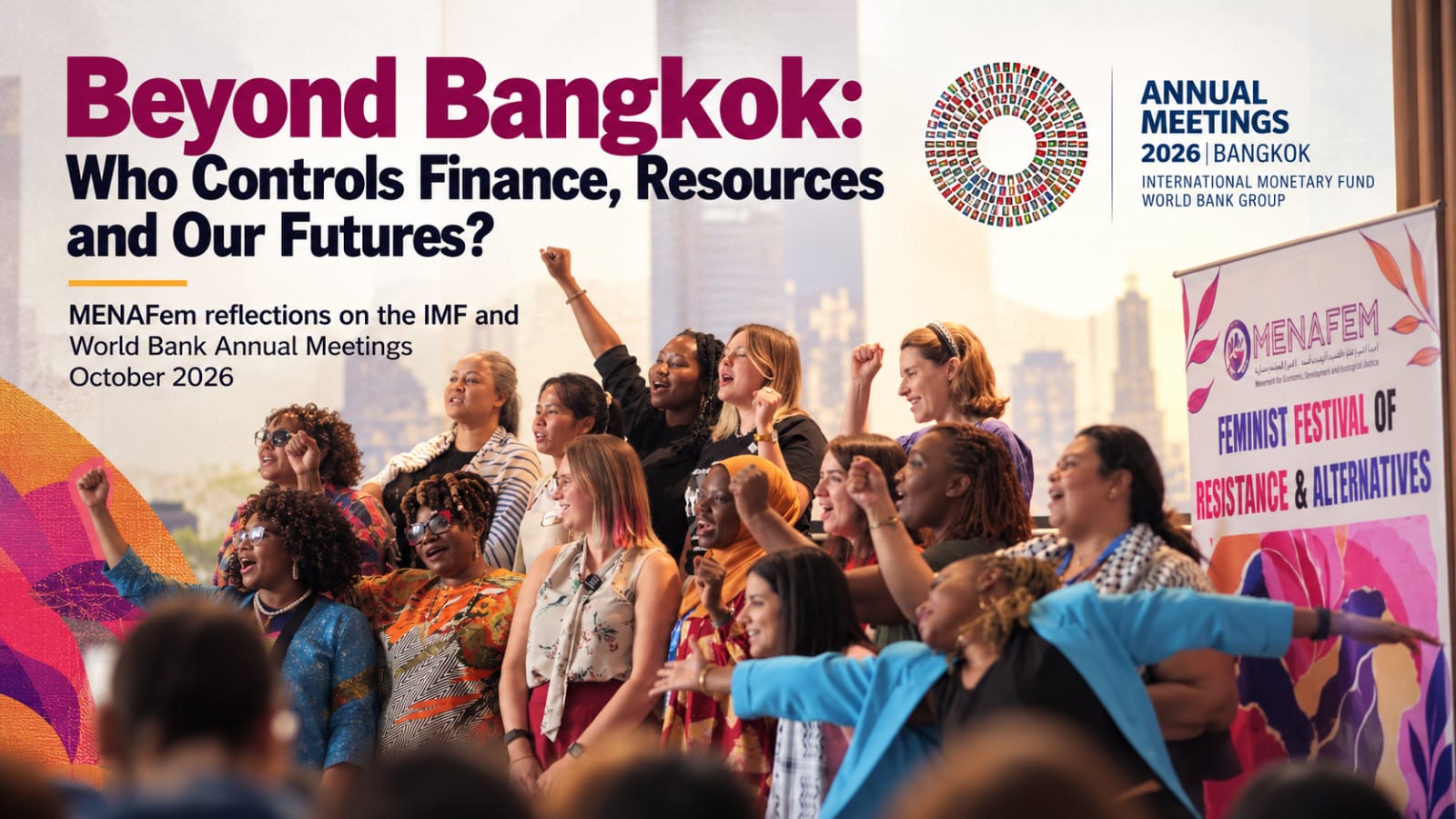
While the official programme ran inside the convention centre, feminist, debt justice and people’s movements built a different agenda around it. From 11 to 16 October MENAFem and its partners took part in Bangkok through the Feminist Festival of Resistance & Alternatives, ten sessions at the Civil Society Policy Forum and the International People’s Assembly. The Forum is the official space where civil society engages IMF and World Bank staff, peers and government delegations.
The Festival was designed as a space where feminist analysis could be developed on its own terms rather than as a response to the institutions’ agenda. Its sessions included “The Political Economy of War”, which looked at how economic and military multilateralism and diplomatic power deepen inequalities and what this means for women and girls, and “The Real Cost of Debt Screening”, which brought together contributions from different regions on how debt and austerity are experienced in everyday life. Across these sessions, participants insisted that debt, care, militarisation, climate, taxation and resource control belong in the same political conversation.
The streets were part of that conversation too. On 16 October Thai farmers, fishermen and workers marched through Bangkok, some carrying banners telling the World Bank to stop destroying the poor, and some protesting specific projects such as the Pak Mun dam, whose effects on fishing communities remain a source of grievance three decades after its completion. Bangkok has hosted these meetings before, and local movements remember what came with them.
The Feminist Resistance & Alternatives Declaration
The Feminist Resistance & Alternatives Declaration is a collective political statement emerging from the feminist and anti-imperialist festival in Bangkok. It brings together shared analyses, positions and demands concerning the IMF, the World Bank, debt, austerity and broader structures of economic and imperial power. The Declaration provides a collective reference point for the political demands articulated throughout the Festival and the wider mobilisation around the Annual Meetings.
# Read the Declaration and access the signature form.
From Bangkok to the Rabat Roadmap
The Rabat Declaration and Roadmap, produced in 2025 at a convening of about fifty feminist and allied organisations, two thirds of them from South-West Asia and Africa, call us to move beyond inclusion in existing institutions. They demand redistribution, public services, ecological justice, democratic economic governance and solidarity across regions.
Our demands after Bangkok are clear: abolish IMF surcharges; establish a UN sovereign debt convention and a fair restructuring process; end austerity-driven conditionality; democratise IMF and World Bank governance; expand grants-based climate finance and public investment; assess the gender and rights impacts of AI-related financing before it is scaled; and build borrower cooperation that is accountable to people rather than investors.
Bangkok showed that the Global South is demanding more collective voice. Collective voice is not yet collective power. The Borrowers’ Platform and African coordination are important openings, and the first year of the Platform’s work will show whether borrowing countries can move from consultation to common negotiating power.
The question is not whether new actors can join or replace the old financial centres. It is whether we can change the economic model itself: who owns resources, who bears risk, who makes decisions, and whose lives public finance is meant to sustain.