A Pact Without Justice: How the EU’s Mediterranean Agenda Deepens Extraction, Inequality, and Displacement in MENA and the Global South
In January of this year, only a month after the European Union (EU) officially launched the Pact for the Mediterranean — a new framework on European geopolitical and economic priorities in the Middle East and North Africa (MENA) — European Commission President Ursula von der Leyen
Who are the real winners and losers?
The Pact for the Mediterranean is presented as a renewal of the 1995 Barcelona Declaration, which in a similar vein promised peace, prosperity, and respect for human rights through Euro–MENA cooperation. Yet, as the past three decades make clear, the reality has been starkly different. Successive EU policies and actions have consistently deepened conflict and instability across the MENA region. The EU speaks of human rights in one breath while continuing to militarize and externalize its borders, which have killed more than 33,000 people in the Mediterranean Sea since 2014, most recently when a migrant boat capsized off the Libyan coast in early February, killing 53 people. It celebrates economic cooperation and investment in one moment, only to extract immense profits from cheapened resources in the next, with little benefit for citizens and communities on the ground. And while it proclaims support for decarbonization, it prioritizes renewable projects designed for export to Europe rather than enabling the MENA region to decarbonize on its own terms first.
It is against this backdrop that the EU now advances its Pact for the Mediterranean, organized around the three pillars “people,” “economies”, and “migration management and security” with its “Southern Neighbourhood” which is made up of Algeria, Egypt, Israel, Jordan, Lebanon, Libya, Morocco, Palestine, Syria, and Tunisia. The Pact deliberately tries to invoke proximity from the get go, from the first use of the term “Mediterranean” instead of “Middle East and North Africa” to subtly depoliticize a region shaped by (neo)colonial domination and resource extraction. Moreover, including Israel as an economic partner amid an ongoing genocide further proves Europe’s normalization of colonialism and occupation, and the defacto valuing of white lives over brown lives.
ather than confronting structural drivers of instability including debt, inequality, dispossession, and ecological degradation, which are caused and exacerbated by its already existing Migration Pact and Global Gateway investment plan, the Pact uses the same instruments and architecture through which Europe externalizes its crises onto the Global South. It once again positions MENA as a resource frontier: a reservoir of cheap labor, abundant solar energy, land, water, and minerals needed to power Europe’s green transition. These resources are mobilized primarily to secure European energy autonomy, especially after its gas crisis that was ignited by Russia’s war on Ukraine.
Development as terrain for capital expansion rather than political responsibility
At the heart of the Pact lies its second pillar: “Stronger, more sustainable and integrated economies.” Marketed as the engine of stability and job creation, it relies on familiar neoliberal assumptions that have repeatedly failed the region. Many MENA countries are currently experiencing severe debt crises, accompanied by austerity measures imposed through international financial institutions. These policies erode public services and social protection, disproportionately affecting women, migrants, rural populations, and informal workers who depend most on affordable healthcare, education, water, and energy.
Under these conditions, governments are pressured to attract foreign investment at any cost, offering tax exemptions, cheap land, and deregulated labor conditions to multinational firms, most of which are European. Local small and medium enterprises rarely receive similar support, weakening domestic economic structures and stifling industrial development. The Pact’s language of “complementary economies” and “mutual benefit” obscures how MENA countries have long been integrated into a global division of labor as suppliers of raw materials and cheap labor, while remaining dependent on imported high-value technologies.
Its economic pillar is inseparable from the EU’s Global Gateway strategy, which aims to mobilize up to €300 billion in investments by 2027. The Pact itself states that “all relevant EU financial instruments will be mobilised to support its implementation” including those used to push forward Global Gateway “development” projects. Yet the Gateway’s strategy relies on opaque financing mechanisms such as guarantees and blended finance to leverage private profit from “development,” promoting infrastructure privatization, the commercialization of public services, and a liberal reform agenda tailored to corporate opportunity. In practice, this model is already reshaping energy sectors across the region. In Egypt, Global Gateway projects are accelerating privatization, with initiatives like the GREGY interconnector designed primarily to export renewable electricity to Europe via Greece, even as domestic energy access and affordability remain deeply unequal. In Tunisia, the ELMED interconnector to Italy is celebrated as a flagship project, yet its main function is to integrate Tunisia into Europe’s energy market rather than to advance local energy justice. In Jordan, private investors have profited greatly from renewable energy projects while the state has accumulated debt and financial losses, ultimately passed onto the population through higher prices and reduced public spending.
These dynamics are especially troubling in water-stressed countries. Large-scale solar and green hydrogen projects require significant land and water, often at the expense of rural livelihoods and food security. In Morocco, Global Gateway projects such as the Noor Midelt solar complex were developed on communal lands historically used by pastoral and agrarian communities, who were dispossessed through legal expropriation in the name of the public interest. Similar patterns are emerging around green hydrogen initiatives. In Egypt, where more than a third of the population depends on agriculture, further strain on water and land disproportionately harms women, who play a central role in rural economies.
A persistent pattern in EU external action
The Pact’s reliance on institutions such as the European Investment Bank (EIB) raises additional concerns. Despite its development mandate, the EIB has been widely criticized for inadequate human rights due diligence, weak transparency, and insufficient gender accountability. Without binding safeguards, public funds risk subsidizing corporate profits while externalizing social and environmental costs onto already vulnerable communities.
Migration is perhaps the most glaring contradiction within the Pact. While the EU claims to address the “root causes” of displacement, its policies often deepen them by exacerbating debt, austerity, land dispossession, and climate vulnerability. At the same time, migration is framed primarily through a security lens, leading to increased cooperation with authoritarian regimes to violently constrain movement, such as the recent mass arrests of Syrian and Sudanese refugees in Egypt, who, even when seeking ways to return safely to their home countries, fear doing so because of the risk of arrest. This outsourcing of border enforcement has made migration routes more dangerous and normalized violence against migrants and refugees. The same policies that destabilize livelihoods and environments are then used to justify fortified borders.

© European Union, reused under CC BY 4.0 licence
Despite its rhetoric of inclusivity, the Pact was developed with minimal meaningful participation from Southern Mediterranean parliaments, civil society, or social movements. Consultation processes, where they exist, remain sporadic and largely symbolic. This democratic deficit is compounded by the EU’s selective application of international law. While invoking a “rules-based order,” the EU has failed to meaningfully confront Israel’s ongoing violence in Gaza. Palestine appears in the Pact with a legal caveat explicitly stating that its inclusion does not imply recognition of statehood — a political asterisk that contrasts sharply with Israel’s full participation.
More broadly, the Mediterranean Pact reflects a preference for investment-led solutions over structural reform, and for control over genuine partnership. This is visible in Europe’s resistance to more democratic approaches to sovereign debt restructuring at the United Nations, where borrowing countries would have equal voice with creditors. Instead, the EU favors informal, creditor-dominated forums that preserve existing power hierarchies. Taken together, the Pact risks reinforcing the very injustices it claims to address. The primary beneficiaries are European corporations, investors, and geopolitical interests.
A just alternative would look radically different. It would prioritize reparations over loans, cancel illegitimate debts, halt extractive and privatized development models, and redistribute power toward communities. It would support feminist, locally led pathways to climate justice, energy sovereignty, and economic democracy. Rather than treating development as a market opportunity, it would recognize dignity, justice, and self-determination as the foundation of any meaningful cooperation.
Tunisia: Green Hydrogen, Sacrifice Zones, and the Mediterranean Frontier
If the Pact for the Mediterranean outlines Europe’s strategy in abstract, Tunisia, and in particular the city of Gabès on the east coast, reveals what it would look like in practice.
Under President Kais Saied’s increasingly authoritarian rule, Tunisia’s green hydrogen strategy has been designed behind closed doors, with parliament sidelined and civil society excluded, and even targeted in a recent wave of arbitrary arrests. In May 2024, the government announced plans to produce 8.3 million tonnes of green hydrogen by 2050, nearly six million tonnes of which are explicitly earmarked for export to Europe. To do this, Tunisia would need around 100 GW of new renewable capacity, vastly exceeding its current energy infrastructure.
At the heart of this vision sits the SouthH2 Corridor, a 3,300-kilometre pipeline promoted by Italy’s Snam and backed by the EU’s Global Gateway and Italy’s Mattei Plan for Africa. Gabès is positioned along this route, not as a beneficiary, but as a transit zone in a wider extractive geography linking North Africa to Germany and the EU market.
Alongside the pipeline, a new Italy–Tunisia electricity interconnector (“Eleni”) will also pass through Gabès, physically embedding the city into Europe’s energy system. These are presented as development projects. In reality, they deepen Tunisia’s role as an externalized energy provider while Europe retains control over markets, technology, and profits.
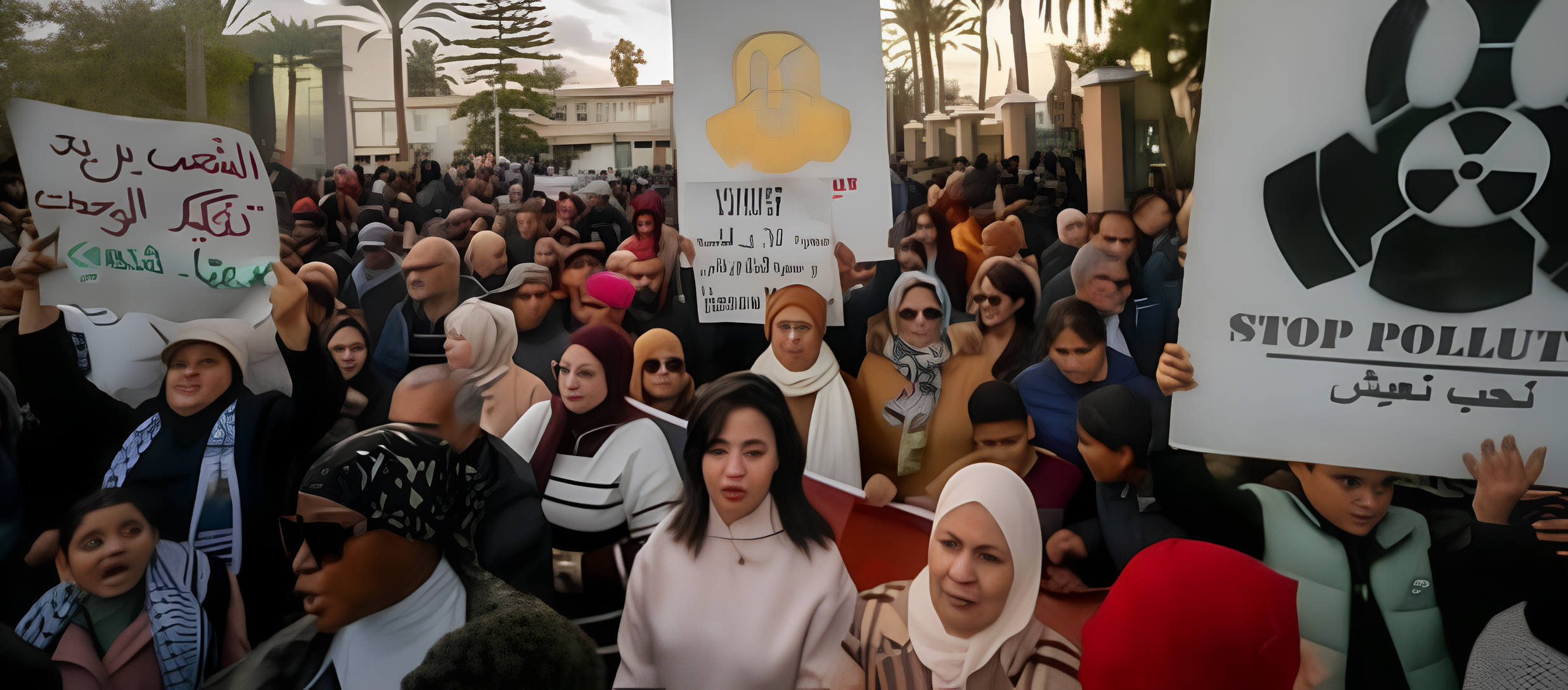
But Gabés is already fraught with over five decades of extraction and pollution, a history that culminated last year in mass resistance after a wave of gas poisonings in October 2025 hospitalized more than 310 people. The gas came from the factories processing phosphate, much of which are exported to Europe in the form of fertilizers and chemical products. Over 100,000 residents joined what may have been the largest environmental protest in Tunisia’s history, with slogans like “Breathing is a right” and “We are not Chernobyl.”

© Yassine Gaidi, Sipa USA, Alamy Live News
Local groups such as Stop Pollution argue that green hydrogen risks becoming another layer of dispossession, a project serving European markets while deepening local ecological collapse. Activists have protested at the German cooperation agency GIZ in Tunis, calling the strategy “neo-colonial” and warning that Europe is outsourcing its energy transition to North Africa’s most vulnerable communities.
Tragically, the state-owned Groupe Chimique Tunisien (GCT), which processes the phosphate, has turned the coastline into a toxic dumping ground, discharging 14,000 tonnes of phosphogypsum into the sea every day. Heavy metals, hydrogen sulfide, and fine particulates have devastated marine life, contaminated air and water, and driven rising rates of respiratory illness, cancer, and infertility. Once home to the only coastal oasis in the Mediterranean, a fragile ecosystem based on communal water management and date agriculture, the city now functions as an industrial sacrifice zone.
Paradoxically, the government has selected the GCT site in Ghannouch as Tunisia’s pilot “green hydrogen” project. Instead of trying to repair past damage, it is integrating new infrastructure into the same industrial complex that poisoned the region. The plan includes a desalination plant despite the groundwater in Gabes already having been drained for industry, with aquifers collapsing from saltwater intrusion and farmers waiting months for irrigation. Today, two-thirds of fruit rots before ripening. Desalination plants run at half capacity. Water, once a shared resource, has become scarce, commodified, and conflict-ridden.
Even when labeled “green,” this project depends on large land areas, desalinated water, and continued industrial extraction. Studies show that desalination produces toxic brine that worsens marine pollution — a cruel irony in a gulf already biologically devastated by GCT waste.
Gabes shows how the so-called “green” transition can be built atop decades of environmental violence designed and sustained by Europe through an economic system that thrives on extraction. The European vision of a hydrogen corridor runs straight through a city already deemed expendable.
Until Europe confronts this reality, Gabès will remain what the Pact creates:a logistical node, a resource frontier, and a human sacrifice zone for Europe’s green future.
Parallel Pacts: One Extractive Logic Across the Global South
What is unfolding in Tunisia is not an isolated case, but part of a broader European strategy that stretches well beyond the Mediterranean. From North Africa to sub-Saharan Africa and across the Atlantic to Latin America, the EU is advancing a similar model: partnerships framed as “green,” “strategic,” or “mutually beneficial,” but structured in ways that lock partner countries into extractive roles while consolidating European economic advantage.
This logic was laid bare in January 2026 with the signing of the EU–Mercosur trade agreement. Brussels presented the deal as a geopolitical necessity and a step toward closer cooperation with South America. Yet the terms of the agreement largely reproduce the same asymmetries visible in North Africa. As critics have warned, higher-value European goods will flow south, while Mercosur countries are pushed further into the role of exporters of low-value raw materials (meat, soy, minerals, and other commodities) produced through land-intensive, environmentally destructive industries.
Civil society groups across Europe and Latin America have condemned the deal as “neocolonialism in disguise.” The agreement risks accelerating deforestation in the Amazon, expanding pesticide-heavy agribusiness, and deepening land grabbing at the expense of Indigenous peoples and small farmers. Much like green hydrogen in North Africa, the Mercosur deal is wrapped in the language of transition and development while entrenching an extractive economic model that benefits a handful of corporations and European consumers.
A similar pattern is emerging in the EU’s renewed engagement with Africa. At the 2025 Europe–Africa summit in Luanda, European leaders spoke of “mutual understanding” and historical reckoning with colonialism. Yet alongside this rhetoric came an aggressive push for access to critical raw materials needed for Europe’s green and digital industries, namely lithium, cobalt, manganese, platinum, and other minerals concentrated across the continent.

© European Union – European Commission (Global Gateway)
Through its Global Gateway program, the EU has pledged billions in infrastructure and investment, including large-scale renewable energy projects and strategic transport corridors such as the Lobito railway linking Angola to mineral-rich regions of central Africa, largely designed to secure supply chains for European industry and reduce dependence on China.
These deals once again risk reinforcing dependency rather than strengthening the autonomy and sovereignty of local economies, especially as fourteen African nations still use currencies pegged to the euro, with reserves held in the French Treasury, effectively constraining monetary policy to former colonial powers.
International trade rules and bilateral agreements have often prevented African states from protecting nascent industries or subsidizing domestic manufacturing, while allowing Europe to secure minerals at low prices for its own industrial transition.
From Gabès to Mercosur to sub-Saharan Africa, a clear pattern emerges. The EU’s green transition is increasingly built on externalized extraction: hydrogen from North Africa, agricultural commodities from South America, and critical minerals from across the African continent. Local communities bear the environmental and social costs, while decision-making and wealth remains concentrated in European capitals and corporate boardrooms.
“If Europe is serious about a just transition, cooperation must start from fiscal justice, providing grants instead of loans, and decision-making power for communities on the frontlines of climate and economic crises. Real partnership means shifting away from resource extraction toward care economies, water and food sovereignty, and feminist climate solutions rooted in the region. Otherwise, the Mediterranean Pact and Global Gateway will reproduce old hierarchies under a new geopolitical label rather than build a future grounded in equity and shared responsibility.” – Shereen Talaat, Director of MENAFem Movement
“The Mediterranean Pact further institutionalizes the growing violent regime of unequal trade exchange, enabling Europe to accumulate surplus while the SWANA region is extracted of labor, resources, and ecological wealth purposely cheapened by the West.” – Habiba Fouad, Climate and Economic Justice Officer