

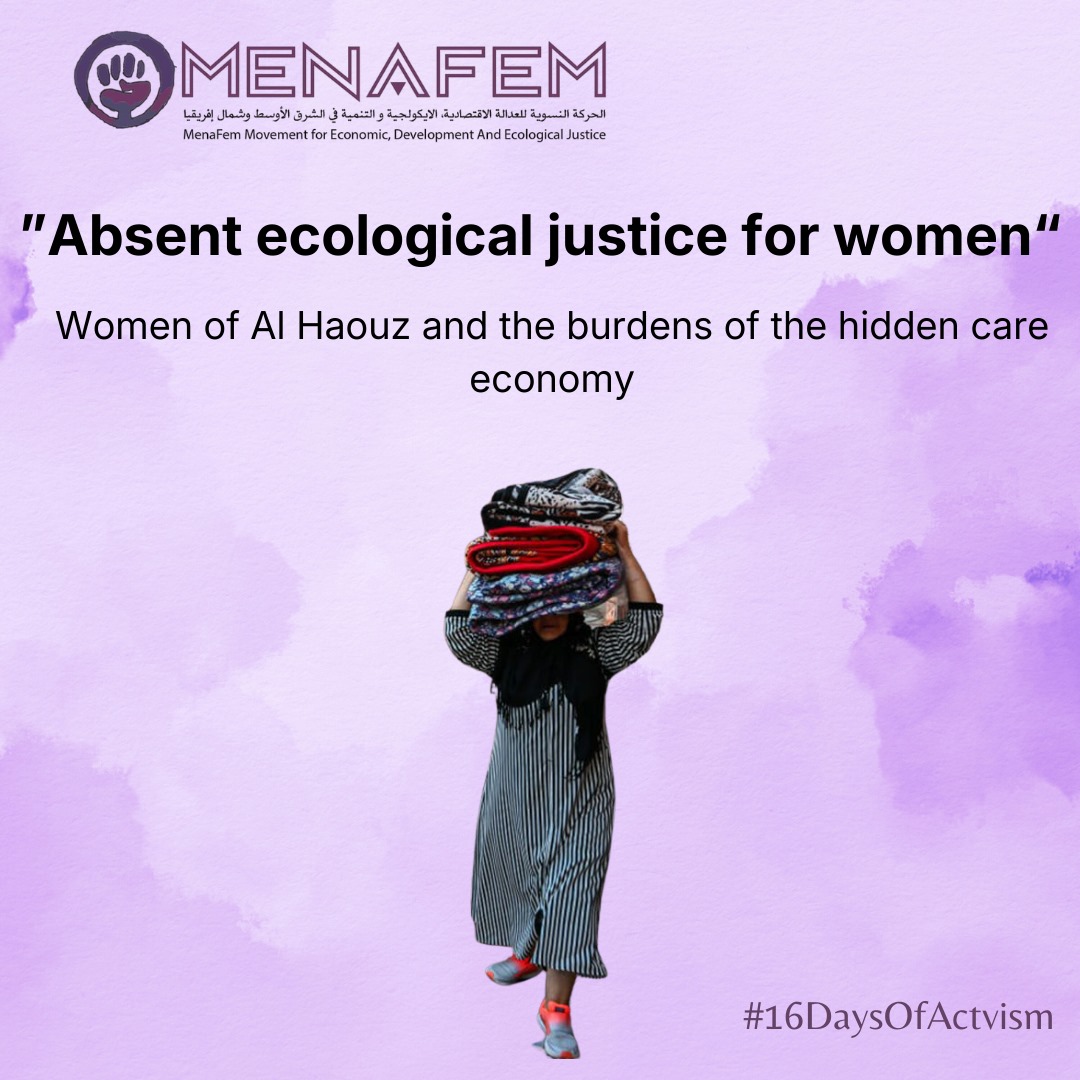
Absent Ecological Justice for Women: Women of Al Haouz and the Burdens of the Hidden Care Economy
Natural disasters reveal what has long remained hidden in the background of everyday life. They do not merely destroy buildings; they expose the fragility of social structures that sustain survival and push the most marginalized groups to the forefront. In Morocco, as in many places around the world, women are not simply “earthquake victims”; they are the invisible actors ensuring the continuity of life after catastrophe. Understanding the impact of the Al-Haouz earthquake, therefore, requires recognizing the silent economy women build within homes and fields, and its intimate connection to education, land, and the right to be represented in public policy.
The collapse of homes cannot be viewed in isolation from the social context that feminizes domestic labor—particularly in rural areas, where more than half of girls (52%) drop out of school before high school due to the absence of school transportation. The longer the distance to school, the lower the likelihood that girls will remain in education, and the greater the risk of being pushed into early domestic labor or forced marriage as a household survival strategy, especially when income is limited.
The destruction of housing in Al-Haouz has deepened the crisis on multiple levels. On one hand, the damage to educational facilities has reduced girls’ attendance in temporary classrooms, making distance a decisive factor shaping their future. On the other hand, this collapse represents the dismantling of the household economy built on women’s labor—an economy that accounts for nearly 70% of family economic activity. In mountain villages, the home is a daily production unit: managing water, food, care, storage, and small livestock. Yet this economy is entirely absent from national accounting systems, excluded from compensation frameworks, and ignored by social protection mechanisms. The loss is thus rendered invisible, even though it is the very loss that determines whether life can be sustained after disaster.
With the interruption of this productive infrastructure, women have become solely responsible for reorganizing the conditions of daily survival: walking longer distances to fetch water on damaged roads, searching for scarce resources to secure food and medicine, managing living spaces in tents or temporary shelters with no privacy, and enduring continuous physical and psychological strain without any form of compensation—because the legal system refuses to recognize this labor as “work” at all.
For decades, the state has invested in central and coastal regions while leaving mountain communities governed by an “economy of silence,” where women’s labor is treated as self-evident and undeserving of support. The continuity of life is perceived as a natural process—rather than as the outcome of unrecognized and indispensable labor. When the material base of this economy is struck, the burden of recovery is entirely transferred to those whose contributions have been systematically ignored.
Beyond the immediate destruction caused by the earthquake, land governance reveals the deeper limitations of the development model imposed on mountain regions. Policies dismantling access to land—devaluing small-scale farmers and pushing residents into precarious service-sector jobs under migration pressure—have placed women in a structurally vulnerable position within an unstable economy: land is no longer a source of livelihood security but a burdensome asset without guaranteed rights. In these villages, land ownership relies on customary arrangements that provide women with neither clear rights nor legal protection in disputes or disasters. As arable land shrinks, productivity declines due to climate change and water depletion, rural households are forced to divide survival roles between “those who migrate to the city” and “those who remain to secure daily food”—a role overwhelmingly assumed by women.
After the earthquake, this fragile balance collapsed. Villages have ceased to produce what households need, remittance-based incomes have been disrupted, and women are once again left on the front line without protection—holding families together in the absence of resources.
Any reconstruction process that fails to restore residents’ rights to land, and that does not recognize small-scale agriculture as a pillar of livelihood security, will accelerate what had already begun before the earthquake: the depopulation of mountain regions, the dispossession of women from their economic roles, and the transformation of villages into residual spaces incapable of sustaining social reproduction. What threatens these regions today is not only the possibility of another earthquake, but the continued exclusion of land from any vision of justice—and the continued expectation that women bear the weight of an economy that never acknowledged their labor, while decisions affecting their futures are made in distant urban centers.
The lesson to be learned is that structural violence does not begin at the moment of disaster, nor does it end when emergency measures are lifted. It is expressed through the unequal distribution of responsibility for survival—the question of who pays the price, and who gets to decide the future?