
The IMF & World Bank’s Grip on the Region: Launching MENAFem’s Paper Through a Webinar on Debt, Power, and Gendered Harm
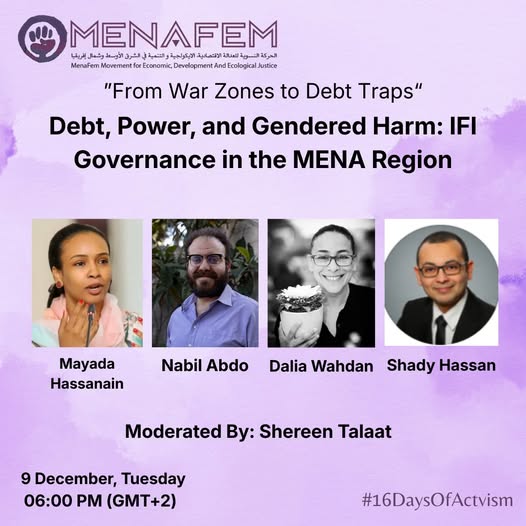
MENAFem convened a webinar titled “Debt, Power, and Gendered Harm: IFI Governance in the MENA Region” on the occasion of launching its new background paper, as part of its 16 Days of Activism campaign, “From War Zones to Debt Traps.”
The background paper, “The IMF & World Bank’s Grip on MENA,” examines how debt and IMF and World Bank conditionalities operate as a governing framework across the region. It demonstrates how austerity-driven economic policies function as forms of structural violence, reshaping state–society relations and placing disproportionate burdens on women and marginalized communities.
The full paper is available here.
The webinar opened with a presentation by economist Shady Hassan, who outlined the paper’s analytical framework and key findings, including the expansion of conditionalities, the shrinking of fiscal space, and the use of debt as a mechanism to reorient national policymaking toward external priorities.
In his intervention, economic researcher Nabil Abdo framed debt as a relationship of power, focusing on Egypt as a central case within a broader regional system of financial dependency. He explained how lending programs lock countries into cycles of borrowing and repayment, undermining social investment and deepening inequality.
Mayada Hassanien offered a feminist analysis of the gendered impacts of debt and austerity, emphasizing how these policies materialize in women’s everyday lives through the erosion of public services, the expansion of unpaid care work, and women’s efforts to fill the gaps left by a retreating state. She also highlighted the emotional and social toll of austerity, including exhaustion, anger, and collective frustration.
Dalia Wahdan provided a sociological reading of debt governance, focusing on conditionalities, the lack of transparency surrounding sovereign funds and state-created financial vehicles, and the changing forms of privatization. She discussed how new state institutions are increasingly acting as commercial actors, citing Egypt’s New Urban Communities Authority as an example of how public bodies are being restructured within market logics.
The webinar reflects MENAFem’s broader effort to connect economic violence with conflict, debt, and the erosion of social protection, while centering women’s lived experiences and feminist political economy perspectives. MENAFem emphasizes that debt is not merely a financial issue, but a deeply political and gendered one that requires structural alternatives grounded in economic and social justice.
The webinar recording is available on Zoom HERE.
Passcode: z0ake!56