

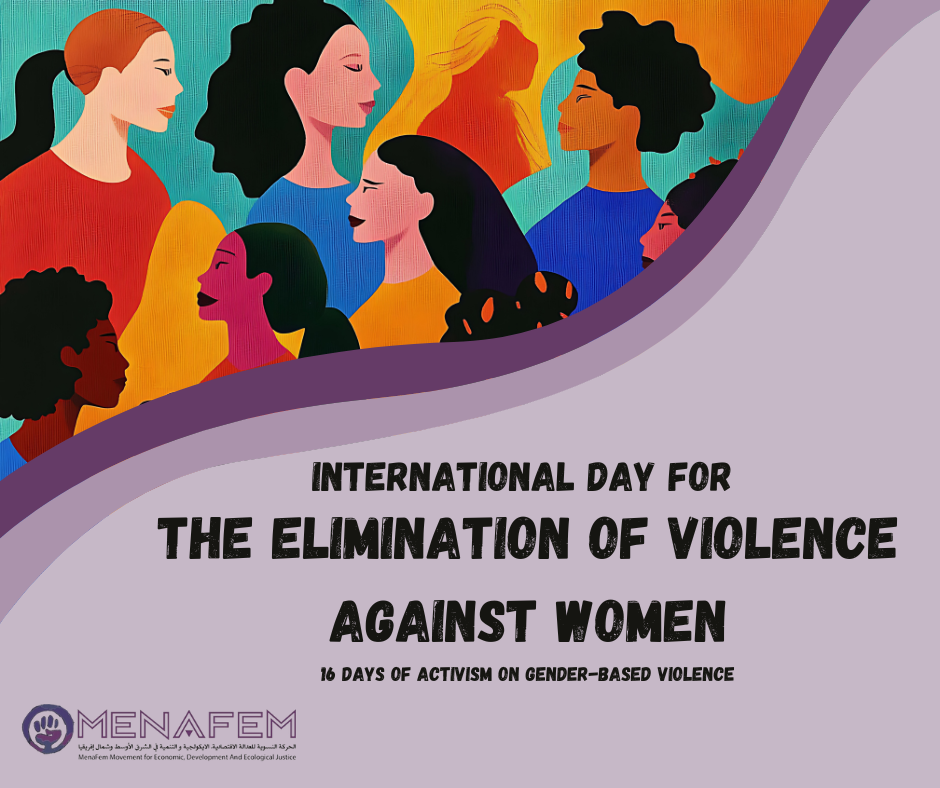
Women Between the Dual Dominance of Arms and Debt – MENAFem Movement’s Closing Statement for the 16 Days Campaign
Over the past weeks, our campaign “From Conflict Zones to Debt Traps” has shed light on forms of violence that extend far beyond the immediacy of armed conflict and reconstitute themselves in periods presented as times of “stability.” The campaign began from a clear feminist conviction: violence is an apparatus for reshaping life itself through controlling resources, the conditions of survival, and the social roles assigned to women as structural expectations rather than individual choices.
Throughout the campaign, Gaza and Sudan emerged as sites where the most explicit and brutal forms of violence are enacted: genocide, displacement, the collapse of life-sustaining infrastructures, and sexual violence as an assertion of sovereign power that disciplines the body and reorders the collective. This constellation of violence produces a reality in which social structures are destroyed while women are simultaneously exhausted as the last remaining pillars of daily survival.
The campaign further revealed how policies that appear to be economically neutral function as mechanisms for managing scarcity and distributing it unfairly. As the cost of living rises, social protection networks erode, access to healthcare becomes increasingly restricted, and the burden of unpaid care work expands within households. In all of this, women bear the highest cost, not merely because they are assumed to be more vulnerable, but because the political and economic order is restructured in ways that make their bodies, time, and unpaid labor a continuous compensatory infrastructure for what states fail to provide.
Through the background paper we released, “Background Paper: The IMF & World Bank’s Grip on MENA,” and through our webinar held yesterday, we sought to demonstrate that heavy indebtedness, the conditionalities of international financial institutions, and austerity policies are not technical tools for managing the economy. Rather, they are deployed to discipline social life and determine who receives protection and who is pushed toward the margins of precarity. As state budgets are redirected toward debt servicing instead of public care, social protection systems unravel, risks are redistributed onto households and communities, prices rise, and public services deteriorate. This includes the erosion of healthcare, the decline of food security, and the fragmentation of care systems, producing layered forms of structural violence borne disproportionately by women due to the social organization of labor and care, which positions their bodies and time as sites where the system processes its crises.
The campaign shows that this form of structural economic violence is not separate from military violence; it is its continuation. When war subsides, its economic afterlives are managed through the same financial instruments that reproduce inequality. Violence thus shifts from control over bodies to control over the conditions of living and the most basic pathways to a dignified life.
Resisting violence against women in the region requires dismantling the structures that produce it, not merely addressing its visible expressions. This includes interrogating the role of international financial institutions in shaping national policies, examining the power relations that govern resource distribution, and restoring care economies as essential components of justice rather than expendable items in depleted budgets.
In closing this campaign, MENAFem Movement affirms that structural violence is not an inevitable reality. Dismantling the political economy of violence, from conflict zones to state budgets, is central to shaping a future in which life is no longer governed by manufactured scarcity, and in which women regain the ability to live under conditions that are fair, safe, and dignified.