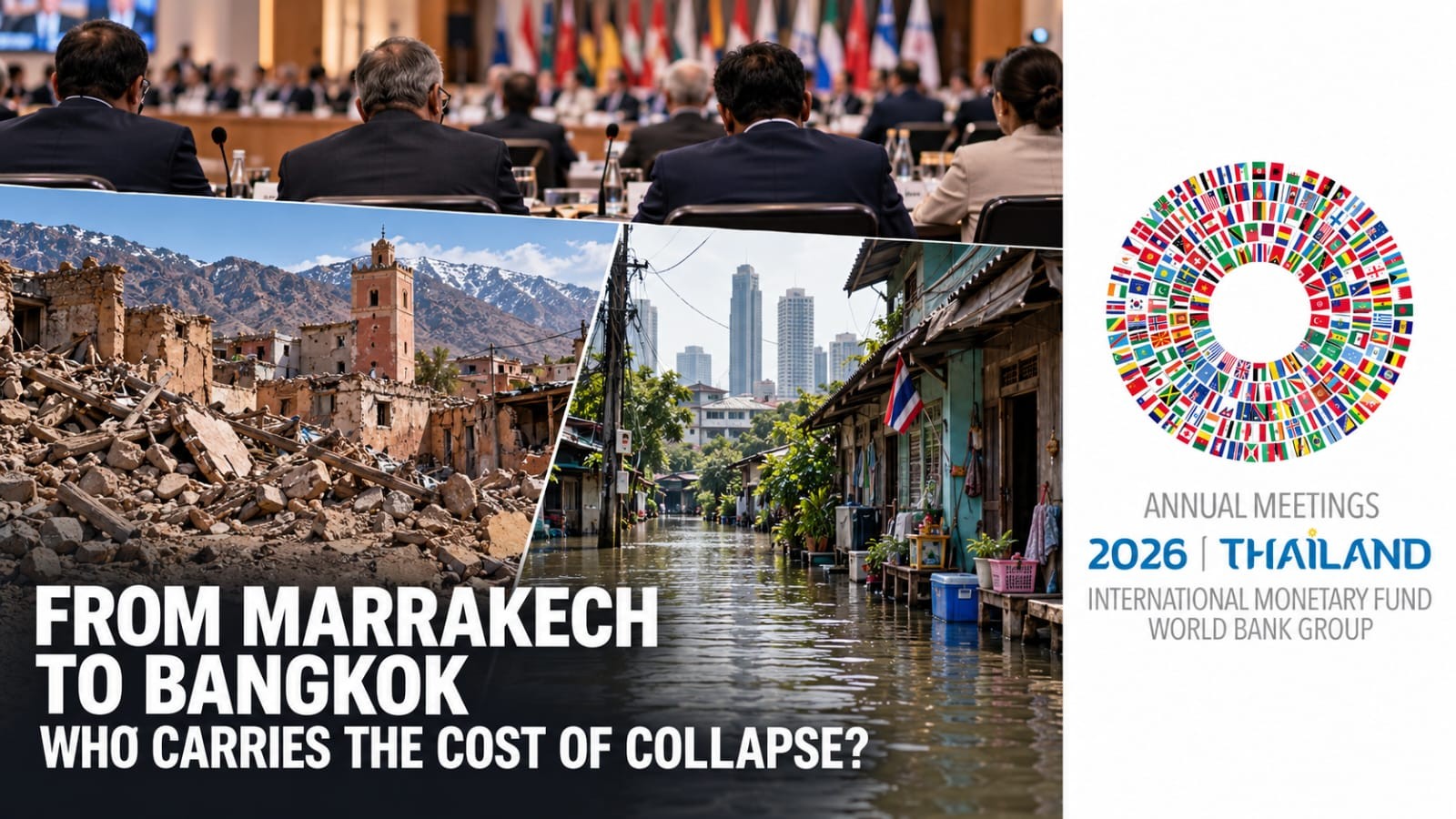
From Marrakech to Bangkok who carries the cost of collapse
A MENAFem perspective on the 2026 IMF and World Bank Annual Meetings
Shereen Talaat
Founder and Executive Director of MENAFem
2 October 2026
The disaster is already inside the meeting
In October 2023, the IMF and World Bank met in Marrakech weeks after an earthquake devastated communities in Morocco[1]. This October, their Annual Meetings come to Bangkok after September floods disrupted the city and surrounding provinces[2]. Once again, the institutions arrive to discuss resilience while people are living through the failure of the systems meant to protect them.
For us at MENAFem, these events belong in a political discussion of ecological collapse. The earthquake was a tectonic event. But its link to Bangkok’s floods lies in the destruction of the conditions that sustain life, and in the unequal protection available before, during and after a disaster. In Morocco’s mountain communities, the World Bank itself recognised how limited the benefits of economic growth had been[3]. A collapsed home carries the history of decisions about housing, infrastructure, land and public investment.
Climate change adds pressure to these conditions. The IPCC documents the intensification of heavy rainfall as the planet warms[4], although attributing this particular flood requires a separate assessment. The political connection remains clear. Recovery requires resources. Debt service claims those resources. When recovery is financed through more borrowing, a disaster becomes a future obligation imposed on people who have already lost their homes, livelihoods and security.
Bangkok must answer a question that Marrakech left with us. How can institutions speak of resilience while preserving rules that make communities finance their own survival through debt?
SWANA and the economy of permanent adjustment
South West Asia and North Africa(SWANA) enters these meetings through several interconnected crises. War destroys the capacity to produce and sustain life. Debt narrows public choices. Climate damage threatens water, food and livelihoods. Patriarchal economies transfer the labour of survival onto women. Discussing each crisis in a separate policy room conceals how they reinforce one another.
SWANA also refuses a geography defined from the viewpoint of an imperial centre. Our region contains different economies and unequal powers, including wealthy creditor states, countries dependent on energy imports, fossil fuel exporters and populations living under occupation. Those differences matter. Regional solidarity must confront the role of our own governments and financial elites in reproducing extraction, repression and inequality.
Egypt illustrates the choices embedded in adjustment. The IMF’s July 2026 review calls for sustained primary surpluses, renewed automatic fuel pricing and faster divestment[5]. A primary surplus means government revenues exceed spending before interest payments. It can support debt reduction, but the target alone tells us nothing about whose income is taxed or whose services are constrained. When energy costs rise, the effects can travel through transport, food prices and the costs of earning a living We demand that be evaluated the whole programme through these consequences, including the time and labour households must supply to cope.
In Jordan, the IMF’s reform agenda links fiscal adjustment with the financial sustainability of public utilities, while its climate facility addresses water and electricity vulnerabilities[6]. These sectors sustain life. Their reform must be assessed through affordability, reliable access and the protection of workers. A utility balance sheet can improve while a household’s access deteriorates. We need public investment and fair financing arrangements that prevent the transfer of costs onto people who cannot absorb them.
In Lebanon, the World Bank’s recovery framework begins with a US$250 million loan for urgent reconstruction[7]. Restoring infrastructure is essential, but the financing choice still deserves scrutiny. People whose communities have been destroyed should not inherit the primary financial responsibility for repairing that destruction. Across SWANA, the same political question returns through different programmes. Who is protected by the financing arrangement, and who becomes responsible for its repayment?
Colonial governance survives through the rules
The governance of the IMF and World Bank gives financial contributions decisive weight over authority. The United States holds 16.49 per cent of IMF votes[8], enough to block decisions requiring an 85 per cent majority, including most amendments to the Articles of Agreement[9]. At the World Bank’s IBRD, votes combine basic votes with capital shares[10]. Countries do not meet as equals when they negotiate the rules governing their economic future.
This is the institutional meaning of colonial economic governance. Formal independence coexists with unequal power over borrowing, taxation, public ownership and development choices. Creditor influence operates through conditions attached to financing and through assessments that determine which policies are considered credible. Hosting the meetings in Marrakech or Bangkok brings the institutions closer to the geography of these consequences. It leaves their governing authority concentrated.
Changing that authority requires redistribution of voting power, an end to unilateral blocking power over governance reforms, and enforceable accountability to affected populations. It also requires accountability within borrower countries. Sovereignty must give people control over economic decisions. Governments cannot invoke it to shield military business, elite accumulation, secret contracts or repression of the movements demanding change.
War has creditors and perpetrators
The destruction of Gaza, which the UN Commission of Inquiry concluded amounts to genocide[11], must shape any serious discussion of our region’s economy. So must the war involving the United States, Israel and Iran[12], and the destruction experienced across the region. Economic analysis must name the actors and decisions producing harm. Reducing war to an external shock or an investment risk erases responsibility.
War destroys homes, hospitals, water networks, farmland and the institutions through which people care for one another. Its ecological consequences endure in damaged land, hazardous debris and the loss of safe water. Its economic consequences reach beyond the place of attack through disrupted trade, import costs, displacement and lost livelihoods. Women carry care responsibilities through this destruction while facing violence, insecure work and the loss of public support.
Borrowing for reconstruction can turn those losses into obligations to creditors. When adjustment follows, affected populations may pay again through taxes, service cuts or the transfer of public assets. A feminist approach must interrupt that sequence. We demand an end to attacks on civilians and arms transfers enabling violations, accountability for perpetrators, reparations and grants for recovery. Palestinian reconstruction must be governed by Palestinian self-determination. Housing and public services cannot be made dependent on a reconstruction model designed around investor returns.
Austerity is organised through gender and care
A spending cut does not eliminate a need. Someone still cares for an ill relative, finds water, prepares food, accompanies a child or makes up for a service that has become unaffordable. In patriarchal economies, much of this work is assigned to women. An adjustment programme can record a fiscal saving while concealing a transfer of costs into unpaid labour, lost income and exhaustion.
That transfer connects debt policy directly to gender. A woman’s ability to take paid work depends on transport, childcare, health services, safe workplaces and the distribution of care. Entrepreneurship programmes cannot compensate for the withdrawal of these conditions. Gender commitments must change macroeconomic choices, including the pace of adjustment, the design of taxation and the financing of public services[13].
We demand public gender and distributional assessments before conditions are approved, with an obligation to revise measures that cause harm. Spending protections must maintain their value against inflation and meet actual needs. Universal social protection, public care systems and decent public employment require stable financing. Progressive taxes on wealth, corporate profits and harmful extraction can help provide it. A UN Tax Convention that strengthens developing countries’ taxing rights belongs in this discussion because revenue choices shape how much a country needs to borrow.
Climate finance must change who pays
Morocco’s climate financing offers a concrete lesson. MENAFem’s analysis of its IMF Resilience and Sustainability Facility documents the authorities’ refusal of a proposed increase in fossil fuel VAT on social grounds[14]. A negotiated replacement focused on excises on polluting industrial inputs. The case shows that the distribution of climate costs is open to political contestation. The first policy design is a choice, and countries can demand another.
The wider problem remains. Climate vulnerability becomes a reason to take on repayable finance, while historical responsibility for emissions and extraction is kept outside the financing terms. Low interest rates may reduce the cost of a loan. They do not remove the repayment obligation. Adaptation, disaster recovery and loss and damage require grants and contributions grounded in responsibility and capacity to pay.
For SWANA, a just transition must also change control over land, water and energy. An export project presented as green can reproduce extraction if it claims scarce water and land while local communities face unreliable or expensive services. We demand public scrutiny of hydrogen, renewable energy and other transition projects through ownership, water use, labour rights and who receives the benefits. Community consent and affordable domestic access must shape investment decisions.
Fossil fuel dependence creates different challenges for exporters and importers. Both need a transition that protects workers, diversifies livelihoods and strengthens public provision. We reject gas expansion presented as climate progress and energy contracts that conceal future public liabilities. Climate finance must expand the capacity to act, with communities able to shape the transition.
What the Bangkok agenda opens and what it leaves unresolved
We expect the meetings to continue promoting fiscal adjustment and the mobilisation of private capital. The World Bank’s programme includes a flagship discussion on private capital and jobs[15]. We must ask which jobs, under which labour protections, and with which public guarantees. Where governments absorb commercial risks or guarantee revenues, an investment can generate future claims on budgets even when it is presented as an alternative to public borrowing.
Civil society is bringing these contradictions into the programme. “Whose Buffers?” will scrutinise austerity and the household costs of adjustment. Other sessions examine the IMF–World Bank three-pillar response to debt pressures, gender commitments and the climate claims attached to policy lending. MENAFem’s session on surveillance and lending will connect overlapping shocks with the protection of services[16]. These are opportunities to challenge institutional decisions. Participation must lead to answers, disclosed evidence and changes in policy.
The September review of the debt sustainability framework for low-income countries creates another opening through greater attention to domestic debt and development and adaptation needs[17]. Implementation is expected in the second half of 2027. Bangkok therefore provides an opportunity to press for how the changes will work. The revised framework also does not directly settle the treatment of many middle-income borrowers across SWANA.
We demand debt assessments that begin with the resources needed to fulfil rights, provide care and prevent ecological harm. Assumptions and model results must be open to scrutiny. A country cannot be judged sustainably financed simply because it can keep paying creditors while undermining the conditions that sustain its population.
The Borrowers’ Platform gives us work to build on
There is also reason for hope. The Borrowers’ Platform launched in April with UNCTAD as its secretariat[18]. Its first Governing Council is scheduled for Bangkok on 12 October, with governing arrangements, membership and leadership among the expected decisions[19]. This is a chance to strengthen cooperation among countries that often face creditor institutions separately.
We should be precise about what exists. The Platform’s current mandate centres on peer learning, assistance and coordination[20]. It is not a mechanism for collective restructuring or bargaining. Its first Council in Bangkok is a step in building the institution, rather than its original launch. The political potential lies in what borrowers can develop through it.
Shared positions on repayment pressures, independent legal support and comparisons of creditor offers could improve countries’ ability to negotiate. Cooperation across SWANA, Africa, Asia, Latin America and the Caribbean could also challenge rules that isolate borrowers. We want this coordination to protect spending on care, services and climate action, and to support changes in the wider debt architecture.
That ambition requires channels through which feminist movements, unions and affected communities can shape priorities and scrutinise outcomes. A stronger voice for finance ministries must translate into greater authority and protection for people. Hope rests on the possibility of organising that relationship and securing better terms.
What we demand from these Annual Meetings
Our demands follow from the connections between these crises. Cancel illegitimate and unsustainable debt. Suspend payments during disasters and conflict without turning deferred obligations into another trap. Ensure private creditors participate in relief. Provide grants for emergency response and reconstruction, alongside reparations from those responsible for destruction.
Change lending conditions that undermine services, care and climate protection. Publish debt contracts, guarantees and the assumptions behind assessments. Protect public ownership and democratic control over essential services. Advance a UN debt convention that gives borrowers an effective voice and grounds restructuring in human rights. Debt swaps must not displace cancellation or extend creditor control over ecosystems.
Bangkok will be judged through decisions about money and power. We will look for lower repayment burdens, greater capacity to fund public services, fairer climate financing and stronger authority for affected communities. The Borrowers’ Platform and civil society organising offer ways to advance those changes. Our task is to turn those openings into obligations that institutions and governments must honour.
From Morocco’s mountain communities to flooded Bangkok, from Gaza to the households absorbing the cost of adjustment across The GlobalSouth, the demand is for the resources and power to sustain life. That demand must govern the terms of finance
Sources
- IMF and World Bank statement on the Morocco earthquake and the 2023 Annual Meetings. 18 September 2023.
- Thailand Government Public Relations Department on flooding and emergency holidays. 27 September 2026.
- World Bank Morocco Economic Monitor on the earthquake and mountain communities. 2023.
- IPCC Sixth Assessment Report Working Group I Chapter 11 on rainfall extremes. 2021.
- World Bank Annual Meetings programme. 2026.
- World Bank Civil Society Policy Forum programme. 13–16 October 2026.
- IMF member quotas and voting power. Updated 26 September 2026.
- IMF Articles of Agreement Article XXVIII on amendments. Current governing agreement.
- World Bank voting powers. Current allocation rules.
- UN Commission of Inquiry finding on genocide in Gaza. 16 September 2025.
- UN Fact-Finding Mission on civilian harm and repression in Iran. 17 September 2026.
- IMF press briefing on the regional war and economic risks. 10 September 2026.
- IMF review of the debt sustainability framework for low-income countries. September 2026.
- UNCTAD Borrowers Platform preparations for the first Governing Council. 25 September 2026.
- UNCTAD on the mandate of the Borrowers Platform. 13 April 2026.
- World Bank Gender Strategy 2024–2030 and its care policy analysis. 2024.
- IMF seventh EFF review and second RSF review for Egypt. 30 July 2026.
- IMF staff-level agreement on Jordan’s EFF and RSF reviews. 15 April 2026.
- World Bank Lebanon Emergency Assistance Project financing and reconstruction FAQ. 17 February 2026.
- MENAFem analysis by Shady Hassan on Morocco’s RSF and green colonialism. 9 July 2026.
[1] 1. IMF and World Bank statement on the Morocco earthquake and the 2023 Annual Meetings. 18 September 2023.
[2] 2. Thailand Government Public Relations Department on flooding and emergency holidays. 27 September 2026.
[3] World Bank Morocco Economic Monitor on the earthquake and mountain communities. 2023.
[4] IPCC Sixth Assessment Report Working Group I Chapter 11 on rainfall extremes. 2021.
[5] World Bank Annual Meetings programme. 2026.
[6] World Bank Civil Society Policy Forum programme. 13–16 October 2026.
[7] IMF member quotas and voting power. Updated 26 September 2026.
[8] IMF Articles of Agreement Article XXVIII on amendments. Current governing agreement.
[9] World Bank voting powers. Current allocation rules.
[11] UN Fact-Finding Mission on civilian harm and repression in Iran. 17 September 2026.
[12] IMF press briefing on the regional war and economic risks. 10 September 2026.
[13] IMF review of the debt sustainability framework for low-income countries. September 2026.
[14] UNCTAD Borrowers Platform preparations for the first Governing Council. 25 September 2026.
[15] UNCTAD on the mandate of the Borrowers Platform. 13 April 2026.
[16] World Bank Gender Strategy 2024–2030 and its care policy analysis. 2024
[17] IMF seventh EFF review and second RSF review for Egypt. 30 July 2026
[18] IMF staff-level agreement on Jordan’s EFF and RSF reviews. 15 April 2026.
[19] World Bank Lebanon Emergency Assistance Project financing and reconstruction FAQ. 17 February 2026.
[20] MENAFem analysis by Shady Hassan on Morocco’s RSF and green colonialism. 9 July 2026.