

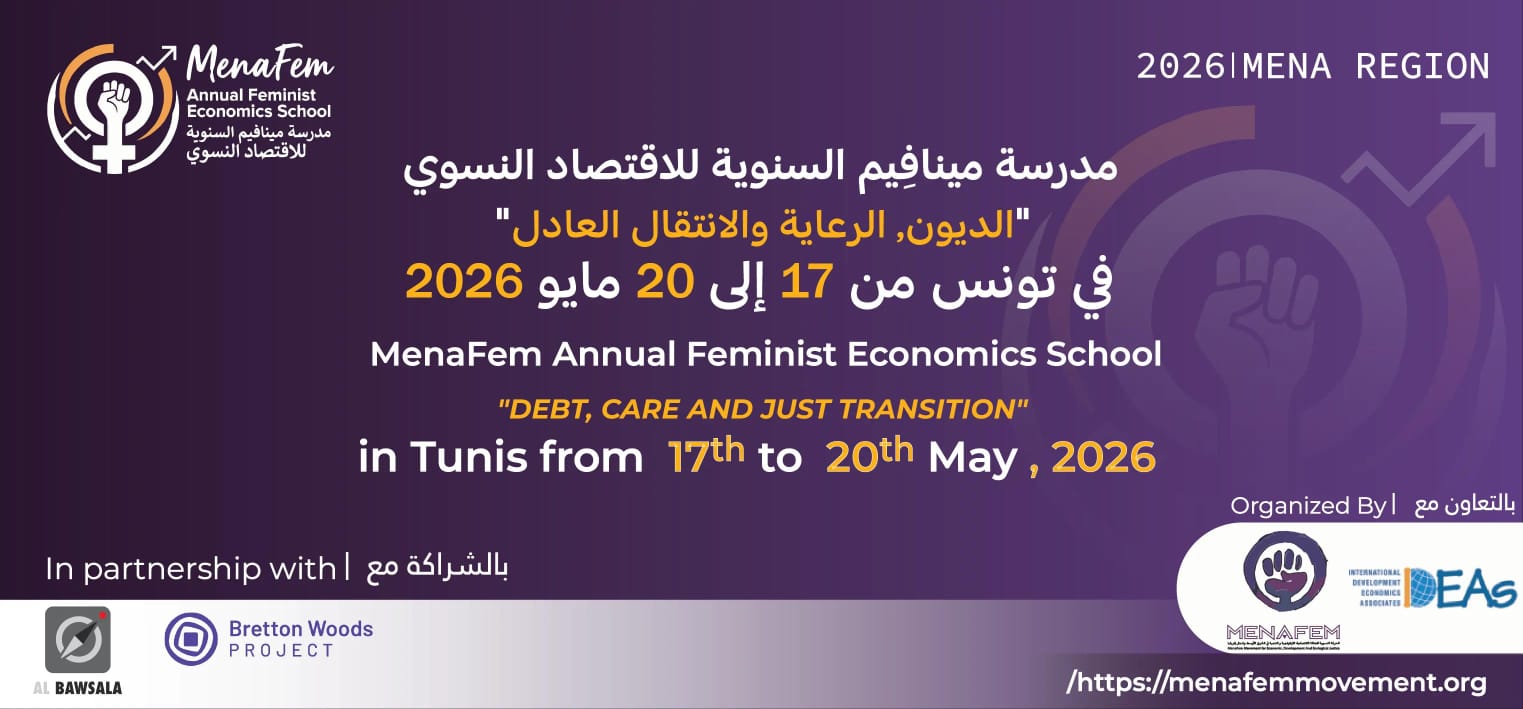
MENAFEM ANNUAL FEMINIST ECONOMICS SCHOOL – 2026
Debt, Care and Just Transition 17-20 May 2026. Tunis, Tunisia
The economies of the MENA region have been shaped by a specific mode of underdevelopment, driven first by colonialism and the post-colonial economic order, and later reinforced by the post-Washington Consensus and neoliberal restructuring. The region’s integration into global finance promoted as expanding development opportunities through access to international liquidity has instead produced recurring debt, currency, and banking crises. This integration has also sharply limited domestic policy space while deepening structural vulnerabilities.
Over recent decades, several SWANA countries have become increasingly reliant on external borrowing. In Egypt, external debt expanded from USD 36 billion to over USD 165 billion, without a corresponding increase in foreign currency reserves. In Morocco, public debt reached 69% of GDP in 2024. This growing dependence on external financing reinforced by successive IMF-backed programs has heightened exposure to currency shocks, inflation, and rising debt-servicing costs, directly undermining economic and social stability. These pressures have translated into deteriorating living conditions: according to FAO estimates, 28.5% of the population in Egypt experienced moderate to severe food insecurity (2020–2022), while undernourishment reached 7.2%. This is why we chose this year’s school to focus on the Debt Crisis, International Financial Architecture and Just Transition in the MENA region, where escalating debt burdens are now a central constraint on economic stability, social rights, and development of futures.
Highly indebted countries are increasingly pushed to adopt externally designed “green” transitions, often financed through new debt instruments, privatization schemes, and market-based mechanisms. Rather than enabling structural transformation, these approaches can deepen fiscal constraints, reinforce unequal integration into global value chains, and shift the social and ecological costs of transition onto already marginalized communities.
Therefore emerging climate and transition frameworks risk functioning as a new wave of “green structural adjustment,” where environmental imperatives are used to justify austerity, cost recovery, and privatization, rather than enabling equitable and redistributive transitions.
A feminist understanding of a just transition thus most go beyond sectoral shifts to renewable energy. It centers questions of redistribution, care, labor, and social reproduction, asking who bears the costs of transition and who benefits from it. In the MENA context, this includes recognizing how austerity, subsidy reforms, and climate policies reshape unpaid care work, women’s labor force participation, and access to essential services such as water, food, and energy.
Simultaneously, austerity measures and de-industrialization have entrenched extractive economic models across the region. These dynamics have deepened crises in social sectors, driving rising poverty, vulnerability, and inequality. Despite these structural conditions, conflict, violence, and social fragmentation in the region continue to be framed as symptoms of fundamentalism or so-called cultural backwardness. Such narratives are not only racist but actively obscure the economic and political origins of instability rooted in externally imposed development trajectories.
Universities have played a key role in reproducing these paradigms. The dominance of neoclassical economic thinking has shaped generations of academics, researchers, and policy actors, largely confined to a single economic framework that normalizes and legitimizes regressive policy prescriptions across the region.
Within this landscape, feminist discourse has also been constrained. Liberal feminist agendas largely advanced through donor-driven institutional frameworks have prioritized narrow political and social rights frameworks while sidelining structural economic critique. At the same time, feminist analysis has been diluted into a focus on opposing so-called regressive social norms, rather than confronting the political economy of extraction, debt dependency, and financial subordination.
Against this backdrop, the need to train feminist economists is critical not only to challenge the dominance of neoclassical economic doctrine, or to counter donor-driven liberal feminism, but to rebuild feminist analysis as a structural, political economy project necessary for advancing economic sovereignty, social justice, and systemic reform of the International Financial Architecture.
Objectives:
- Understand the structural drivers of the MENA debt crisis, including its gendered impacts on unpaid care work, employment, public services, and economic inequality.
- Assess the role and impact of IFI lending and policy conditionalities, with attention to how austerity measures disproportionately affect women and marginalized communities.
- Examine alternatives for debt sustainability, domestic resource mobilization, and financial reform, informed by feminist economic approaches that prioritize social infrastructure, care economies, and equitable redistribution of resources.
- Discuss the political economy of just transition in the MENA region, including the role of debt, climate finance, and IFIs in shaping national transition pathways.
- Examine the gendered impacts of climate policies (e.g., subsidy reform, carbon pricing, energy restructuring) on women, livelihoods, and access to basic services.
Topics:
- Foundations of feminist and heterodox economics and their approaches to development (Social Reproductive Theory)
- Introduction to the International Financial Architecture and feminist critiques.
- Feminist Understandings of the Debt Crisis.
- Climate Justice,debt crisis, and just transition.
- Gendered Dimensions of Domestic Resource Mobilization.
- Labour and employment