✊🛑May Day Statement — 1 May 2026🛑✊
 May Day 2026 arrives amid a deepening convergence of structural crises: the mounting debt burden weighing on countries of the Global South, accelerating climate breakdown, widening class inequalities, the expanding logic of militarism and war economies, and the steady erosion of peoples’ economic and social rights. These are not separate crises. They are expressions of a single global system that reproduces itself through debt, austerity, extraction, and war.
In this context, neoliberal policies continue to be reasserted under new labels — “reform,” “fiscal stability,” “resilience,” “green transition,” and “development partnerships.” Yet this technical language conceals a set of clear political choices: protecting the interests of creditors and markets, expanding the authority of international financial institutions, transferring the cost of crisis onto peoples — and above all onto women, workers, and all those who bear the weight of social injustice in every form it takes.
In our region — Southwest Asia and North Africa — the realities of labour cannot be understood in isolation from a long history of economic dependency, debt conditionality, IMF and World Bank structural programmes, unequal trade agreements, and extractivist development models. What is presented as “fiscal balance” translates in practice into the privatisation of public services, the dismantling of formal employment, the expansion of the informal economy, the erosion of wages, the rolling back of social protections, and the suppression of trade union rights.
These transformations unfold alongside the expansion of war economies and militarisation. Public resources are redirected toward “security” and armaments, while health, education, welfare, and social protection budgets are cut. In our region — where wars, occupations, and external interventions intersect, and where the genocide against the Palestinian people stands as the most stark example — it is clear that the global economic order draws no distinction between war and market, between colonialism and profit, between repression and structural adjustment.
At the heart of this crisis, women bear a doubled burden. As public services are dismantled and social spending cut, the cost of care is transferred to families — and unpaid labour is imposed as the invisible foundation on which the economy continues to run. Care is not marginal to the economy; it is what makes life possible. Yet the economic system persists in devaluing it, rendering it invisible, and building upon it without recognition or redistribution.
Young people across our region face a closed horizon: structural unemployment, generalised precarity, and relentless pressure to emigrate or accept indecent working conditions. Denying millions of young people access to dignified work is not an incidental policy failure — it is the direct result of an economic model that does not produce social futures, but rather produces a surplus of precarity and despair.
Alongside this, the logic of extraction is accelerating in energy, minerals, agriculture, and water, all in the name of “development” and “green transition.” The digital transformation — and above all artificial intelligence — raises new challenges for labour and climate justice, given its reliance on energy- and resource-intensive infrastructure. In the absence of regulatory frameworks, AI is deployed as a tool to deepen exploitation and displace workers, rather than to support them and improve the conditions of their lives.
What unites all these policies is a single logic: reorganising the economy at the expense of labour, at the expense of care, at the expense of the land, and at the expense of life.
We Stand in Solidarity With:
• Workers and working people in their struggles against exploitation and precarity.
• Young people — and especially young women — in their fight for the right to decent work, a dignified future, and just public policies.
• Women’s struggles against all forms of visible and invisible exploitation — particularly in the domains of care and unpaid labour.
• Social movements fighting for land, water, food, housing, and public services.
• The Palestinian people and all peoples of the region in their resistance to colonialism, war, forced displacement, starvation, and the systematic destruction of the conditions of life
We Reject:
• Austerity policies and the conditionalities of international financial institutions that mortgage the futures of our peoples.
• The unjust debt system that undermines economic and social sovereignty.
• Extractivist development models that drain resources and marginalise communities.
• The reorientation of economies toward war and militarisation at the expense of life.
• False “green transitions” when they serve as new cover for privatisation, dependency, and extraction.
We Affirm:
• The cancellation of illegitimate and unjust debts, and the construction of alternative financing built on justice, reparations, and grants — not further indebtedness.
• The rebuilding of public services as fundamental rights, not commodities subject to market logic.
• The guarantee of rights for all workers — inside and outside the formal economy — and the strengthening of trade union freedoms.
• The recognition of unpaid care work and its integration into economic and social policies.
• The imposition of just taxation on wealth and major profits, and an end to regressive taxes that burden the poor and working classes.
• The construction and funding of a comprehensive social protection system guaranteeing protection for all people throughout their lives.
• The building of a just ecological transition that breaks with the logic of extraction and places communities at the centre of decision-making.
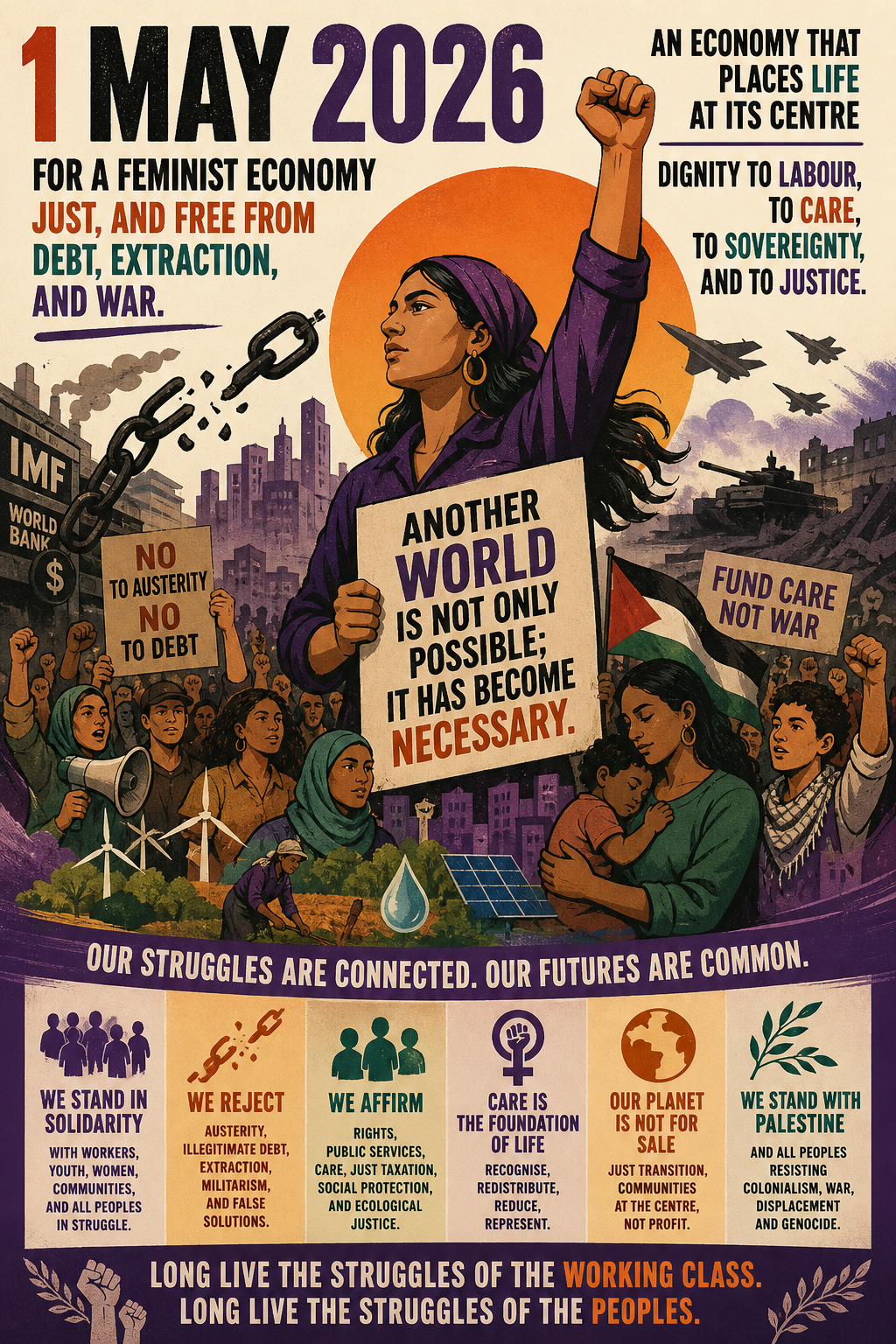
Finally, we reaffirm that May Day is a political moment — a moment to renew our collective commitment to struggle against all forms of exploitation and domination. We declare that another world is not only possible; it has become necessary: an economy that places life at its centre, and restores dignity to labour, to care, to sovereignty, and to justice.
Long live the struggles of the working class.
Long live the struggles of the peoples.
For a feminist economy — just, and free from debt, extraction, and war.