

Financing a Just Socio-Ecological Transition: More Isn’t Always Better
By Federico Sibaja - Recourse
 At the IMF Spring Meetings 2026, much of the discussion circled around familiar themes: a worsening global debt crisis, growing external imbalances, and the surge in defense spending reshaping fiscal priorities. But framed through a justice lens, these are not isolated issues—they are deeply interconnected symptoms of a financial system that continues to extract from the Global South while limiting its development options.
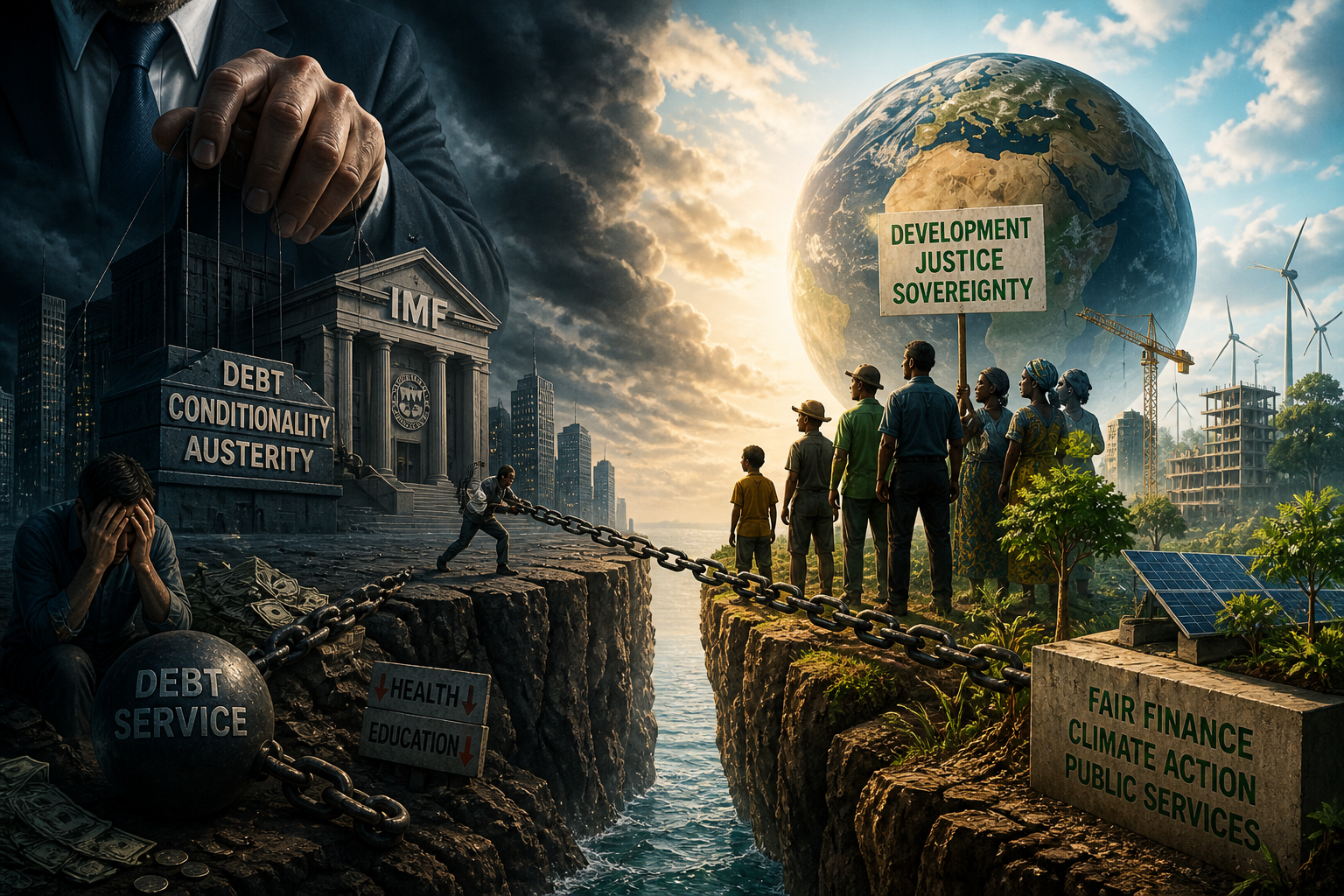
This crisis is unfolding in a context of record indebtedness. The post-2008/09 period of loose monetary policy accelerated external borrowing across the Global South, without delivering structural transformation. By 2024, more than 54 countries were spending over 10% of government revenues on interest payments, and 48 were spending more on debt servicing than on health or education.
Argentina illustrates the scale of the problem. In 2025, debt repayments to the IMF and private creditors are estimated at USD 19.1 billion, equivalent to 24% of 2024 export earnings. Across the region, debt vulnerabilities have intensified, with private creditors holding 32.9% of public debt in Latin America—compared to just 8.5% in emerging Asia.
Despite repeated claims about an “investment gap,” the issue is not simply the volume of financing. Over recent decades, long-term, stable financing has been replaced by market-based instruments and portfolio flows. This shift has reinforced financialization: a regime where profit-making increasingly happens through financial channels rather than productive investment.
As a result, countries compete for short-term capital inflows, shaping their development strategies around investor expectations. This dynamic—described as “financial subordination” —limits policy space and reinforces dependence on external financing conditions.
Financing and shrinking policy space
Financial liberalization in Latin America, largely implemented after the debt crises of the 1980s under IMF and World Bank conditionalities, expanded financial systems but skewed them toward short-term returns.
Because their currencies lack international hierarchy, countries in the region remain highly exposed to global liquidity cycles. To sustain external balances, governments often resort to:
- High interest rates and macroeconomic policies that prioritize investor confidence over development
- Expanding exports—often through extractive sectors—to accumulate reserves
These strategies come at a cost. They can suppress domestic economic activity while intensifying pressure on natural resources. At the same time, the high participation of private creditors increases volatility and forces governments to continuously “signal” stability to avoid default risks.
The result is a constrained policy space. As acknowledged even within the IMF, countries often have “very few options other than fiscal adjustment” if they want to maintain market access. The debates at the IMF Spring Meetings 2026 echoed this tension: calls for fiscal prudence coexist with growing recognition that austerity and rising defense expenditures are crowding out development and climate investment—especially in the Global South.
The Wall Street Consensus in practice
Efforts to scale up financing have increasingly relied on private capital and de-risking strategies. Instruments like the IMF’s Resilience and Sustainability Facility (RSF) reflect this approach, linking climate finance to broader reform programs.
In practice, this has included conditionalities such as reducing energy subsidies and advancing privatization, alongside fiscal adjustment targets. By June 2024, the IMF had active programs with 51 countries, with average fiscal consolidation targets of 3.3% of GDP—and 4.1% for low-income countries.
Despite their limited scale—just over USD 8 billion disbursed—these flows are counted toward international climate finance commitments.
Export-led solutions: escape or trap?
Faced with these constraints, some argue that boosting exports—particularly in extractive sectors—can help reduce financial dependence. Argentina followed this path in the late 2000s and early 2010s, sustaining a current account surplus through strong export performance after losing access to international markets.
But this strategy proved fragile. When commodity prices declined, external constraints quickly returned. More fundamentally, higher exports did not resolve structural issues such as external debt, capital flight, or weak domestic reinvestment.
In fact, during periods of favorable terms of trade, capital flight exceeded USD 20 billion in 2008 and USD 25 billion in 2011. Recent policy debates—such as those surrounding investment incentive regimes—suggest that attracting capital often requires deregulation, tax breaks, and guarantees for profit repatriation, with little requirement for local productive linkages.
The outcome is familiar: expanded extractive activity, increased socio-environmental conflict, and continued exposure to both commodity cycles and financial volatility.
So, where do we go from here?
The key takeaway is that more financing is not inherently better. In a highly financialized global economy, the quality and terms of financing matter deeply. Some forms of financing actively undermine development by reinforcing austerity or extractive dependence.
At the IMF Spring Meetings 2026, discussions on debt, imbalances, and fiscal pressures made clear that the current system is struggling to reconcile financial stability with development and climate goals. A justice-centered approach requires shifting the focus: from ensuring repayment and investor confidence to enabling structural transformation and protecting rights.
This, in turn, requires rethinking global financial governance. Institutions like the G20, the IMF, and central banks remain opaque, with limited participation from civil society.
Ultimately, development should not be shaped to fit the needs of finance. Today, billions of dollars leave the Global South through debt servicing and profit repatriation, reinforcing global inequalities.
Reversing this trend will require not only policy space, but political will. And that, as always, will depend on sustained pressure from civil society to ensure that development pathways reflect local needs—not financial imperatives.