

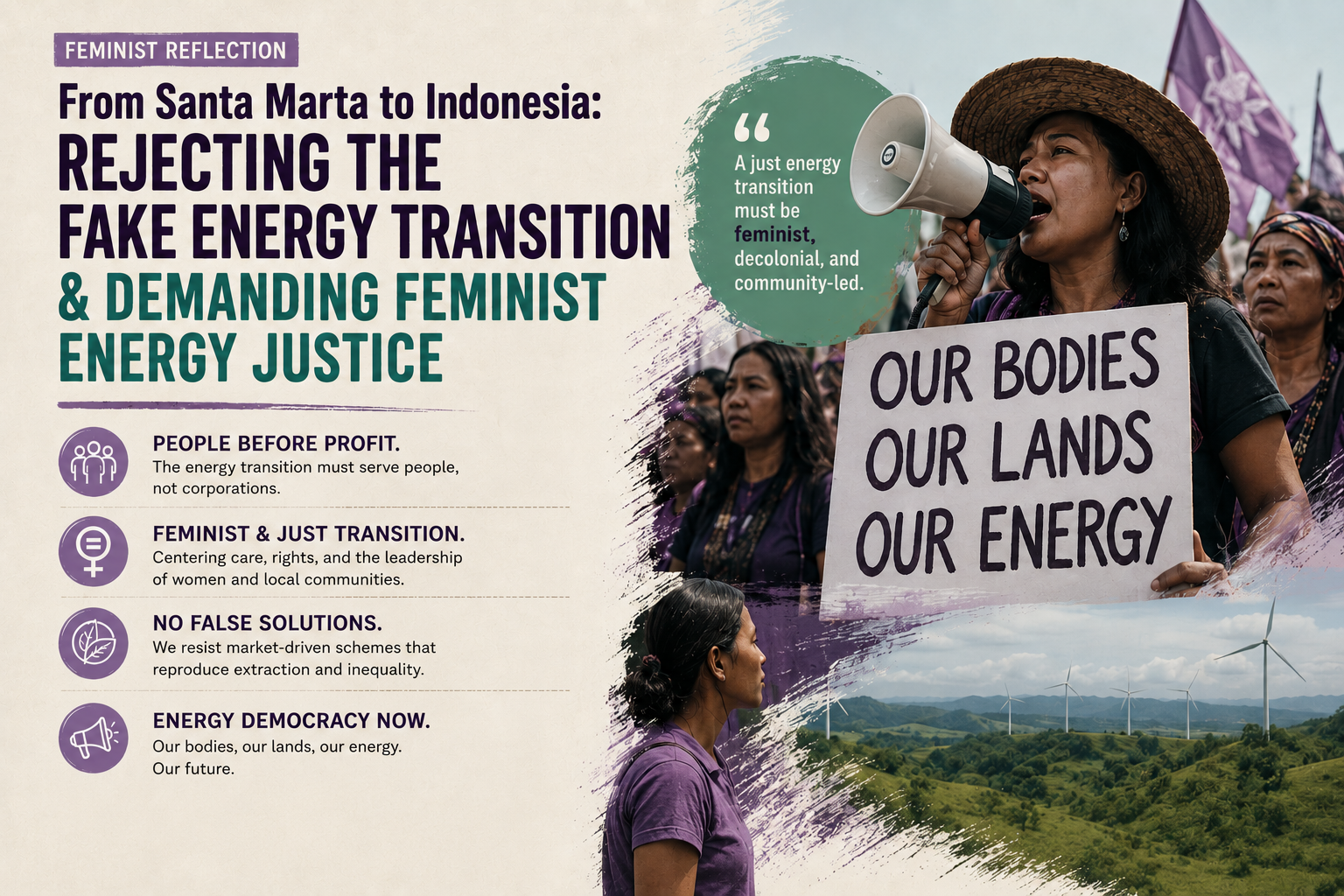
From Santa Marta to Indonesia: Rejecting the Fake Energy Transition and Demanding Feminist Energy Justice
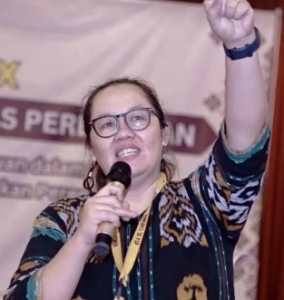
Armayanti Sanusi Chairperson of the National Executive Body Women’s Solidarity for Human Rights
 Amid the escalating global climate crisis, the energy transition agenda is increasingly being promoted as the solution to ending dependence on fossil fuels. Countries around the world are racing to set emission reduction targets and expand renewable energy projects as part of their commitment to addressing climate change. However, behind the grand narrative of “clean energy” and the “green transition,” there lies a fundamental issue that continues to be overlooked: who benefits from the energy transition, and who bears the brunt of its impacts?
This question was raised at the First Conference on Transitioning Away from Fossil Fuels (TAFF), held April 24–29, 2026, in Santa Marta, Colombia. Initiated by an alliance of 18 UNFCCC member states, the conference was promoted as a new political space to drive the creation of a Fossil Fuels Treaty as a global framework for a just energy transition. At the forum, attended by 45 countries, nations were encouraged to begin moving away from dependence on fossil fuels and to build an energy system considered safer for the future of the Earth and human life.
However, behind these ambitions, the global energy transition agenda still harbors serious issues. Rather than addressing the root causes of injustice, the energy transition risks reproducing old inequalities in new forms. Northern countries continue to evade their historical responsibility for the climate crisis they created through decades of industrialization and the exploitation of natural resources. Meanwhile, Southern nations are once again burdened by debt-based financing schemes and market mechanisms that deepen economic dependence.
Armayanti Sanusi, Chair of the National Executive Body of Solidaritas Perempuan, who attended the Santa Marta conference as the representative of the Gender and Diversity sector from Asia, noted that although the conference opened up opportunities for various groups to participate, women were still treated as mere symbols rather than as political actors who shape the direction of the energy transition.
According to Solidaritas Perempuan, the political process at the Santa Marta Conference remains dominated by a technocratic and elitist approach that marginalizes the lived experiences of grassroots women. While women’s participation is indeed present in the conference setting, it is largely procedural rather than substantive. Women are present as “participants,” not as key political actors with the power to determine the direction, framework, and agenda of the global energy transition.
The Santa Marta Forum has also not explicitly positioned feminism as a political perspective in developing equitable energy transition policies. Discussions remain focused on emission targets, investment, technology, and financing, without dismantling the power dynamics of patriarchy, colonialism, and extractive capitalism that lie at the root of the climate crisis. Consequently, the energy transition is understood merely as a shift in energy sources from fossil fuels to renewable energy, rather than as a systemic transformation that addresses unequal social, economic, and political relations.
In addition, the conference process also revealed disparities in access and representation. Grassroots women’s groups from the Global South face limited access to negotiation spaces, information, and decision-making. Meanwhile, state actors, international financial institutions, and energy corporations hold dominant positions in shaping the direction of global discussions. This situation demonstrates that the energy transition process remains controlled by the global elite, while the communities most affected are marginalized.
Feminist criticism has also been directed at the absence of accountability mechanisms that ensure the protection of women’s rights within the energy transition agenda. Terms such as “inclusive,” “participatory,” and “equitable” are used repeatedly, but without concrete indicators of how women will gain access to, protection of, recovery from, and control over energy resources. In practice, the language of inclusion risks becoming a tool to legitimize energy transition projects that remain exploitative.
For Solidaritas Perempuan, the climate crisis and the energy crisis are never gender-neutral. Both stem from patriarchy, extractive capitalism, and colonialism, which treat women’s bodies and nature as objects of exploitation. Therefore, the energy transition cannot be understood merely as a shift in technology or energy sources. Without dismantling these unequal power dynamics, the energy transition will merely be an extension of old injustices with a “greener” facade.
The concept of a just transition, which is frequently discussed in international forums, is also seen as having lost its political significance. The terms “just” and “community-based” are used without a clear framework of gender justice. Yet, access to energy is deeply intertwined with care work—a burden disproportionately borne by women. Energy shapes how women cook, access clean water, care for their families, safeguard community health, and sustain daily life. When this dimension is overlooked, the lived experiences of the majority of women worldwide are also sidelined in energy transition policies.
Similar issues are evident in the economic and financial approaches to the energy transition, which remain elitist and male-dominated. Green investment schemes, debt restructuring, and energy financing fail to account for their impact on women or to provide women with equitable access to economic resources. The global financial system is once again portrayed as neutral, when in fact it is a major source of inequality through debt financing and extractive projects.
This situation is particularly evident in Indonesia. The government has indeed been actively discussing its commitment to the energy transition through various international initiatives such as the Just Energy Transition Partnership (JETP). However, in practice, national policy continues to prioritize dependence on coal, gas, and extractive industries. The energy transition currently being developed is more focused on investment and economic growth than on protecting people’s rights and ensuring the sustainability of their living environments.
Various projects touted as clean energy are actually creating new ecological and social crises. Geothermal projects, hydroelectric power plants, wind farms, and nickel mining for electric vehicle batteries continue to drive the dispossession of land, violence, and the criminalization of local communities, particularly women.
In Poco Leok, Flores, East Nusa Tenggara, the expansion of the Ulumbu geothermal power plant project is proceeding without Free, Prior, and Informed Consent (FPIC). The project threatens communal lands, water sources, and the livelihoods of indigenous communities. Women are at the forefront of the resistance, taking action to protect their villages while facing intimidation and violence from authorities.
A similar situation is unfolding at Mount Rajabasa in Lampung. A geothermal project touted as a source of green energy is actually threatening a forest area that has long been the community’s lifeline. The lack of meaningful participation and the absence of FPIC demonstrate how women and local communities are once again being sidelined from the decision-making process.
In Poso, Central Sulawesi, the Poso Energy hydroelectric power plant project has damaged the Poso River, which serves as a source of livelihood for the local community. Changes in the river’s flow, water pollution, and recurring floods have increased the workload on women while depriving them of access to water, food, and healthcare.
Meanwhile, in Lhoknga, Aceh Besar, the designation of Mount Lampuuk as a protected forest area for a planned wind power project reveals another facet of a gender-unequal energy transition. “Green” projects continue to be carried out using the same logic of power: disregarding the voices of indigenous women and local communities, while simultaneously creating conditions for social conflict and gender-based violence.
A critical feminist analysis by Solidaritas Perempuan asserts that the current direction of global and national energy transition policies remains dominated by the interests of corporations and the political elite. What is taking place is not a systemic transformation, but rather the reproduction of injustice in a new form. For grassroots women, the energy transition must be understood as a comprehensive transformation that dismantles systems of oppression, eliminates unequal power dynamics, guarantees women’s rights to land, water, and energy, and prioritizes local knowledge and community practices as the foundation of a just and sustainable energy system.
Therefore, the struggle for energy justice cannot be separated from the struggle to build energy democracy, gender justice, and people’s sovereignty over their own living spaces. A just energy transition must begin with the recognition of the rights of women and local communities as the primary guardians of sustainable living. Without such fundamental changes, the energy transition will merely be a shift from one form of injustice to another.