

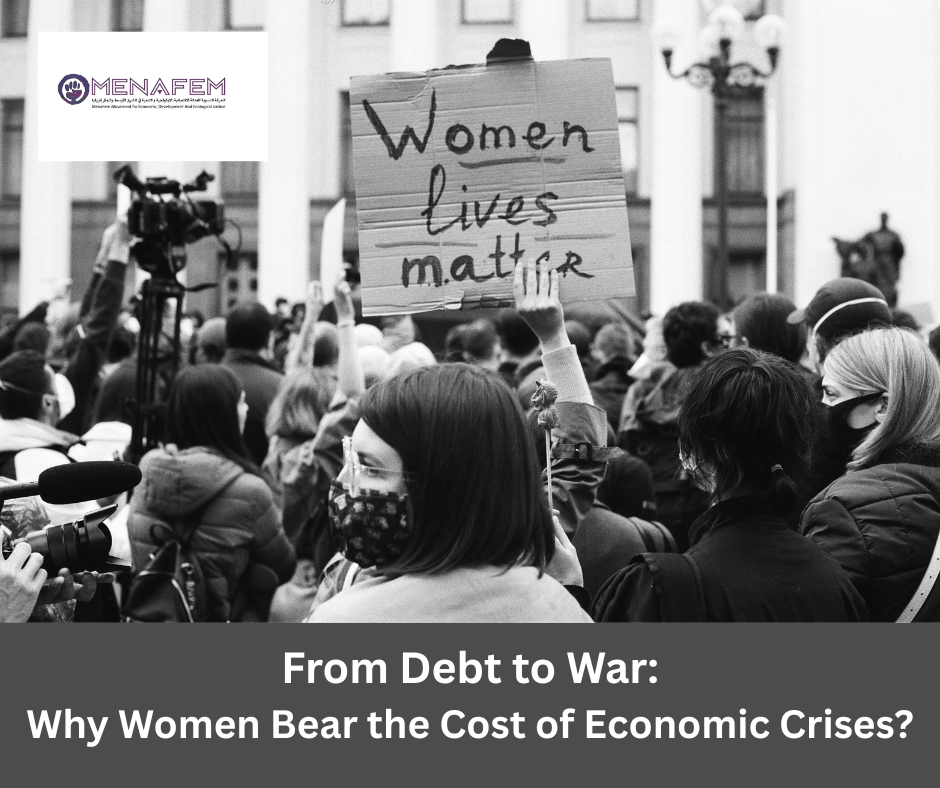
From Debt to War: Why Women Bear the Cost of Economic Crises
As part of MENA Fem’s March campaign questioning the meaning of justice in an unequal world, we seek to unpack dominant narratives around gender justice and connect them to the economic, social, and political realities shaping women’s lives in our region today. While international discourse—particularly within the framework of the Commission on the Status of Women—often focuses on “access to justice” as a matter of legal reforms and institutional mechanisms, this moment compels us to ask deeper questions: what kind of justice is being discussed in a context marked by escalating wars in the region, deepening debt crises, and austerity policies that undermine states’ ability to protect their societies?
In many countries across our region, debt has become a direct factor shaping the independence of political decision-making and governments’ capacity to respond to crises and conflicts. When states are heavily indebted and reliant on loans and international financial institutions, their political, economic, and social choices become increasingly constrained. This often results in austerity policies, subsidy reductions, and cuts to public services. These policies do not affect societies equally. Women often bear the greatest burden of economic crises, as they are more vulnerable due to their position in the labor market and their central role in household care responsibilities.
In Egypt, for example, external debt reached approximately $168 billion in 2023, according to data from the Central Bank of Egypt and the International Monetary Fund. As the country entered successive IMF programs, the government adopted policies including reducing fuel and electricity subsidies, floating the exchange rate, and cutting public spending. Although these measures are framed as “economic reforms,” their consequences are evident in rising living costs and declining household purchasing power.
Lebanon presents another example of the relationship between debt and social crises. Before the financial collapse in 2019, Lebanon’s public debt had already exceeded 170% of GDP, according to the World Bank, making it one of the most indebted countries in the world. Following the collapse, the country entered a severe economic crisis that pushed poverty rates to over 80% of the population, according to United Nations estimates. In this context, essential services such as electricity and healthcare have deteriorated, and households increasingly rely on family-based care networks. Women, once again, are the ones managing daily survival under conditions of service collapse, rising prices, and shrinking incomes.
In Iraq, despite the country’s vast oil wealth, the economy remains heavily dependent on oil revenues, which account for more than 85% of government income, according to World Bank data. This dependency makes the economy highly vulnerable to global price fluctuations and limits the state’s capacity to invest in social services and long-term development. Meanwhile, ongoing security and political tensions in the region often redirect public spending toward security and political stabilization rather than toward improving healthcare, education, and social protection.
This economic reality intersects with escalating conflicts across the region. The recent military escalation—including attacks on Iran and Lebanon and the bombardment of displaced communities—adds new pressures to economies already struggling under the weight of debt and austerity. As governments increase military spending or manage the economic fallout of regional conflicts, this often comes at the expense of social spending and essential public services.
Under these conditions, heavily indebted states have limited capacity to protect their populations or pursue alternative social policies. Communities are left to cope with multiple overlapping crises, while women bear a disproportionate burden—through rising costs of living, declining access to decent work, and the expansion of unpaid care work that keeps families and societies functioning despite these pressures.
For this reason, discussions of gender justice in our region cannot be separated from questions of debt, economic policy, and war. The economy is not merely a matter of numbers or financial management; it is a political arena that determines who pays the cost of crises and who has the ability to live with dignity.