 In April 2026, I had the opportunity to participate in the follow-up meetings for the implementation of the Seville Agreement on Financing for Development. What I take away from that experience is that decision-making in these spaces has never been so disconnected from realities on the ground, nor has the terrain where these discussions take place been so hostile.
Feminisms have much to contribute to imagining and fighting for other possible worlds. In this moment of backlash, it is crucial to strengthen feminist spaces, deepen solidarity, and learn from our shared trajectories. As feminists, coming together—even in hostile environments—gives us collective strength. It allows us to build South–South solidarity and rehearse forms of North–South collaboration that can sustain our movements. It also means using whatever privilege we hold to amplify the voices of poor, racialized women and gender-diverse people, who are rarely heard in these decision-making spaces.
But truth be told, it was very difficult to imagine advancing agreements that improve the conditions of the Global South in the United States, a country that has kidnapped the president of another nation and launched wars without congressional approval. A place where the rule of law is increasingly eroded and that targets with severe sanctions those who investigate crimes against humanity, harasses individuals working to hold perpetrators accountable, including Francesca Albanese, who has been financially penalized and separated from her family. Judges of the International Criminal Court investigating the genocide in Gaza face similar pressure.
Without changing the set, there is little hope for honest and meaningful collaboration. We need spaces that can support agreements capable of addressing the volatility shaping human and planetary life. That volatility is, at the end of the day, driven by extreme wealth concentration in the hands of a few—petro-oligarchs, and technological and financial magnates—unelected actors who nonetheless shape governments captured by corporate interests.
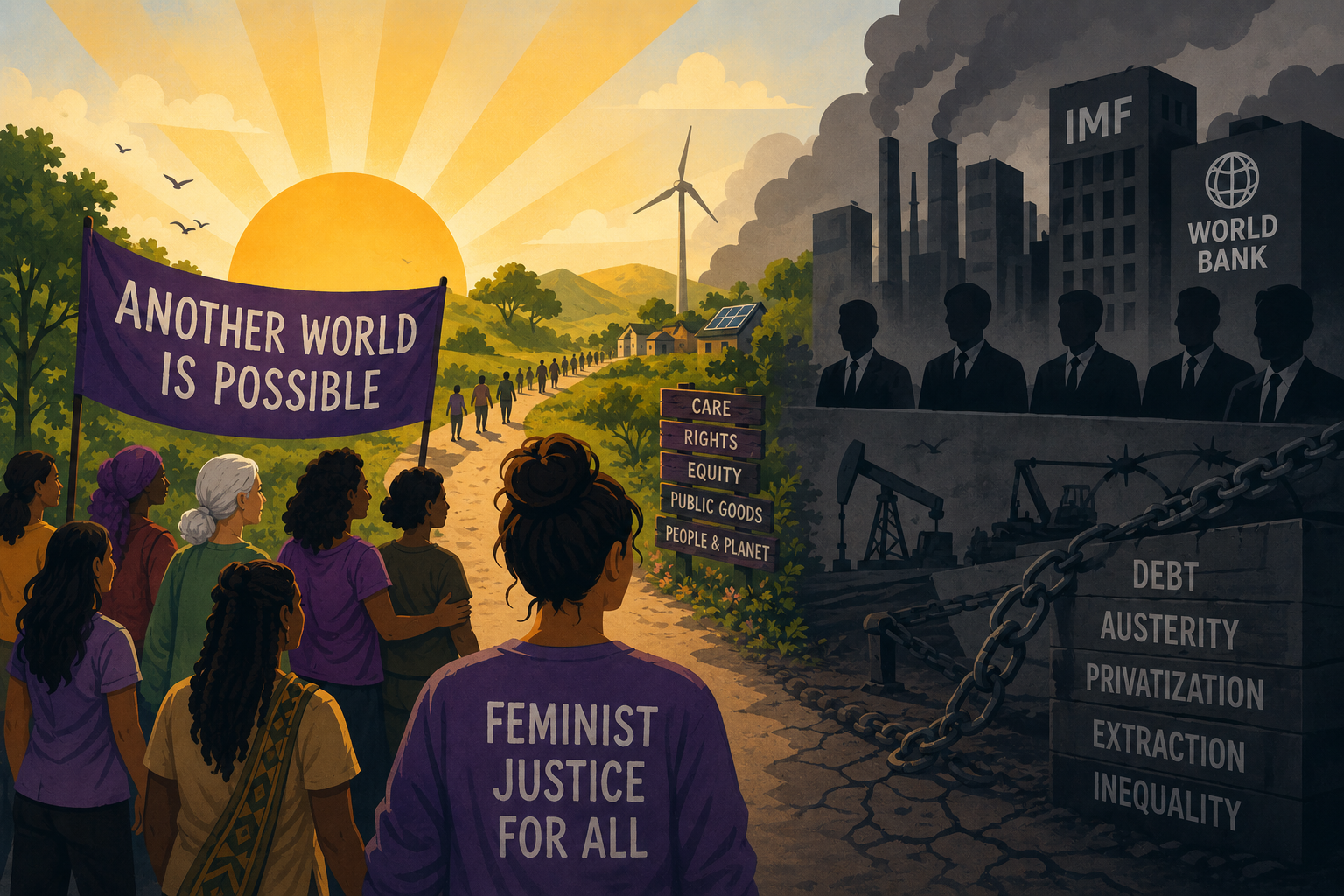
To align decision-making with realities on the ground, it is not enough to change the set, we must change the actors as well. Financing for development is not a technical issue; it is a political choice—and today that choice puts wolves in charge of the sheep. I took part in a panel where the International Monetary Fund and the World Bank presented themselves as drivers of sustainable development. As an Argentine woman, this rang hollow. For the past eight years, my country has lived with the consequences of the Fund’s prescriptions—policies that entrench, rather than overcome, underdevelopment.
Better reporting of debt-sustainability systems or smoother, standardized sustainable-investment pipelines will not fix the problem. Bretton Woods Institutions’ governance structures are shaped by entrenched geopolitical dynamics that have long favored wealthy countries.
In practice, their interventions do not aim to guarantee human rights. They aim to secure debt repayment and promote economic growth—growth that does not necessarily translate into rights. The IMF has gone so far as to argue that its mandate for macroeconomic stability frees it from fully complying with international human rights law. Today, BWI actions work to lubricate processes of financialization and assetization that dispossess and expropriate the majority to sustain an economic system that has already pushed beyond seven of the nine planetary boundaries, placing the very possibility of life on this planet at risk, all to avoid transforming existing modes of accumulation and shifting power dynamics.
In my country, the International Monetary Fund continues to disburse—and even expand—funds while failing to comply with Argentina’s legislation and its own statutes. Meanwhile, pensioners and people with disabilities face repression in the streets, and taxes on the wealthiest are being reduced. The Argentine case shows clearly that the only time the country achieved debt relief compatible with development was when it did not depend on the Fund’s disbursements for its survival.
And why should we place trust in the World Bank’s ability to work towards sustainable development? Its involvement in initiatives such as the so-called “Board of Peace” and its private-sector-led reconstruction model for Gaza raises serious concerns. Reconstruction cannot be treated as a business, nor can it erase the memory of massacre and extermination. Any reconstruction process must be multilateral, under the framework of the United Nations, holding accountable and prosecuting those responsible for crimes against humanity, and aligned with the needs, rights, and priorities of the Palestinian people, including the necessary reparations.
The problem is not decision-making, but its absence. The lack of political will for transformative agreements in the vast majority of states serves concentrated capital, widening the gaps that divide humanity. With states underfunded, current investment models rely on the privatization and financialization of education, healthcare, social protection, food systems, water, and sanitation. Treating these as markets—rather than public goods—deepens fragmentation and inequality.
Across territories, regions, and global alliances, feminisms push for alternatives. We call for institutions that cancel debts, curb illicit financial flows, and effectively tax corporate profits and extreme wealth to fund universal public goods. Yet these demands are met with inaction, responses that come too little, too late in the head of nondemocratic international financial institutions, which in practice, have produced cooperation for underdevelopment.
This “cooperation for underdevelopment” is reshaping my country’s economy. It sacrifices industry for extractivism, turning us into suppliers of food, energy, and minerals for others—while neglecting our own needs. It weakens the domestic market and pushes urban populations, built around small and medium industry, into unemployment and hunger. What happens to the millions in metropolitan outskirts that mining and hydrocarbons cannot absorb?
I’m left to think that perhaps it is time to call for non-cooperation for sustainable development: to demand that governments collectively withdraw support from states that drive death and annihilation, refuse to finance war, and cut ties with extractive “death deals.” ; to reject the so-called “win-win” cooperative approach to actors whose fortunes exceed the GDP of entire countries, so global decision-making can finally address feminist demands to redistribute income, wealth, resources, and time within and between countries and build a more just social organization of care.
With the bitter taste of these agreements—but a stronger spirit forged in coming together—I returned home to what felt the most productive thing I could do, caring for my loved ones, my community, and my place in this hostile world, as we get organized to move toward a new dawn.