

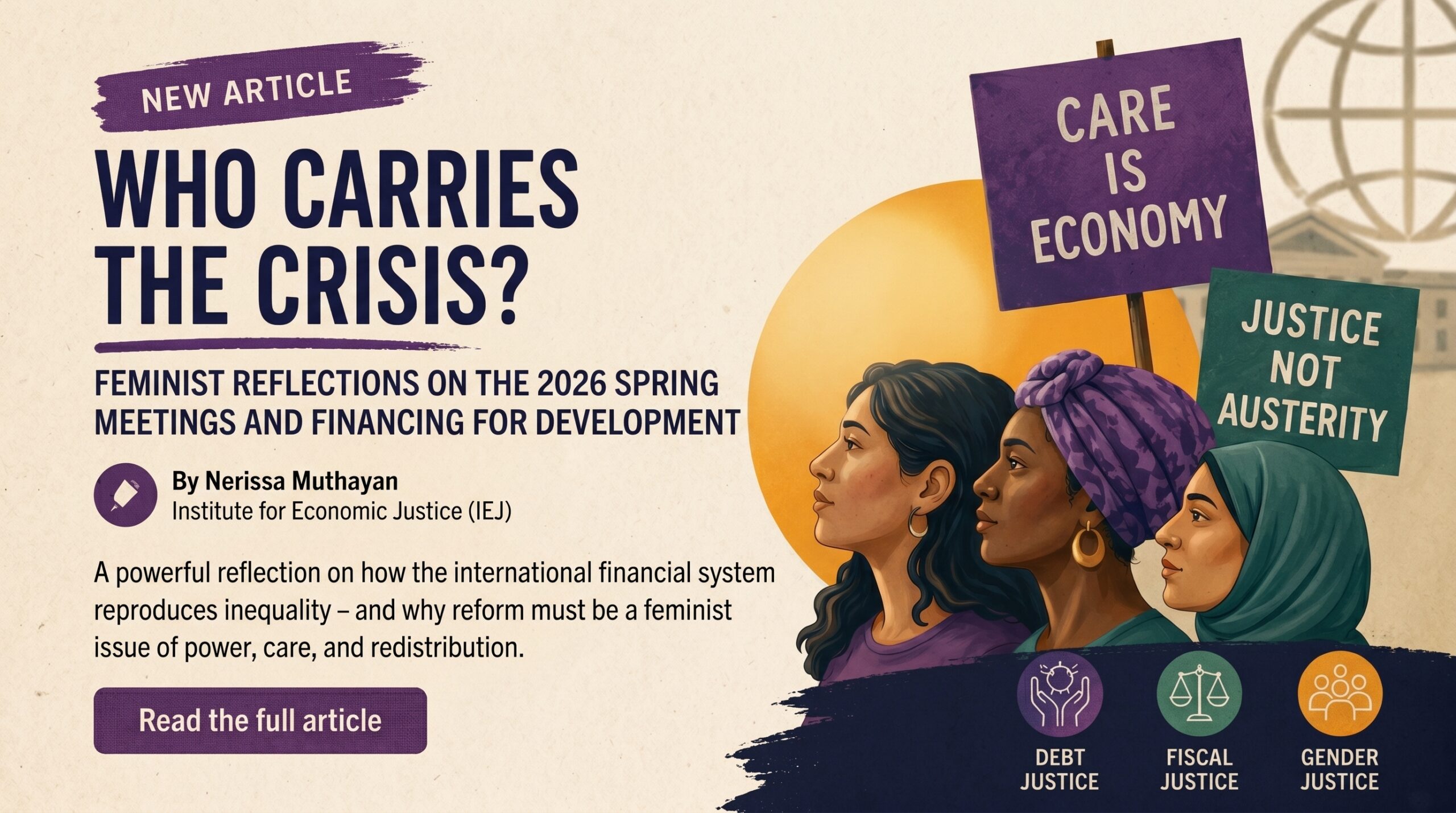
Who Carries the Crisis? Feminist Reflections on the 2026 Spring Meetings and FfD
By Nerissa Muthayan - Institute for Economic Justice (IEJ)

Sitting in discussions at the 2026 Spring Meetings of the International Monetary Fund (IMF) and World Bank, alongside the Financing for Development (FfD) Forum, what stood out was not only the scale of the crises being described, but the language used to contain them. Conflict, rising costs of living, and deepening inequality were repeatedly acknowledged, yet framed in ways that rendered them technical, manageable, and ultimately neutral.
These conversations unfolded across Washington D.C. and New York, bringing together policymakers, activists, and economists to deliberate on economic coordination, reform of the international financial architecture, and the future of multilateralism. But beneath these discussions lies a deeper question: who is expected to absorb the cost of crisis?
Despite the unprecedented nature of these interrelated crises, the language of multilateral development institutions has remained strikingly unchanged. Crisis is framed as risk, disruption as volatility, and conflict as an external shock to otherwise stable systems. This ‘business as usual’ approach treats the global economic system as neutral and its negative impacts as broadly shared.
But these systems are not neutral, their consequences are not evenly borne, and in a time of government budget cuts and reductions, gender equality often becomes the first casualty. Social protections are weakened and the labour that sustains households and communities becomes more invisible, even as it becomes more essential. Women are not simply ‘impacted’ by the crisis, rather they are expected to carry it.
It is for this reason that reform of the international financial architecture must be understood fundamentally as a feminist issue, not as a matter of inclusion, but as a question of how power, resources, and risk are distributed within the international economy.
The current system is not only shaped by structural inequalities between countries, but also reproduces inequalities within them. When states are forced into austerity, the costs are systematically externalised onto households and communities, where women disproportionately absorb them.
Fiscal constraints, debt burdens, and policy conditionalities that translate directly into reduced public spending weaken social protection systems, and increase reliance on unpaid and underpaid care work, that are disproportionately carried by women.
Women are estimated to perform more than three-quarters of unpaid care and domestic work globally.(1) In this sense, the international financial system does not simply respond to crises, it also influences how crises are experienced. Therefore, reform is not only about making the system more inclusive, but also about directly confronting the conditions that allow it to remain unequal.
The question of debt sits at the centre of these dynamics. For many developing countries, rising debt burdens continue to constrain fiscal space, limiting the ability of governments to invest in essential services, such as healthcare and education. This pressure is compounded by the 2025 historic decline of 23.1% in Official Development Assistance. (2)
Multilateral development institutions have responded to this decline with a clear expectation that private financing will fill in the gap. However, access to private capital remains uneven and costly, and credit rating agencies are likely to further penalise countries facing heightened risk, particularly in Africa.
Private capital investments in social spending are also driven by profit, which increases the cost of social spending for households and governments. This will reinforce the familiar cycle in the global governance system, where those most in need of financing are the least able to secure it on sustainable and fair terms, leaving developing countries to bear the brunt of a war not of their own making.
Recent efforts, such as the launch of the Borrowers’ Platform, signal a recognition of the need to rebalance these dynamics by creating space for debtor countries to engage more actively in shaping the terms of financing and restructuring. Yet without meaningful changes to how debt is structured, negotiated, and resolved, the underlying asymmetries of the system are set to remain intact.
Addressing these imbalances requires more than targeted interventions, it calls for a fundamental rethinking of how macroeconomic policy is designed and evaluated. Gender-responsive approaches must be integrated across all areas of economic governance, with care as the central pillar.
Compromiso de Sevilla, the outcome document of the Fourth International Conference on Financing for Development (FfD4), provides a foundation for these approaches. Under Paragraph 27, Compromiso de Sevilla commits states to promoting gender responsive budgeting and advancing discussions on gender responsive taxation, as part of efforts to strengthen fiscal systems and promote sustainable development. (3)
A pivotal opportunity to address these structural imbalances lies in the ongoing efforts to establish a United Nations (UN) Framework Convention on International Tax Cooperation, which reflects the growing global recognition of the role that wealth taxation could play in providing public goods and reducing inequality, particularly gender inequality.(4) Regressive taxation structures tend to place a disproportionate burden on low-income households, among whom women are the majority.(5)
By embedding targeted gender-responsive considerations, a UN Tax Convention could serve as an important step toward aligning global fiscal systems with broader goals of equity and women’s economic justice. This could include considerations such as recognising the differentiated impacts of tax policy, addressing structural gender biases, and ensuring that tax revenues are directed toward strengthening care systems and social protection.(6)
1-https://www.unwomen.org/sites/default/files/2023-10/technical-brief-forecasting-time-spent-in-unpaid-care-and-domestic-work-en.pdf
2-https://www.oecd.org/en/data/insights/data-explainers/2026/04/a-historic-decline-in-foreign-aid-preliminary-2025-oda-data.html
3-https://unctad.org/system/files/official-document/aconf227-2025-l1_en.pdf
4-https://www.cesr.org/building-blocks-for-change-reflections-on-ffd4-and-the-compromiso-de-sevilla/
5-https://taxjustice.net/2025/03/12/incorporate-gender-transformative-provisions-into-the-un-tax-convention/
6-https://www.femnet.org/wp-content/uploads/2025/11/Feminist-Tax-Justice-and-the-United-Nations-Framework-Convention-on-International-Tax-Cooperation.pdf