

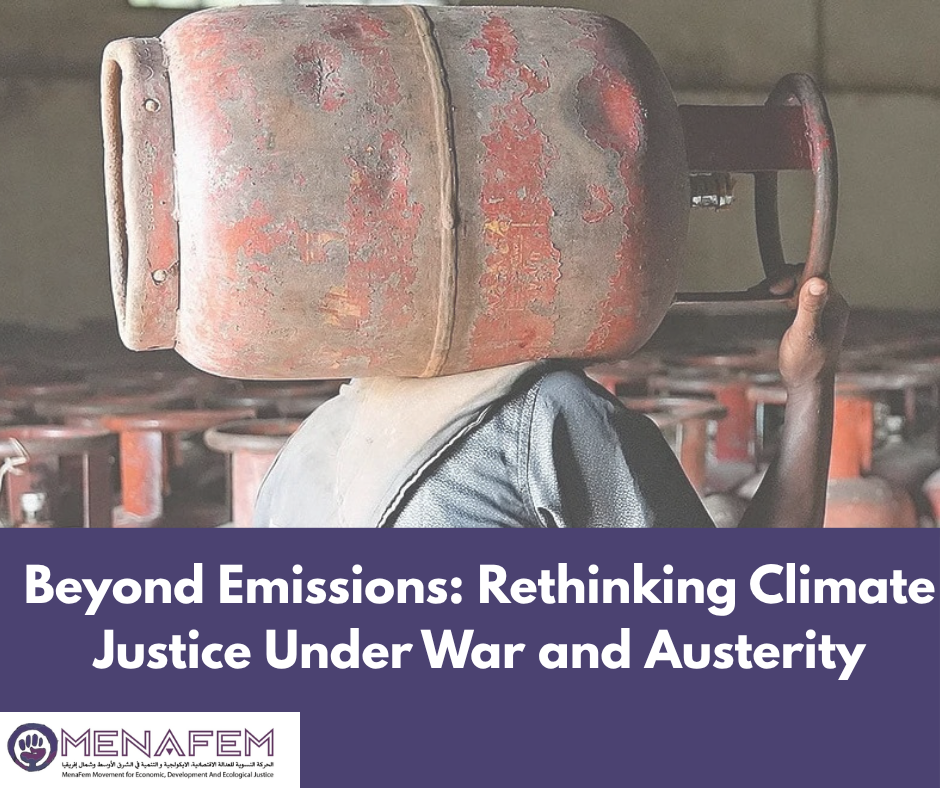
Beyond Emissions: Rethinking Climate Justice Under War and Austerity
As part of MENAFem’s March campaign questioning the meaning of justice in an unequal world, we seek to unpack dominant narratives around gender justice and connect them to the economic, social, political, and environmental realities shaping women’s lives in our region today.
Climate justice is often presented as a question of emissions targets, green transitions, and future environmental risk. But in our region, climate injustice is already shaping everyday life through the unequal distribution of harm in the present. The current war in the region is not landing on equal ground. It is hitting societies already hollowed out by debt, inflation, and years of austerity, leaving little room to absorb new shocks.
From Palestine, to Lebanon and Iran, entire populations are enduring war, bombardment, occupation, militarisation, and political repression. Homes, hospitals, energy systems, water networks, agricultural land, and coastal areas are continuously the target of destruction, once again proving that humanitarian and environmental catastrophe are one and the same. The Israeli occupation and the US target public infrastructure, agriculture, and ecosystems to intentionally degrade the systems that sustain life, including water and sanitation, food production, transport, and energy, so that the consequences of war endure long after active fighting subsides. War produces polluted landscapes, hazardous debris, and degraded natural resources, causing widespread contamination, weakened health systems, and often irreversible ecological damage.
These dynamics are closely tied to the political economy of energy. Fossil fuels are not merely affected by war but are often deeply embedded within it. Revenues from oil and gas continue to sustain military operations, while struggles over pipelines, ports, and key maritime routes frequently shape the dynamics of geopolitical tension. In a global economy still reliant on concentrated and highly volatile energy sources, these infrastructures become strategic targets. Strikes on refineries, storage facilities, tankers, or shipping corridors do not simply interrupt supply chains but also trigger cascading consequences that undermine public health and destabilize already fragile economies.
In Egypt, where repeated IMF-backed reforms and mounting external debt have narrowed fiscal space, the economic fallout of regional escalation is being pushed directly onto people’s daily survival. On March 10, Egypt’s government raised fuel prices again: 15 percent for gasoline, 22 percent for cooking gas, and 17 percent for diesel. These hikes do not simply increase transport and production costs. They also trigger opportunistic and predatory rises in the prices of essential goods, often far beyond any real increase in underlying costs brought about by the war. For households already stretched by successive currency devaluations, inflation, and the erosion of purchasing power, this means another round of forced precarity and vulnerability.
This unequal exposure has a clear gendered dimension. Women are often the ones managing this increase: stretching food budgets, securing water, reorganizing care, rationing movement, and absorbing the daily violence of scarcity. In this sense, war is not only experienced through bombardment and displacement. It is also experienced through the price of a gas cylinder, the cost of transport, and the growing impossibility of securing basic needs.
Climate change intensifies these pressures further. All across Egypt for example, a growing number of people die or become ill due to the increasing temperatures and heat waves while access to cooling systems remains deeply unequal. Pregnant women, young children, the elderly, and people with chronic illnesses are especially vulnerable to extreme heat, which means that climate pressure deepens care burdens that are already unpaid and unevenly distributed. Low-income households are less able to afford rising electricity costs, particularly as subsidies are reduced due to the IMFs violent structural adjustment programs. This is while the World Bank funds oil and gas projects. For example, in 2008, it approved the expansion of natural gas distribution particularly for household use, followed in 2009 by an investment loan for the Ain Sokhna Power Project.
In this sense, the climate crisis cannot be separated from the wider economic model producing vulnerability. Fossil-fuel dependence, debt pressures, and austerity policies deepen environmental harm while weakening the public systems communities need in order to withstand it. The groups most affected by this model are those with the least political power such as rural farmers, informal workers, women in low-paid sectors, and communities living near pollution and extraction. Climate justice, therefore, is not only an environmental question. It is a question of power, inequality, and whose lives are made more disposable in the face of crisis. The current energy transition makes this contradiction visible: even renewable expansion is being structured through extractive neoliberal logics that shift resources from the Global South while concentrating wealth in the Global North.