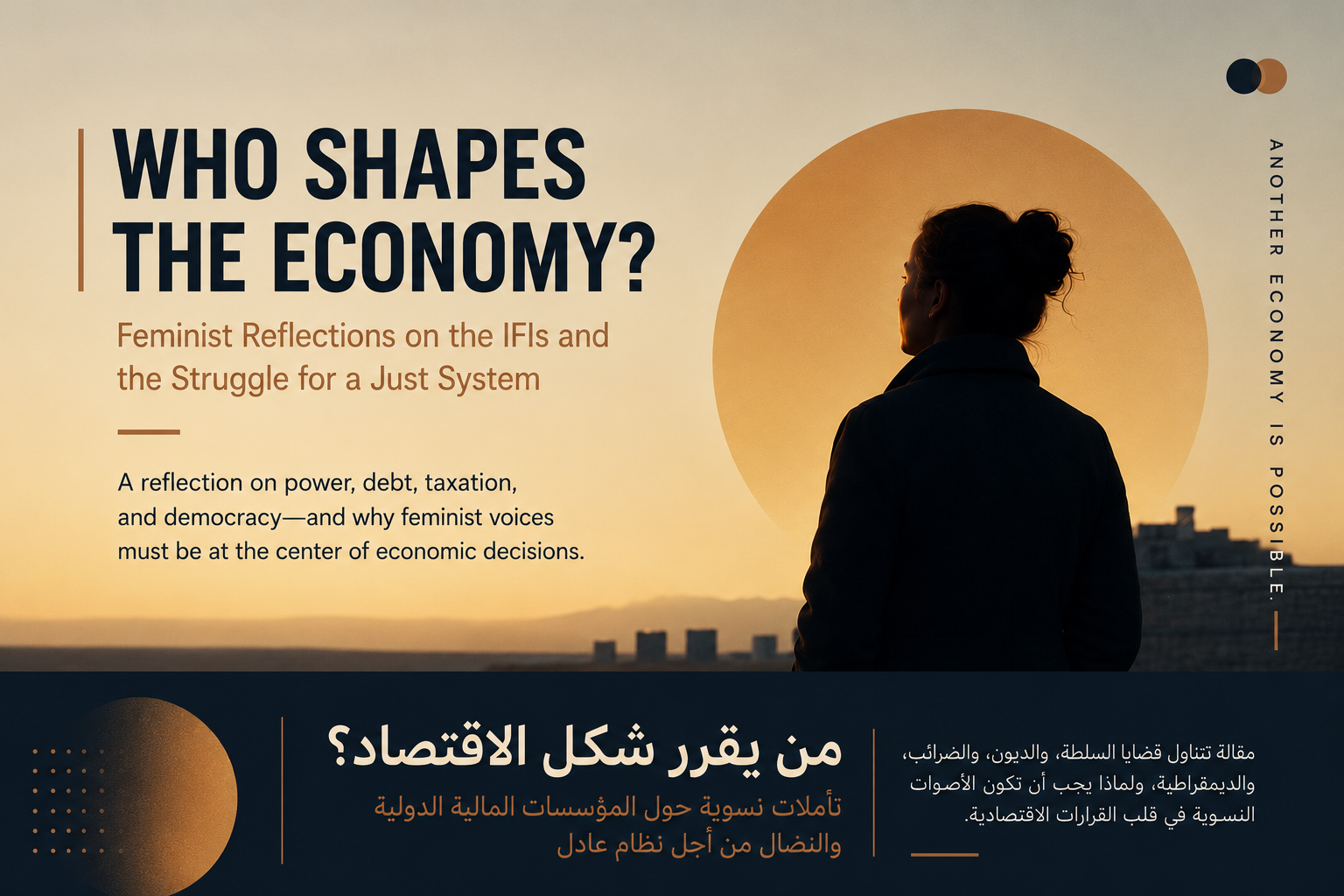
Who Shapes the Economy? Feminist Reflections on the IFIs and the Struggle for a Just System
By Imene Cherif - Research & Economic Justice Advisor - MenaFem Movement
 This year, while travelling to Washington, DC for the Spring Meetings and then following the FfD Forum, I kept asking myself: what should our takeaways be as a feminist movement from these spaces? What are we really able to change? Are we there only to react to what the IMF and the World Bank are discussing, or are we also able to shift the terms of the debate?
This question felt even more urgent in a global context marked by ongoing wars in Iran, Lebanon and Palestine, where militarization, destruction and geopolitical tensions are not disconnected from economic governance, but deeply intertwined with it. These crises reshape fiscal priorities, redirect resources toward military spending and further constrain the already limited policy space of countries in the Global South.
For me, the answer starts from something I keep repeating whenever I have the opportunity : democracy should not be optional. Not at the national level, not at the international level, and certainly not in global economic governance. As an economist, I have always been uncomfortable with the idea that development, democracy and human rights can be treated as separate objectives, or even as trade offs. Economic policies are not neutral. They distribute resources, risks and power.
This is why I believe that international financial architecture is a feminist issue. Global rules on debt, liquidity, taxation and crisis response shape governments’ fiscal space and fiscal space determines whether states can invest in care systems, social protection, health, education and public services. When this space is constrained, it is women, particularly in the Global South, who absorb the shock through unpaid care work, precarious employment and reduced access to services.
Quotas and governance: a question of legitimacy
The question of quotas and governance is as always in the highlights of the Spring Meetings. Eighty years after Bretton Woods, power asymmetries remain deeply entrenched. European overrepresentation and the disproportionate influence of the United States are not abstract problems. They shape what policies are promoted, what risks are prioritized and whose voices count.
Quota reform is therefore about legitimacy. Incremental changes are no longer enough. A fair and transparent realignment is overdue. Restoring basic votes, rejecting proposals that tie voting power to voluntary contributions, and breaking the old leadership arrangements would be minimum steps. But beyond voting shares, governance is also about participation. The IMF’s review of its engagement with civil society is an opportunity, but it cannot remain symbolic. Feminist movements and affected communities should not only be consulted, they should be part of shaping economic debates.
Surveillance and the politics of fiscal advice
Article IV consultations remain one of the IMF’s most influential tools, yet the advice provided continues to be uneven. Advanced economies are more likely to receive countercyclical recommendations, while low and middle income countries are often pushed toward fiscal consolidation, even in fragile contexts.
This translates into reduced access to public services, increased reliance on regressive taxation and a transfer of costs to households. The unpaid care burden expands, and inequalities deepen. While references to inequality, gender and climate have increased in IMF reports, they remain marginal to core policy recommendations and rarely lead to alternative macroeconomic pathways. Without systematically integrating distributional and gendered impact analysis, surveillance risks reinforcing the very inequalities it claims to address.
Debt sustainability or social sustainability?
The LIC-DSA review raises similar concerns. Debt sustainability analysis is often treated as technical, but it shapes the policy space of entire countries. If sustainability is defined mainly as the ability to repay, then social and developmental needs are sidelined. Can debt be considered sustainable if it undermines health systems, education, social protection and climate resilience? Sustainability should include the capacity of states to meet people’s needs and invest in the future. Otherwise, debt frameworks will continue to justify austerity while ignoring its social costs.
At the same time, the process of this review raises its own concerns. We have been told that the revised LIC-DSA framework will be ready by the Annual Meetings 2026, yet for many of us engaging from civil society, the review still feels like a black box. CSOs are being asked to provide inputs and comments on a process whose content has not been meaningfully shared. This raises important questions about transparency, participation and whose knowledge counts in shaping such a critical framework.
Tax justice beyond technical fixes
After debt, the question of tax becomes unavoidable. We are currently following the negotiations on the UN Framework Convention on International Tax Cooperation, which represent a critical opportunity. Tax justice is not only about fixing technical rules. It is about transforming how resources and power are distributed. Tax systems are political. They reflect whose wealth is taxed and whose needs are funded.
This is also reflected in IMF advice. Tax reform is often framed as revenue mobilization and fiscal consolidation rather than redistribution or gender justice. The risk is that even well designed reforms remain constrained by a system that prioritizes stability over equity. This is why we need to keep asking whether global tax negotiations will address wealth concentration, shift power toward the Global South and generate resources at the scale needed for care systems.
FfD as a space for systemic change
The FfD Forum brought these issues together and reaffirmed the importance of the United Nations as a more democratic space for global economic governance. It is one of the few arenas where debt, tax, climate finance and inequality can be discussed in a systemic way. For feminist movements, this matters because global finance cannot continue to be governed by a small group of actors.
At the same time, the outcomes of the Forum, including the Compromiso de Sevilla, did not fully meet the expectations of many civil society actors. While it reaffirmed important principles, it fell short of advancing the level of ambition needed for structural transformation of the international financial architecture. This gap between discourse and action continues to define the limits of current multilateral processes.
Borrowers’ voices and collective power
This year’s Spring Meetings mark the announcement of the creation of the Borrowers’ Platform. While it is still in the very early stages and while we are waiting for net borrower member states to formally join and shape its direction, this announcement was particularly interesting for civil society organizations. It signals a potential shift toward more collective positioning of borrowing countries within the international financial system.
Borrowing countries need to coordinate and strengthen their collective voice. While it is expected that the platform will include finance ministers, possibly heads of central banks, and technical debt experts, it is essential that political economists are also part of this space. The Borrowers’ Platform should not become only a platform for technical exchanges or knowledge sharing on the technical aspects of debt. It should engage with the political economy of debt, including questions of power, conditionalities, distributional impacts and democratic accountability. It needs to include civil society, feminist movements and affected communities. Borrowing decisions shape people’s lives, and therefore people should have a say.
Reclaiming the narrative
In the end, between how the IMF perceives its role and mandate, often focused on making countries able to borrow more or carry more debt, and between people’s needs and feminist demands, I believe part of our role is to take our place and work on the narrative. We need to produce research, build evidence on the human rights implications of debt and macroeconomic policies, and keep repeating with consistency that another economic system is necessary.
We need to insist that democracy is not optional, that care is the foundation of our economies, and that fiscal space is a condition for dignity and justice. Without structural transformation, commitments to gender equality will remain rhetorical. With collective feminist work, we can continue pushing the debate toward a system that truly serves people and the planet.