

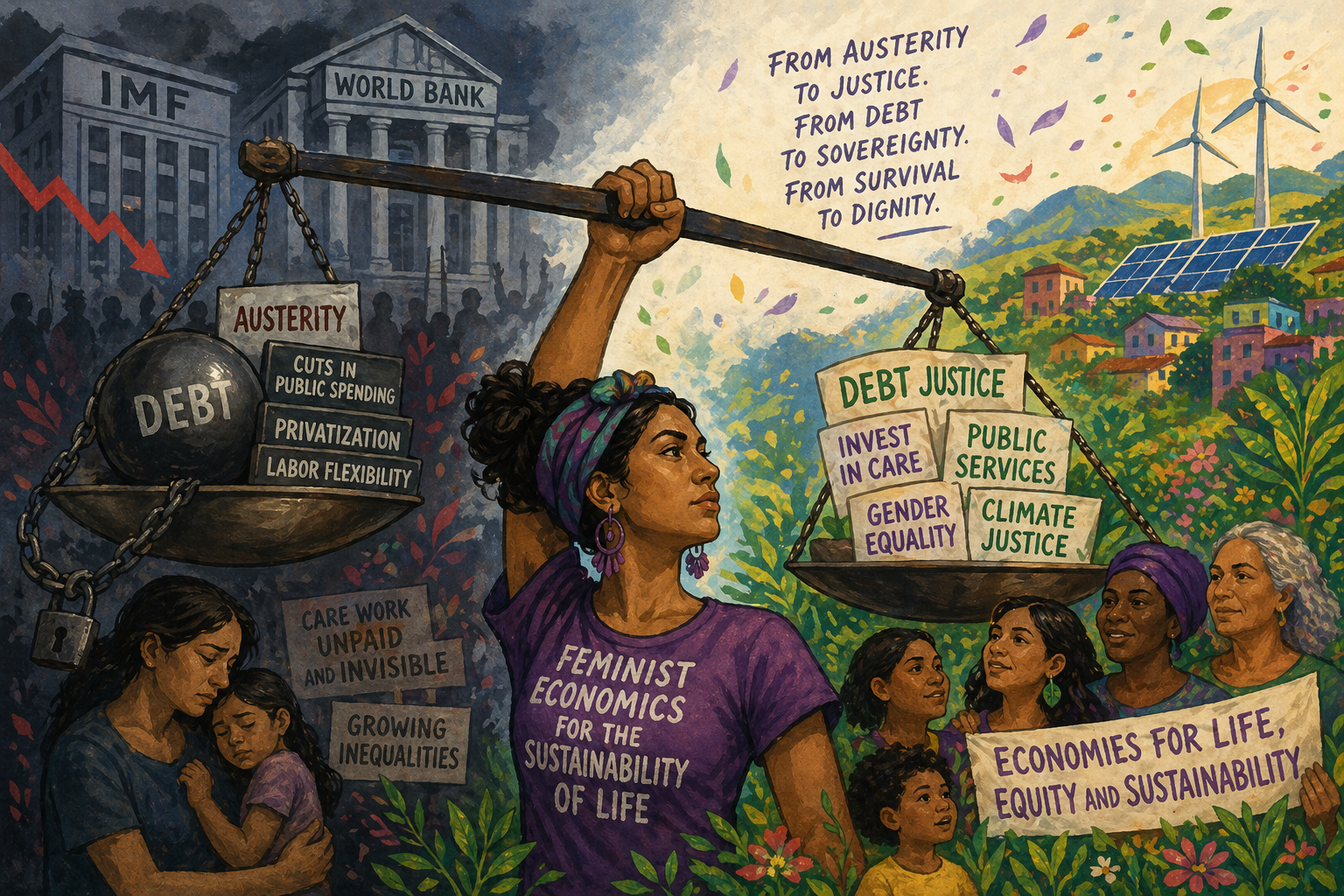
Feminist reflection on 2026 IMF/WB Spring Meetings: Economies Under Strain: Austerity and Debt Gainst the Sustainability of Life
By Daniela Berdeja, - Red Latinoamericana por Justicia Económica y Social - Latindadd

The Spring Meetings of the International Monetary Fund and the World Bank took place against a global backdrop marked by the war in the Middle East and multiple intertwined crises, including: rising debt in the Global South, persistent structural inequalities, inflation, the intensification of the climate emergency, and the widening of social gaps exacerbated by recent economic shocks. At the heart of the global debate lie the inadequate responses from both institutions. From a feminist perspective, it is essential to question not only the proposed solutions, but also the power structures that underpin them.
Despite some progress in the discourse surrounding gender equality and inclusion, a significant disconnection with the policies being promoted remains, rooted in macroeconomic frameworks that prioritise fiscal stability over people’s well-being. The centrality placed on restrictions to fiscal consolidation, inflation control and debt sustainability result in policy advice for cuts in public spending and structural reforms that disproportionately affect women, girls and diverse communities, particularly those in the informal economy, living in poverty, or in historically marginalised territories.
These meetings have not been an exception. In light of the immediate and future repercussions of the war, coupled with mounting global debt, the IMF was unambiguous in its standard advice on fiscal and monetary austerity.
Fiscal consolidation policies often entail cuts in key sectors such as health, education, and social, care and protection systems. These policy decisions are not neutral: they have profoundly gendered effects. When the state reduces its role in the provision of essential services, the burden of care falls even more heavily on households, and particularly on women, who take on these tasks on an unpaid basis or under precarious conditions. As a result, women’s care work becomes a variable of adjustment during periods of crisis when public spending is cut. This limits their economic independence, reduces their participation in the formal labour market and deepens cycles of poverty and inequality.
In a different vein, neither the IMF nor the World Bank acknowledges that the inclusion of women in financial systems or production chains does not, in itself, guarantee decent working conditions or a fair redistribution of resources. On the contrary, in the absence of adequate regulations and redistributive policies, such initiatives may even reinforce patterns of indebtedness and precariousness.
Furthermore, labour reforms promoted in the name of competitiveness and attracting investment tend to make working conditions more flexible, undermining labour rights and increasing informality. Given that women are over-represented in informal and precarious sectors, these reforms further worsen their economic vulnerability.
The promise of economic growth as a means of improving welfare does not automatically translate into better living conditions for women, particularly when the structures of inequality that permeate labour markets and production systems are not addressed. For example, in Latin American countries, there is evidence of an increasing over-representation of women in poverty, even during the years of the surge in growth, such as the commodity boom period.
Another critical issue is the persistence of an international financial architecture that constrains the capacity of Global South countries to implement sovereign, development-oriented economic policies. In this regard, the debt crisis takes on central importance. Many countries are allocating an increasing proportion of their tax revenue to debt servicing, at the expense of investment in social policies and public services.
While debt sustainability is measured in terms of repayment capacity, rather than sustainability from a human and development perspective, fiscal adjustment frameworks continue to dominate fiscal policies. The result is clear: Global South countries are caught between rising debt and persistent austerity.
During the IMF and World Bank meetings there has been an emphasis on strengthening existing instruments: more loans and financing programmes were offered, along with calls to improve ‘resilience’. At the same time, they continue to insist on the Common Framework as the solution to the debt crisis and the three-pillar approach to what they consider to be merely liquidity problems. However, the approach remains limited, not transformative.
Fair and transparent mechanisms for debt restructuring and debt reduction are needed, enabling countries to free up resources to guarantee rights and promote economies centred on the sustainability of life. This long-standing demand can no longer be put on hold.
A feminist agenda also highlights the need to move towards policies that substantively incorporate a human rights and gender equality approach, from an intersectional perspective that recognises the multiple gaps and barriers faced by women in different contexts.
Following yet another Spring Meetings that failed to provide any real or lasting solutions to the multiple crises the world faces, the urgent need to develop feminist economic alternatives that prioritise life, equity and sustainability has been reaffirmed. This means not only resisting policies that exacerbate inequalities, but also proposing and strengthening economic models based on solidarity, care and respect for the planet’s ecological limits.