

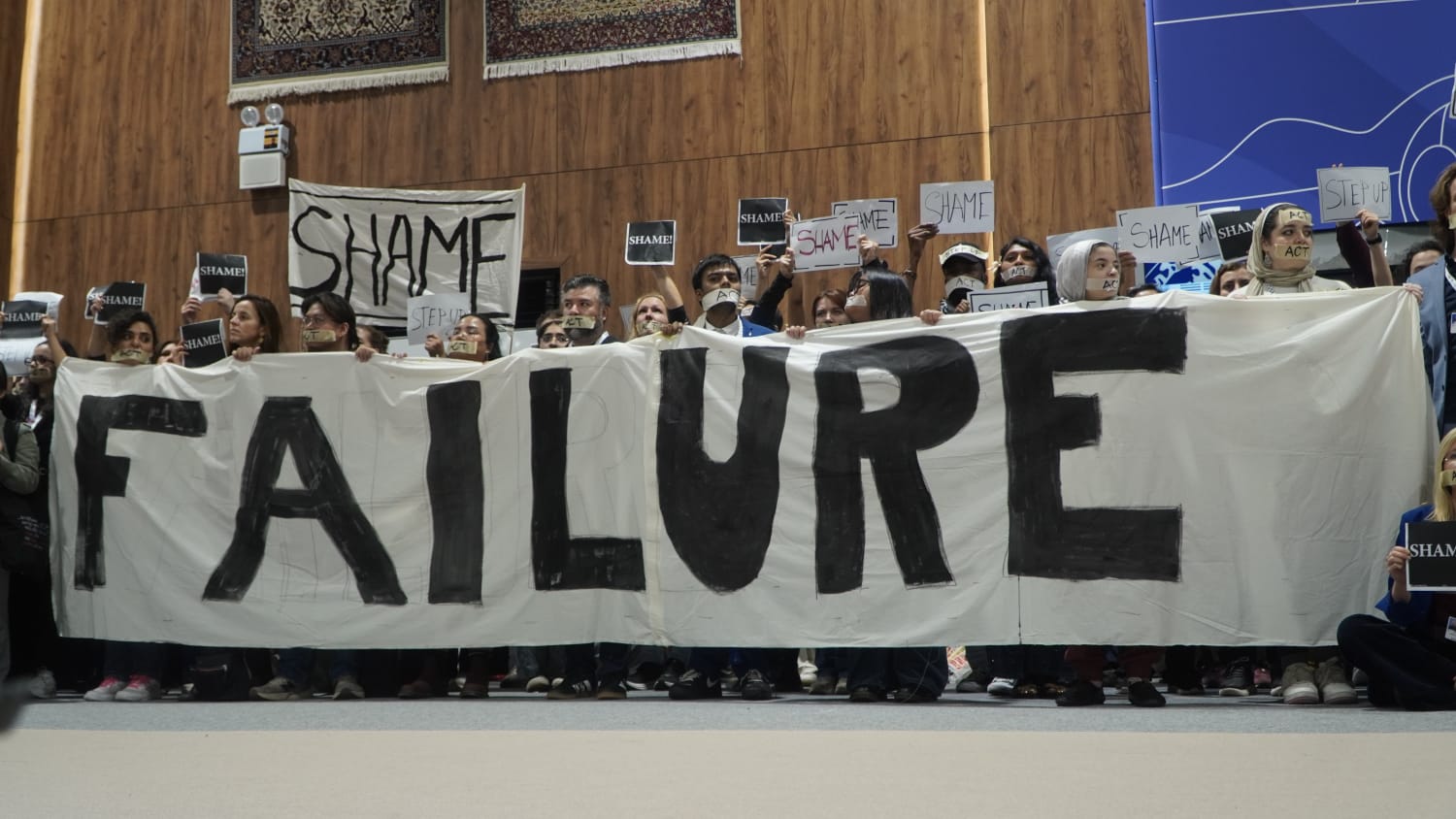
After COP31: Failed Negotiations, Unresolved Climate Injustices
A MENAFem reflection on COP31’s outcomes, Europe’s climate claims, war in SWANA and the limits of multilateralism
At the opening of COP31, we wrote that a just transition cannot be built on unjust finance.1 Antalya confirmed our concerns. Governments debated justice while protecting an economic order that moves wealth, risk and decision-making power away from the communities facing climate breakdown, debt and war.
What does a climate conference deliver if the people facing floods, extreme heat and lost livelihoods leave without the support they need?
COP31, the United Nations climate conference in Antalya, ended without agreement on its main political statement: the proposed Antalya Pact collapsed because Parties could not reach consensus.2,3 The European Union and several climate-vulnerable countries rejected a text that made no mention of fossil fuels.4,5 That was a serious omission. A climate agreement should confront the coal, oil and gas driving the crisis. The refusal mattered: it prevented the summit from presenting weak language as success. But it did not turn Europe into a climate champion. Europe cannot claim leadership on the strength of one negotiating position while its finance, energy, trade and military policies sustain the very crisis it says it wants to solve.
Governments agreed on several separate decisions, but many offered more meetings and future discussions instead of the money and action communities urgently need.2,6 For MENAFem, the question is what these decisions will change in people’s lives. Will women have safer homes, affordable energy and functioning public services? Will countries receive support without taking on more debt? Will communities have a say over projects built on their land?
Across Southwest Asia and North Africa (SWANA), climate change is experienced alongside debt, cuts to public spending, war, occupation and the extraction of resources. When services fail, women often fill the gaps through unpaid care and insecure work. Another year of delay means more of that burden falls on them.
Europe’s climate claim does not survive its own record
The European Union reported EUR 32.3 billion in public climate finance for developing countries in 2025, and a further EUR 9.3 billion in private finance mobilised through public interventions. Only 41 per cent of the public contribution was grant-based. The total includes loans, as well as finance channelled through institutions such as the European Investment Bank.7 These figures cannot tell us how much new fiscal space actually reached communities, how much debt was created in the process, or how much public money was used to shield private investors from risk.
The EU’s closing speech in Antalya cannot erase its position on money either. Climate Action Network, a global network of civil society organisations, accused the EU of blocking efforts to clarify wealthy countries’ funding responsibilities and a baseline for the promise to triple funding for adaptation—helping people prepare for climate impacts.8 Calling on countries to move away from fossil fuels while resisting the support they need to do so is a double standard. Wealthier countries cannot demand change and then leave poorer countries to borrow money to pay for it.
The same Europe that demanded fossil-fuel language in Antalya still subsidised fossil fuels to the tune of EUR 97 billion in 2024. The European Commission found no new phase-out commitments that year, and no concrete end dates among the countries that had already made commitments.9 Europe also imported around EUR 340 billion worth of fossil fuels in 2025; imports supplied 57 per cent of the energy it consumed. Since the 2026 conflict in Iran began, the Commission estimates that the resulting price shock has added EUR 100 billion to Europe’s fossil-fuel import bill without delivering any additional energy.10
Europe’s political priorities become clearer when these figures are set against its defence spending. EU defence expenditure reached EUR 418 billion in 2025 and is projected to reach EUR 454 billion in 2026.11 The ReArm Europe Plan/Readiness 2030 aims to mobilise up to EUR 800 billion for defence.12 These budgets are not directly interchangeable with climate finance, yet they show that governments can create fiscal space when they decide an issue is urgent. Meanwhile, developing countries are told that grants, debt cancellation and loss and damage finance are unaffordable, even as military spending expands at speed.
This does not excuse governments that defended continued fossil fuel use or attacked women’s rights. Different governments blocked different parts of the response. Each must answer for its actions.
War in SWANA is part of the climate economy
War can no longer be treated as external to climate negotiations. It kills people, destroys water and energy systems, contaminates land, increases emissions, and diverts public budgets away from care, reconstruction and climate resilience. It also drives up the cost of food, fuel and borrowing far beyond the battlefield.
UN analysis of the 2026 conflict in the Middle East found that median bond yields across developing countries rose 45 basis points above pre-conflict levels. Urea prices climbed 49 per cent above pre-conflict levels within the first two months. Traffic through the Strait of Hormuz fell by 95 per cent between late February and mid-June.13 These shocks travel through currencies, public budgets and household prices. Women absorb them through unpaid care work, reduced food consumption, insecure employment and the loss of public services.
Gaza makes the material meaning of this failure impossible to ignore. A joint European Union, United Nations and World Bank assessment estimated recovery and reconstruction needs at USD 71.4 billion over ten years, including USD 26.3 billion in the first eighteen months.14 In November, OCHA reported that 90 per cent of Gaza’s energy infrastructure had been destroyed and that 82 per cent of all structures had been destroyed or damaged.15 Reconstruction must not become a new debt market built on destruction. It requires grants, reparative finance, Palestinian leadership and accountability for the harm inflicted.
The multilateral system still manages inequality
COP31 did produce decisions, and we should use every opening they create. But we must not mistake process for delivery. The conference covered many subjects. The main outcomes are grouped below by what they mean for people. An agreement to keep talking is different from an agreement to deliver money or protection.5,6
What did governments actually agree?
A fair transition away from polluting economies: Governments agreed to continue work on “just transition”—making sure climate action protects workers, livelihoods and communities. The decision preserved language on grant-based, highly concessional finance and non-debt instruments, social protection, labour rights, care responsibilities, community finance and the participation of women. It also placed the mechanism under the authority of the CMA, the governing body of the Paris Agreement. Yet governments deferred decisions on its functions, modalities and operational arrangements to 2027, with submissions due by 15 March 2027.16 People are being asked to wait again for the institution meant to support them. The mechanism still has no dedicated funding window and no guarantee that frontline movements will shape its governance.
Money for climate action: Governments agreed on more discussions, workshops and reports over 2027–2028. The work programme on Article 9 now has workshops, submissions and reports, with views due by 28 February 2027.17 The decision does not allocate new funding. Separate decisions kept work going on earlier funding promises and on tracking climate finance. Keeping these conversations open matters, but it does not pay for a school, a water system or protection from flooding.6,17
Making banks and investment support climate goals: Another decision continued discussions about directing financial activity towards climate-friendly development.6 The decision on Article 2.1(c) records concerns about safeguards and unequal participation in discussions on finance flows.18 This must not become an excuse for wealthy governments to replace their own funding obligations with promises that private investors will step in. Neither this decision nor the finance work programme creates new public finance or binds developed countries to provide grants at the scale required.
Preparing for heat, floods and drought: Governments agreed on further work to measure how countries are adapting.19 But the proposed target of at least USD 120 billion a year for adaptation was not secured. Much of the work on national adaptation plans remained unfinished.5 Better information is useful; communities also need resources to protect themselves.
Support for the poorest countries: Governments agreed to create a platform to help least developed countries turn adaptation plans into projects and find support.5,6 Its value will depend on whether those projects receive funding and reach people.
The Adaptation Fund: Governments agreed on changes allowing this fund to move towards serving only the Paris Agreement, the global climate treaty. Developing countries will retain a majority on its board. The decision also advances arrangements for receiving income from carbon trading. That income must supplement reliable public funding, rather than replace it. The World Bank’s role in managing the Fund’s money is different from the board’s role in deciding how the Fund operates.20
Loss and damage: This means harm that people cannot avoid simply by adapting, such as homes destroyed or livelihoods lost. The Fund for Responding to Loss and Damage exposes the gap between recognition and resources. Governments adopted guidance for the Fund. It received 176 funding requests from 119 developing countries, worth USD 2.8 billion, against USD 342 million allocated to the Fund’s Barbados Implementation Modalities. As of 31 July 2026, the Fund had received only USD 485.77 million of the USD 822.71 million pledged. The guidance also calls for promised contributions to be paid.21 Separate decisions continued work on research and technical assistance.2,6 A fund hosted by the World Bank must not become yet another layer of control, delay and financial intermediation. Communities need direct access, grants and decision-making power.
Other climate funds: Guidance for the Green Climate Fund was adopted, while proposed guidance for the Global Environment Facility was not.3,6 The Green Climate Fund guidance gives movements useful language. It affirms the central role of grants and highly concessional finance, and asks the Fund to take fiscal constraints and debt vulnerabilities into account when selecting financial instruments.22 This recognition matters for African states and for indebted countries across SWANA, but it will matter only if it changes project design, allocation and access. Giving instructions to a fund is different from contributing money or approving support for communities.
Women’s rights and gender equality: Talks produced limited conclusions instead of a stronger push to put existing commitments into practice. The Gender Action Plan agreed in Belém remains in place. Women should not have to defend already agreed rights at every conference while funding for action remains inadequate.23
Climate education and public participation: Governments failed to adopt the new plan for helping people understand climate change, access information and participate in decisions. This work is called Action for Climate Empowerment, or ACE. After Russia objected, it was postponed to the June 2027 talks in Bonn.5
Cutting emissions: A proposed continuation of the programme dedicated to reducing climate pollution was not adopted after the Like-Minded Developing Countries, the Arab Group and Russia objected.3 Talks on the economic effects of climate policies also failed to reach agreement, following objections from the EU, supported by the UK and Canada.3,5 These disputes return to further negotiations.
Carbon trading: Governments adopted decisions on arrangements that allow countries to cooperate on emissions cuts, including through trading carbon credits. A credit is meant to represent a reduction or removal of climate pollution. MENAFem’s concern remains whether such systems deliver real reductions, protect land and community rights, and prevent continued pollution being disguised as climate action.6
Food, farming and technology: Agriculture talks brought no substantive breakthrough.5 Decisions on technology cooperation were adopted, including continued hosting of the Climate Technology Centre by the UN Environment Programme.2,6 But institutions need funding, and communities need access to technologies they can use, maintain and help shape.
Checking progress and supporting countries: Governments continued work on reporting, training and reviewing collective progress. The next major global assessment of climate action ends in 2028. Questions about stronger guidance for countries’ climate plans, trade impacts and how decisions are made remain contested.2,3,5,6
What does “Rule 16” mean?
Some unfinished discussions were carried forward under Rule 16. This rule keeps an unresolved issue on the agenda for a future meeting. It does not approve the proposed solution.
Final reporting explicitly identifies its use for three subjects: the programme on cutting emissions, further guidance for countries’ climate plans, and how decisions are made in the UN climate process.3
Other issues were also postponed, but through different arrangements. For example, ACE returns to Bonn, while governments adopted decisions specifically requiring more work on just transition and climate finance. The rejected Antalya Pact did not become an agreed package for Ethiopia.
The distinction matters, but the consequence for communities is easy to understand: keeping an issue on a meeting agenda does not protect anyone from the next disaster. Governments can postpone a decision. People cannot postpone a flood or a failed harvest.
Two presidencies, shared responsibility
Türkiye’s COP president, Murat Kurum, and Australia’s president of negotiations, Chris Bowen, share responsibility for how the conference was run. Having two leaders should have meant more attention to the different negotiations. Instead, their push for a headline agreement took attention away from the work governments had come to complete.
The Women and Gender Constituency—the alliance representing feminist organisations in the UN climate process, known as WGC—criticised that approach. It also highlighted how extending the conference by two days excluded people who could not afford additional accommodation and travel.23
That is an organisational failure with political consequences. A seat at the table means little if only those with enough money can stay until decisions are made.
The closing session also exposed disrespect. Reporting described Kurum telling UN climate chief Simon Stiell to sit down, while Ghana’s representative publicly challenged his treatment of her and his failure to let her finish speaking.24,25 People leading international negotiations must listen, including when delegates criticise them.
Neither presidency can point to the decisions that survived and avoid answering for what went wrong. Communities needed leadership capable of delivering support, and a process that treated their representatives with respect.
This pattern reflects a colonial distribution of power. States meet under formal rules of equality, while creditor power, voting shares, conditionality, access to hard currency and control over investment standards determine whose policy space expands. The IMF, the World Bank and other multilateral development banks can present loans, guarantees and private capital mobilisation as climate solutions, while indebted countries carry the currency risk, the repayment risk and the political cost of austerity.
MDB climate finance can reproduce extraction
This contradiction played out in Egypt during COP31 itself. On 18 November, the EBRD approved a loan of up to USD 100 million for the Indorama fertiliser complex in Ain Sokhna, and plans to mobilise up to USD 74 million more from commercial lenders.26 The IFC had already approved a separate debt package of up to USD 174 million.27 The EBRD classifies around 64 per cent of the investment as green finance because the plant is expected to operate below industry emissions benchmarks.26
Fifteen civil society organisations called on both banks to suspend the financing. They argued that the consultation process excluded future workers and women, and raised concerns about worker accommodation, the environmental assessment, the risk of retaliation, and complaints involving another Indorama subsidiary.28 This is precisely the test that green labels avoid: Who owns the asset? Who receives the public support? Who carries the pollution and labour risks? Who can object without fear of retaliation?
The same test applies to the energy agenda promoted in Antalya. The Turkish and Australian presidencies also promoted greater use of electricity, with EU support.2,29 Their voluntary initiative continued outside the rejected pact.2 But using more electricity does not automatically mean using clean energy or making it affordable. We must ask who produces it, who owns it, whose land and water are used, and who benefits.
Movements demanded more than another weak agreement
The response came from a broad movement. WGC called for rejection of the Antalya Pact over inadequate finance, false solutions and weak accountability. Its reasons went beyond the EU’s objection about fossil fuel language. It also made clear that the failure to agree was not itself a victory: people were still leaving without what they needed.23,30
Feminist organisations, trade unions, Indigenous Peoples, young people and frontline communities organised across their different alliances. This is what “cross-constituency” action means: groups bringing their struggles together to make shared demands.
Their organising for a strong just transition mechanism linked workers’ rights, women’s rights, Indigenous Peoples’ rights and practical support. It included a joint BAM action listed for 18 November. BAM was the name campaigners used for the proposed mechanism.31,32
The demand was straightforward: people affected by the transition must help decide how it happens. They need resources and protection, not simply invitations to speak.
A WGC-led joint letter also challenged the crackdown on LGBTI+ civil society in Türkiye and demanded safe participation.33 Governments cannot promise inclusion inside a conference while ignoring restrictions on people’s freedom to organise outside it.
These alliances are a source of power. We must build on them before the next COP, so movements can push for change together instead of repeatedly defending promises already made.
What we carry forward
Our opening COP31 article posed three questions: Implementation for whom? Financed by whom? On whose terms?1 Antalya did not answer them. It made them harder to avoid.
What should we expect from Ethiopia?
COP32 is scheduled for Addis Ababa, Ethiopia, from 8–19 November 2027.34 It will inherit unfinished work from Antalya. Hosting the conference in Africa creates an opportunity to put frontline priorities at the centre, but the location alone cannot guarantee a fair outcome.
For MENAFem, five things must change.
First, the just transition mechanism must become a useful institution, with resources and a meaningful role for women, workers and communities in its decisions.
Second, wealthy countries must explain how much adaptation funding they will provide, when it will arrive and how it will reach people. Money that must be repaid cannot be treated as equivalent to a grant. Climate support must not deepen debt or come with cuts to public services.
Third, loss and damage support must reach survivors quickly. Women-led groups and affected communities must help shape access to it.
Fourth, governments must resolve the delayed work on education, emissions and other issues while protecting gender equality and human rights. Existing rights must be implemented, not reopened for bargaining.
Finally, Ethiopia must organise a conference people can safely attend and afford: timely information, predictable schedules, interpretation and respectful leadership. The work must begin at the June Bonn meetings, rather than be left to another exhausting final night.
Our demands
Beyond COP32, MENAFem and allied movements should now press for the following demands in the 2027 work programmes and in national advocacy:
- Grant-based public climate finance that is new, predictable and additional to development aid.
- Debt cancellation, and automatic suspension of debt service after climate disasters and during restructuring negotiations.
- A funded just transition mechanism with direct access for women-led groups, workers, communities and public institutions.
- A fossil-fuel phase-out with binding dates, public finance and differentiated responsibilities, including an end to public support for fossil-fuel expansion.
- Reconstruction finance for Palestine and other war-affected communities that does not create debt and that respects the right to self-determination.
- Public ownership, local value creation and enforceable rights in energy, minerals, agriculture and industrial policy.
- Tax justice, action on illicit financial flows, and limits on guarantees that convert private investment risk into public debt.
- Demilitarisation as a climate and development demand, with transparent reporting of military emissions and of the fiscal costs of war.
We still need multilateral cooperation. But the current system cannot claim legitimacy while it protects creditor rights, fossil-fuel interests and military budgets more strongly than human rights and ecological survival. A different multilateralism must redistribute both resources and decision-making power. It must allow communities in SWANA to shape their own transitions, rather than receive plans designed by creditors and investors.
Our region cannot be treated as a storehouse of land, minerals and energy for someone else’s transition. Climate justice requires affordable energy, decent work, public services and communities with the power to decide their futures. It also requires confronting war, occupation and the destruction they bring.
Women and communities cannot keep paying for governments’ failure through their labour, livelihoods and lives.
Our position after Antalya remains clear. Climate action must expand public resources, reduce debt and strengthen care. Europe cannot call itself a climate champion while it refuses to finance justice at scale, delays the fossil-fuel phase-out at home, and treats war as separate from climate policy.
References
1.MENAFem Movement, COP31: A Just Transition Cannot Be Built on Unjust Finance, 9 November 2026.
https://menafemmovement.org/cop31-a-just-transition-cannot-be-built-on-unjust-finance/
2.UNFCCC, “COP31 Delivers Progress that Advances Implementation of the Paris Agreement, but Stalls on Range of Key Issues,” 23 November 2026, https://unfccc.int/news/cop31-delivers-progress-that-advances-implementation-of-the-paris-agreement-but-stalls-on-range-of
3.Third World Network, “‘Antalya Pact’ at COP 31 Collapses as EU Brinkmanship Derails Decision,” TWN Antalya Climate News Update No. 14, 24 November 2026, https://www.twn.my/title2/climate/info.service/2026/cc261114.htm
4.Associated Press, “Leaders Explain Why COP31 Negotiations Ended without a Pact,” 23 November 2026.
5.Carbon Brief, “COP31: Key Outcomes Agreed at the UN Climate Talks in Antalya,” November 2026, https://www.carbonbrief.org/cop31-key-outcomes-agreed-at-the-un-climate-talks-in-antalya
6.UNFCCC, Outcomes of the Antalya Climate Change Conference: Advance Unedited Versions (AUVs) of the Decisions, November 2026, https://unfccc.int/cop31/auvs
7.Council of the European Union, Council Conclusions on Climate Finance: Addendum (Replacement of Paragraph 13), ST 15100/26, 29 October 2026, https://data.consilium.europa.eu/doc/document/ST-15100-2026-INIT/en/pdf
8.Climate Action Network, “COP31: A Shameful Failure as Rich Countries Turn Their Backs on a World in Crisis,” 22 November 2026, https://climatenetwork.org/2026/11/22/cop31-a-shameful-failure/
9.European Commission, Report on Energy Subsidies in the EU, COM(2026) 472 final, 17 September 2026, https://energy.ec.europa.eu/news/energy-subsidies-report-highlights-further-reduction-2024-2026-09-17_en
10.European Commission, AccelerateEU: Affordable and Secure Energy through Accelerated Action, April 2026 (Council doc. ST 8482/26), https://data.consilium.europa.eu/doc/document/ST-8482-2026-INIT/en/pdf; European Commission, EU Climate Action Progress Report 2026, COM(2026) 601 final, 9 November 2026, https://data.consilium.europa.eu/doc/document/ST-15659-2026-INIT/en/pdf
11.European Defence Agency, “EU Defence Spending: €418 Billion in 2025, Projected to €454 Billion in 2026,” 16 July 2026, https://eda.europa.eu/news-and-events/news/2026/07/16/eu-defence-spending—418-billion-in-2025–projected-to–454-billion-in-2026
12.European Commission, ReArm Europe Plan/Readiness 2030, 2025.
13.UN DESA, Impact of the Conflict in the Middle East on Development Financing, Policy Brief No. 193, August 2026, https://desapublications.un.org/file/22605/download
14.European Union, United Nations and World Bank, Gaza Strip Rapid Damage and Needs Assessment (Final), 20 April 2026, https://www.un.org/unispal/document/report-gaza-strip-rapid-damage-20apr26/
15.OCHA, Reported Impact Snapshot: Gaza Strip, 18 November 2026, https://www.ochaopt.org/sites/default/files/Gaza_Reported_Impact_Snapshot_18_November_2026.pdf
16.UNFCCC, United Arab Emirates Just Transition Work Programme, draft decision -/CMA.8 proposed by the President, FCCC/PA/CMA/2026/L.24, advance version, 22 November 2026 (adopted; see AUV list), https://docs.unfccc.int/documents/10000418/files/en/UAE%20JTWP_DT_SB653.pdf
17.UNFCCC, Work Programme on Climate Finance, Including on Article 9, Paragraph 1, of the Paris Agreement, draft decision -/CMA.8 proposed by the President, FCCC/PA/CMA/2026/L.17, advance version, 22 November 2026 (adopted; see AUV list), https://docs.unfccc.int/documents/10000415/files/en/CFWP_DT_cma83.pdf
18.UNFCCC, Matters Relating to the Implementation of Article 2, Paragraph 1(c), of the Paris Agreement, decision -/CMA.8, November 2026 (adopted; see AUV list).
19.UNFCCC, Global Goal on Adaptation, draft decision -/CMA.8 proposed by the President, FCCC/PA/CMA/2026/L.18, advance version, 22 November 2026 (adopted; see AUV list), https://docs.unfccc.int/documents/10000409/files/en/GGA_DT_SB653.pdf
20.UNFCCC, Matters Relating to the Adaptation Fund, draft decision -/CMA.8 proposed by the President, FCCC/PA/CMA/2026/L.16, advance version, 21 November 2026 (adopted; see AUV list), https://docs.unfccc.int/documents/10000403/files/en/DT_COP31_AF%20matters_CMA.pdf
21.UNFCCC, Report of the Fund for Responding to Loss and Damage and Guidance to the Fund, draft decisions -/CP.31 and -/CMA.8 (CMA text: FCCC/PA/CMA/2026/L.22, advance version, 22 November 2026; both adopted, see AUV list), https://docs.unfccc.int/documents/10000408/files/en/FRLD_DT_CMA8.pdf
22.UNFCCC, Guidance to the Green Climate Fund, decision -/CMA.8, November 2026 (adopted; see AUV list).
23.Women and Gender Constituency, “WGC COP31 Outcome Statement: The Failure to Deliver Is a Political Choice,” 22 November 2026, https://womengenderclimate.org/resources/wgc-cop31-outcome-statement-the-failure-to-deliver-is-a-political-choice/
24.The Australian, closing-plenary reporting, https://www.theaustralian.com.au/nation/politics/doomed-to-fail-inside-chris-bowens-disastrous-cop31-summit-collapse-in-turkey/news-story/84d1f7ae1ccba23421497c064c96a92e
25.bne IntelliNews, “COP31 Notebook: Summit Descends into Uproar, Turkish Chair Tangles with UN Climate Chief, Ghanaian Counterpart,” November 2026, https://www.intellinews.com/cop31-notebook-summit-descends-into-uproar-turkish-chair-tangles-with-un-climate-chief-ghanaian-counterpart-487613
26.EBRD, Indorama – Ain Sokhna Fertiliser, Project No. 55287, Project Summary Document, disclosed 24 June 2026 (as recorded by the Early Warning System), https://ewsdata.rightsindevelopment.org/projects/EBRD-55287/
27.IFC, IRC Egypt, Project No. 49554, Summary of Investment Information, https://disclosures.ifc.org/project-detail/SII/49554/irc-egypt
28.Egyptian Human Rights Forum and 14 allied organisations, “Request to Suspend Financing for the Indorama Project,” 17 November 2026.
29.eeNews Europe, “EU Backs Global Electrification Pledge at COP31,” November 2026, https://www.eenewseurope.com/en/eu-backs-global-electrification-pledge-at-cop31/
30.Women and Gender Constituency, “WGC Calls to Reject ‘Antalya Pact’ Cover Decision: We Will Not Give Cover to Climate Injustice,” 22 November 2026, https://womengenderclimate.org/resources/wgc-calls-to-reject-cover-decision-we-will-not-give-cover-to-climate-injustice/
31.GI-ESCR, “COP31: GI-ESCR Calls for a Mechanism Capable of Scaling Just Transitions on the Ground,” 5 November 2026, https://giescr.org/en/our-work/on-the-ground/cop31-gi-escr-calls-for-a-mechanism-capable-of-scaling-just-transitions-on-the-ground
32.Alianza por el Clima, “COP31: 18 de noviembre de 2026” (daily listing of actions), https://alianzaporelclima.org/2026/11/18/cop31-18-de-noviembre-de-2026/
33.Women and Gender Constituency et al., “Open Letter of Five Observer Constituencies on the Coordinated Crackdown of LGBTI+ Civil Society Just Ahead of the Opening of COP31 in Türkiye,” 6 November 2026, https://womengenderclimate.org/resources/open-letter-of-five-observer-constituencies-on-the-coordinated-crackdown-of-lgbti-civil-society-just-ahead-of-the-opening-of-cop31-in-turkiye/
34.UNFCCC, Dates and Venues of Future Sessions, decision -/CP.31, advance unedited version, November 2026, https://unfccc.int/sites/default/files/resource/COP31_2g_dates_venues_auv..pdf