

Nouran ElMarsafy
“If we don’t get it, shut it down!” For years of my climate activism, we chanted this sentence whenever we protested against any financial institution or system. On October 12th 2026, as the World Bank Group and IMF Annual Meetings began in Bangkok, people lined up to enter a highly securitized and painfully formal space. They flew from everywhere for a few “generously” – I am being skeptical here – offered spaces of interaction: public sessions, the Civil Society Policy Forum (CSPF), perhaps a bilateral meeting with someone who could discuss their debts, the conditions attached to them, or the money we are told we cannot survive without.
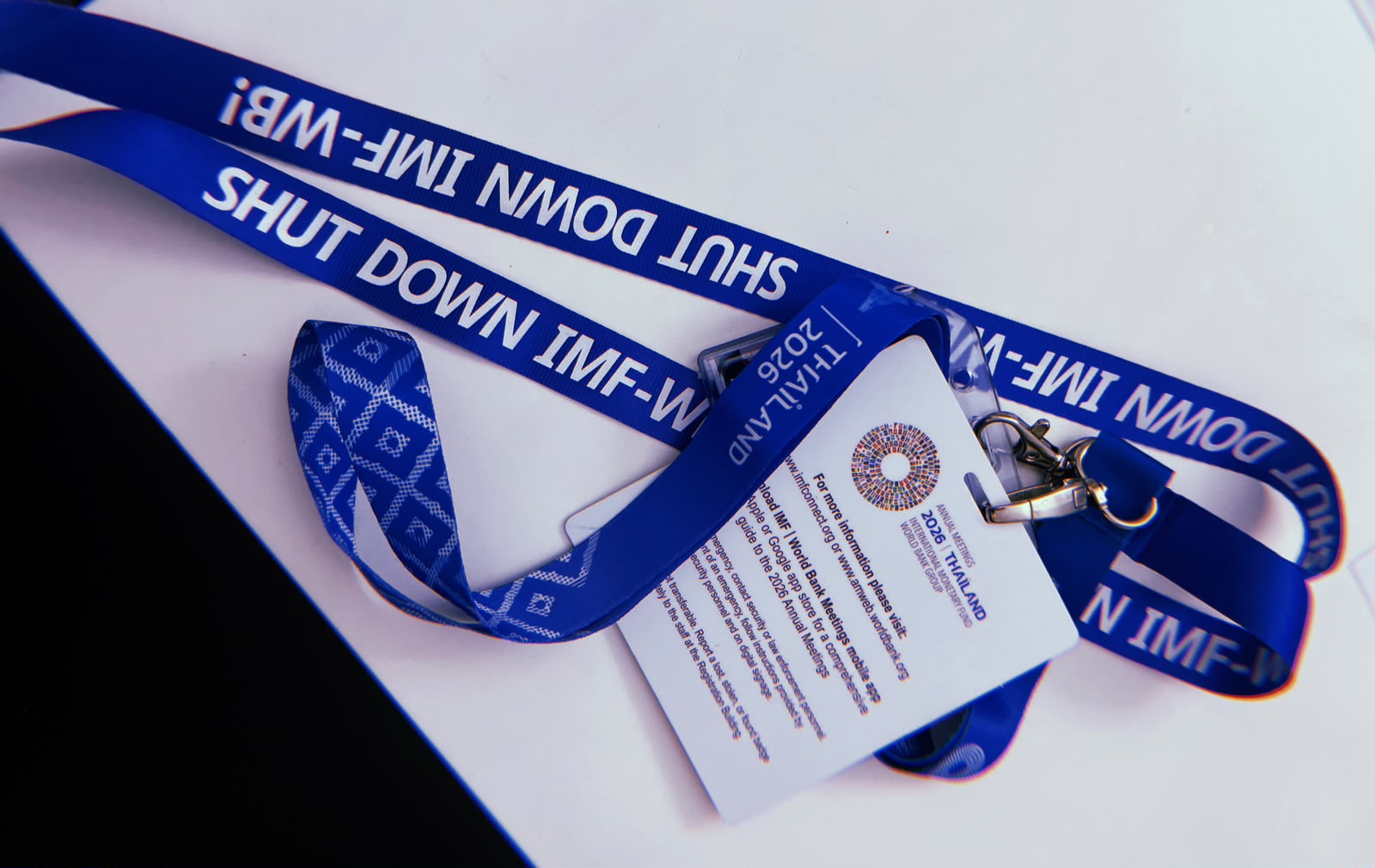
Luckily for me, I was not in that line. I watched people queuing from the car window on my way to an alternative feminist space, where activists from around the world were meeting to discuss the same institutions, yet from a more radical perspective. I signed my name, and a beautiful Thai lady handed me a lanyard that carried a familiar sentence: “SHUT IT DOWN.” I smiled, and then felt profoundly uncomfortable. It took me a day to understand why. This was a place I belong to, and a demand I dream of. Then I realized the root of this discomfort:
What does that demand mean if my own existence, my profession, and even my ability to be in Bangkok traveling, demanding, protesting are dependent on the system I am resisting? In this reflection I will be using an autoethnography to try to explore the aspects of this discomfort.
Contextualizing the room
I am a middle-class Egyptian woman who is bilingual. I do research, write donor reports, manage capacity-building and advocacy projects, and move between communities and multilateral spaces. I can enter rooms that many of the people I work with on a daily basis cannot. International development pays for the work I do, gives me professional networks, and makes my political voice audible in politicized spaces like this one: multilateral meetings, COPs, UN gatherings.
I looked around at the feminists in the room and they felt familiar. I recognized similar speeches, questions and frustrated looks. There were community mobilizers, programme managers, activists, advocates, researchers, workers, trade unionists and local community leaders. We carried a shared burden, but not identical risks or possibilities. The places we return to, our security, influence and capacity to mobilize are different. How many of us were there through organizations sustained by foreign grants, and how many through members’ contributions? I heard from the attendees that the Counter-Docket[1] event had around 1,000 attendees. I was impressed by the scale of mobilization across the Asia-Pacific region[2] and the strength of its regional networks. It brought me back to my discomfort. I want to shut it down, but I cannot ignore what may vanish alongside the grants: the ability to organize, support for frontline women carrying unpaid work, and the means to gather in rooms like this. I was in Bangkok thanks to a development fund. I suspect many others were, too.
Development of what, and for whom?
This highly entangled dependence was neither naturally born nor recently established. It goes back to the period after the Second World War. Development became a global promise: according to Rostow, supposedly “traditional”[i] societies were expected to advance towards industrialization, economic growth and mass consumption. He gave this promise five stages.[3] In 1986, in a public lecture, Michael Parenti offered a far angrier counter-narrative: “These countries are not underdeveloped, they’re overexploited!”[ii] His words challenged the unequal economic relationships concealed by the language of underdevelopment. Today, our movements continue to challenge the assumption that development must follow a universal trajectory measured by economic growth, excluding other understandings of prosperity and collective well-being.
I want to explore how development became an economic sector in its own right, creating institutions, professions and employment opportunities, and how people like myself became part of it. Borrowing from the concept of cheapening, I argue that our intellectual and productive capabilities have been reorganized within these changing economic relationships. I take Egypt as a case through which to reflect on the expansion of technical education during the Nasser era, the 1991 structural adjustment programme and the changing labour market. I am aware that these transformations are neither linear nor directly causal. Privatization, population growth, political regimes and many other factors have shaped them. What interests me is the relationship between development, education, employment, knowledge production and debt.
Egypt pursued industrialization through the expansion of public institutions and technical education during the Nasser era. Public universities trained engineers, doctors, agricultural specialists and scientists to contribute to domestic production and national development.[iii] But the economic conditions under which these capabilities could be exercised changed over the following decades.
Egypt’s 1991 structural adjustment programme offers a revealing example. Alongside IMF-supported stabilization and World Bank-supported restructuring, an internationally financed Social Fund was established to cushion the social impacts of the reforms.[iv] So we were financing economic restructuring and financing the mitigation of its consequences within the same architecture. And this is where my own positionality becomes difficult to separate from this history.
Somewhere along the way, a development profession expanded around projects, consultants, researchers, training, reporting and advocacy: a whole skill set different from my architecture background. Qualifications in development followed an already existing profession and job market, rather than the other way around.[4] I look at myself and fellow practitioners trained in technical disciplines. Some of us opted for development work because we found better-paying jobs and, most importantly, a socio-political cause in development organizations, rather than being sucked into a nine-to-five private company building a reality we find disgusting.
From this position, I argue that our capabilities as nations have been systematically altered. The concept of “cheapening” reflects on the changing value and use of our intellectual and productive capabilities.[v] For me, education should contribute to a society’s ability to produce knowledge, technologies and livelihoods that improve the lives of its people, rather than merely supply labour to an existing market. Yet decades of development assistance have not eliminated poverty or the unequal distribution of its costs. Egypt invested in educating people to participate in industrial and technological advancement. But financing for research and technology remained unequal, while access to intellectual property, licensing and technology transfer continued to be constrained.[5] In the climate negotiations I have followed, I have watched Global North countries resist, delay or water down commitments connected to technology transfer and historical responsibility.
Productive capabilities can be redirected even when the education behind them remains. We were trained to participate in producing development; some of us now earn our living managing it. And our projects generate their own economy of reports, assessments and indicators
Even the knowledge economy in which some of us now work may not remain secure. AI threatens to reorganize the development professions that emerged over decades, potentially reducing the value of some of the intellectual labour on which we built our livelihoods. And this transformation comes with its own material costs. Behind the promise of artificial intelligence are enormous data centres, growing demands for energy and water, mineral extraction and electronic waste.[vi] We may find ourselves facing another restructuring of our capabilities, while the technologies reshaping our work place further pressure on the ecological resources we are supposedly working to protect.
Whose data counts?
To return to how data is connected to debt and development, I turn to the Xingu Finance Talks, a workshop before the official high-level event on the 13th inside the main venue, where limited civil-society seats were offered and I could not attend. At the workshop, discussions of transparency and the cost of capital repeatedly returned to investors’ language and needs: risk profiles, recovery data, guarantees and information that could restore their confidence. Investor confidence seemed to define the problem before the relevance of projects to communities, bottom-up evidence or national capacities. Whose development was being financed became a central concern at the table. Community knowledge, gender-sensitive evidence and unpaid care felt like data expected to fit an already established frame.
James Ferguson described how development can turn political struggles into technical problems.[vii] I am concerned not only with the extraction of information, but also with producing particular understandings of societies that make certain interventions appear necessary. We collect evidence, write assessments, translate people’s lives into indicators and produce reports that justify the next project.[viii] Even in feminist work, demands for power and redistribution can become measurable gender outputs. I know this work because I do it, and I have been suffering from producing it.
This brings me back to the AI discussions like who produces and interprets knowledge that were a big part of the Annual Meetings. The World Bank held a session titled “Small AI: More and Better Jobs” on 12 October.[ix] Kristalina Georgieva warned that roughly 40% of jobs worldwide could be affected by AI and raised a fiscal problem: if income shifts from labour towards capital, what will governments tax? The World Bank is also backing data and computing infrastructure for AI, while official development assistance is projected to contract.[x] This does not mean AI is causing aid cuts, or that the Bank’s AI investments are replacing development workers, but it does suggest that we might be facing a new cycle of cheapening
After Xingu, this sounded less like a separate discussion about employment than another struggle over who gets to produce knowledge and determine its value. For years, people like me have been paid to collect, interpret and report the knowledge that makes development projects possible. Now the World Bank is investing in infrastructure capable of processing some of that knowledge at scale. I refuse to treat the overlap as politically innocent or incidental. In the language of Couldry and Mejias, data itself becomes a site of extraction.[xi] The threat is not simply job loss. It is that the institutions controlling data, computational infrastructure and funding may also shape how our labour is valued and how societies are understood.
Who pays to shut it down?
Let us return to the room. We can chant all we want, but the cost of that disappearance will not be shared equally. Following the January 2025 US foreign-assistance freeze, an official audit recorded 44 terminated USAID awards in Egypt and about $2 million in assets that could not be used as intended after associated training was cancelled.[xii] Separately, UNHCR warned that funding cuts threatened cash assistance for at least 20,000 refugee families in Egypt, most of them female-headed households. Families were already choosing between food, medicine and keeping children in school.[xiii] When that support disappears, the work of keeping families alive, often women’s work, does not. Cutting assistance does not cancel debt. cutting assistance does not suddenly put medicines in clinics or pay the people delivering services.
In one of the Civil Society Policy Forum sessions I attended, an IMF representative discussed taxing car ownership as a way of relinquishing privilege. From Cairo, this sounded detached from the lived urban reality of the city, where housing and jobs are separated by punishingly long journeys and accessible public transport is not assured. For many middle- and lower-middle-income households, a car can be an asset and a survival strategy at the same time. Egypt’s latest IMF programme continued to call for tax-base broadening, state divestment and fuel-price reforms.[xiv] Meanwhile, debt servicing consumed about 71.2% of government revenues over July 2025–May 2026.[xv] Household budgets absorb what institutions describe as adjustment; lost services leave families to cover needs that do not disappear.
A programme manager, a community organizer, a farmer and a mother losing health assistance cannot absorb the same shock. Nor do we all carry the same responsibility in front of the system. In some ways, a shutdown is already arriving without us: through donor cuts and technological changes decided elsewhere, on terms we did not choose. The demand cannot simply mean that funding disappears tomorrow while debt obligations, intellectual-property arrangements and the distribution of economic power remain intact.
Trying another reality
I still want, demand and dream to shut it down. I want to try another reality even knowing that movement-building involves loss: friends, comrades, jobs and battles. But the poor cannot once again be volunteered as the first casualties of someone else’s transformation. Debt audits, public care and community-controlled resources must form an alternative economic infrastructure, not charity after damage is done.
I do not have a blueprint, and I will not pretend my own livelihood is unaffected. What angers me is how practiced we have become at negotiating the terms of dependence: how to access the funding, improve the indicators, lower the risk and secure another seat in the room. I want us to organize our livelihoods, knowledge and struggles so that shutting this system down becomes materially imaginable, rather than a slogan we can afford to chant only because the system is still paying for the microphone.
In global activism and social justice, the “Counter-Docket” is a major collective initiative led by organizations such as APWLD, JASS, ESCR-Net and other organizations. The event tracks, records, and treats the lived experiences and testimonies of local communities as “evidence” against systemic harms caused by large-scale extraction or international financial policies (like those of the IMF and World Bank)
[2] Coming from the Middle East, it is very hard to coordinate regionally at this scale due to political and regime differences.
[3] In 1960 Rostow outlines five distinct stages of development: (1) Traditional Society, characterized by subsistence agriculture and limited productivity; (2) Preconditions for Take-off, marked by infrastructure investment and agricultural improvements; (3) Take-off, a brief period of rapid industrial growth and rising investment rates; (4) Drive to Maturity, where modern technology spreads across diverse economic sectors; and (5) Age of High Mass Consumption, defined by high living standards and the mass production of consumer durables.
This is my observation of the professional world I work in, not a claim that all development professions or postgraduate programmes emerged at one moment, or that structural adjustment alone created them.
The WTO TRIPS Agreement sets rules for intellectual-property protection and contains provisions concerning technology transfer; the WTO does not grant patents. Access also depends on licensing, funding, infrastructure and domestic innovation capacity. My account of negotiations is based on meetings I followed. https://www.wto.org/english/tratop_e/trips_e/techtransfer_e.htm
Walt W. Rostow, The Stages of Economic Growth: A Non-Communist Manifesto (Cambridge: Cambridge University Press, 1960).
Michael Parenti, “US Interventionism, the Third World, and the USSR,” lecture, University of Colorado Boulder, 15 April 1986, video recording: https://www.youtube.com/watch?v=odWerz1Az6k . Exact time stamp not confirmed.
Alan Richards, Higher Education in Egypt, World Bank Policy Research Working Paper No. 862 (1992), pp. 6–7: https://documents1.worldbank.org/curated/en/163341468770080097/pdf/multi-page.pdf ; Adel Abdel Ghafar, Educated but Unemployed: The Challenge Facing Egypt’s Youth (Brookings Doha Center, 2016), pp. 2–4: https://www.brookings.edu/wp-content/uploads/2016/07/en_youth_in_egypt-2.pdf .
World Bank, Implementation Completion Report: Arab Republic of Egypt, Social Fund Project (Credit No. 2276-EGT), Report No. 17248 (19 December 1997), pp. 1–2: https://documents1.worldbank.org/curated/en/590241468233334496/pdf/multi-page.pdf .
Raj Patel and Jason W. Moore, A History of the World in Seven Cheap Things: A Guide to Capitalism, Nature, and the Future of the Planet (Oakland: University of California Press, 2017), esp. p. 16. The extension of their concept to technical and intellectual capabilities is the author’s interpretation.
[vi] United Nations Environment Programme (2024), Artificial Intelligence (AI) End-to-End: The Environmental Impact of the Full AI Lifecycle Needs to Be Comprehensively Assessed. Nairobi: UNEP. Original UNEP report. See also International Energy Agency (2025), Energy and AI, for electricity and water demand associated with data centres. IEA report
James Ferguson, The Anti-Politics Machine: “Development,” Depoliticization, and Bureaucratic Power in Lesotho (Minneapolis: University of Minnesota Press, 1994), esp. the concluding discussion of depoliticization. https://www.upress.umn.edu/9780816624379/anti-politics-machine/ .
James C. Scott, Seeing Like a State: How Certain Schemes to Improve the Human Condition Have Failed (New Haven: Yale University Press, 1998). The critique of indicators, including gender outputs, is the author’s interpretation of development practice, not a quotation from Scott.
World Bank Live, “Small AI: More and Better Jobs,” 12 October 2026, event transcript. Georgieva discusses labour-market exposure and the fiscal implications of a shift from labour to capital: https://live.worldbank.org/en/event/2026/annual-meetings-small-ai-big-jobs . Exposure does not mean 40% of jobs will be lost.
World Bank, “Building Data Infrastructure for AI Readiness,” 6 May 2026: https://www.worldbank.org/en/results/2026/05/06/data-infrastructure-for-ai ; OECD, ODA Projections for 2026 and the Near Term (2026): https://www.oecd.org/en/publications/oda-projections-for-2026-and-the-near-term_d7c74fa2-en/full-report.html . These sources do not establish a causal relationship between AI investment and aid reductions.
Nick Couldry and Ulises A. Mejias, The Costs of Connection: How Data Is Colonizing Human Life and Appropriating It for Capitalism (Stanford: Stanford University Press, 2019). The proposed continuity between donor-funded knowledge production and AI is the author’s hypothesis.
USAID Office of Inspector General, Terminated USAID Awards in Egypt: USAID Approved Disposition Plans and Implementers Generally Donated Assets, but Some Assets Could Not Be Used as Intended, Audit Report No. 8-263-26-002-P (6 May 2026), pp. 1, 5–6: https://oig.usaid.gov/sites/default/files/2026-05/Final%20Audit%20Report%20-%20Terminated%20USAID%20Awards%20in%20Egypt%20%288-263-26-002-P%29.pdf
Christine Beshay and Nerine Massoud, “Funding Cuts Push Refugee Families in Egypt to the Brink,” UNHCR, 15 April 2026, https://www.unhcr.org/eg/news/stories/funding-cuts-push-refugee-families-egypt-brink . The article reports that cash assistance for at least 20,000 families, mostly female-headed households, was at risk; this funding gap should not be attributed solely to USAID.
IMF, “IMF Executive Board Completes the Seventh Review under the Extended Fund Facility and the Second Review under the Resilience and Sustainability Facility for Egypt,” July 2026: https://www.imf.org/en/news/articles/2026/07/30/pr26271-egypt-imf-completes-the-7th-review-under-eff-and-2nd-review-under-the-rsf . The car-tax exchange is the author’s recollection, not independently sourced.
Nora Abdelhamid, “Egypt’s Deficit Narrows by 7.6% to EGP 1 Tln during First 11 Months of FY 25/26,” Ahram Online, 2 August 2026, https://english.ahram.org.eg/News/573897.aspx . Citing Finance Ministry figures, the article reports debt-servicing costs at 71.2% of revenue for July 2025–May 2026, down from 81.8% after the first nine months of FY 2025/26. This ratio is to revenue, not GDP.