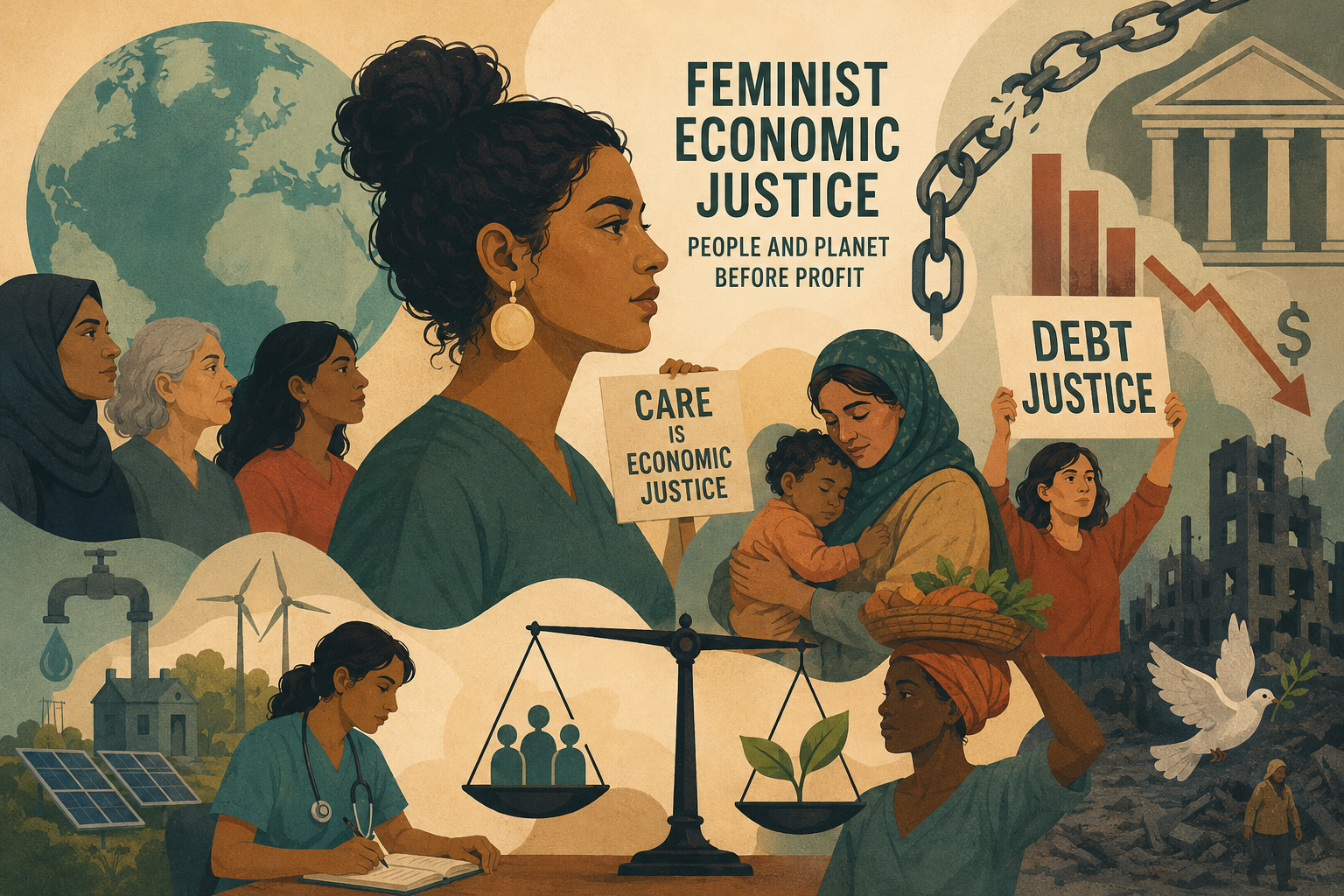
Feminist Economic Justice in a Time of Fracturing Multilateralism A reflection on war, debt, care, and what it would take to (re)build a system that puts people’s rights and the planet before profit
By Mahinour ElBadrawi, Feminist Human Rights Advocate and Global Partnerships Lead at the Center for Economic and Social Rights (CESR)
 In a time of war, debt, ecological breakdown, and fracturing multilateralism, feminist economic justice cannot be treated as a side agenda. It is a measure of whether global economic governance is capable of responding to the realities people are living through.
Across the SWANA region and beyond, violence, occupation, displacement, and ongoing genocide are destroying lives, livelihoods, ecosystems, and the public systems people rely on to survive. Development cannot be separated from these realities. Nor can global economic debates treat war, debt, austerity, climate breakdown, and the cost-of-living crisis as if they belong to different conversations.
War economies devastate lives not only through direct violence and killing, but also by making the basic economic and social conditions necessary for survival and human dignity increasingly unattainable. While the impact is felt across the globe, the heaviest costs are carried in the Global South and pushed especially onto women, girls, and gender-diverse people through lost income, intensified unpaid care, and reduced access to rights, including health, education, food, work, shelter, and social protection. The essential question then becomes: “If people survive the bombing, can they afford the cost of living?”
The crisis is also embodied and lived through the bodies of women, girls, and gender-diverse people. Sexual and reproductive health and rights are not abstract when water is scarce, menstrual hygiene products are lacking, clinics are destroyed, and public systems are collapsing. What does it mean to give birth, manage menstruation, seek contraception, access emergency obstetric care, or maintain dignity under these conditions? A feminist economic analysis must name these realities because war, debt, austerity, and privatization are lived through bodies, households, and care systems.
As foreign policy ministers and governments prepare to gather in Madrid next month for the Fifth Ministerial Conference on Feminist Foreign Policy, under the theme “Building Peace and Democracy,” the test is already clear. In order to deliver on commitments to Sustainable Development Goal 5, the Convention on the Elimination of All Forms of Discrimination against Women and progress on areas of concern of the Beijing Declaration and Platform for Action, Feminist leadership cannot be measured by stronger gender equality language alone. It must be measured by whether governments confront how global economic governance rules on debt, tax, trade and investment, climate finance, official development assistance, private capital, militarization and trade rules and practices shape rights beyond their borders. This extends to governments’ role in the IMF and the World Bank Group’s governance, programs, and policies, in line with their extra territorial obligations and duty to cooperate internationally, coherently, across fora and policy spaces, to do no harm, and to fulfill rights. This is especially timely as Spain hosts the conference, in an attempt to meaningfully connect the dots to the Sevilla commitments of the FFD4 conference last year.
Contrary to what Bretton Woods Institutions and private-sector actors profiting from the current order continue to promote, the problem is not a lack of resources. It is the hoarding of wealth, and a failure of political will to reverse the extractive rules, tax abuses, debt arrangements, and policy choices that allow billionaires and corporations to avoid their social and legal obligations while stripping states of the fiscal space needed to fulfill rights. Too often, the Bretton Woods Institutions protect creditor and investor stability, preserve power structures rooted in historical injustice, and remain unfit for purpose. Those who have profited from the systems that produced inequality, dispossession, and destruction cannot be allowed to define the terms of “development” or “reconstruction,” nor be trusted to deliver different results, and fairer futures.
This is evident in how the crisis is managed in the SWANA region. The language is stability, reconstruction, and recovery. But stability for whom, and recovery on whose terms? Civil society groups have raised serious concerns about the World Bank’s role in Gaza reconstruction discussions, including what this means for multilateral legitimacy, accountability, and Palestinian participation. Reconstruction cannot become another site where powerful actors decide the future of a people without them, or reproduce the colonial, militarized, and profit-driven logics that produced dispossession and destruction in the first place.
This refusal to redistribute power has deep historical roots. In March 2026, the UN General Assembly adopted a declaration, A/80/L.48, recognizing the trafficking of enslaved Africans and the racialized chattel enslavement of Africans as the gravest crime against humanity. That recognition matters for today’s economic debates because the transatlantic slave trade, colonial extraction, and racialized regimes of labour, property, and capital helped build a global economy through oppression and dehumanization. Reparatory justice cannot be separated from IMF quota reform, debt justice, tax justice, or climate finance.
Recent global economic governance debates have made this contradiction visible. Governments speak of implementation while debt burdens rise, aid is cut, and military spending expands. The evidence confirms what feminist movements have long argued: 54 countries, home to 3.4 billion people, now spend more on debt service than on health or education; official development assistance from DAC members fell by 23.1 percent in 2025, the largest annual contraction on record; and global military expenditure reached a record $2.887 trillion that same year. The question is one of political will: whose lives are protected, whose futures are financed, and whose claims are treated as expendable.
A feminist reading begins with the costs that official balance sheets erase. When debt service rises, public services are cut, food and energy prices increase, and climate shocks intensify, the costs do not vanish. They reappear in longer queues at clinics, reduced meals, unpaid hours of care, and the daily labour of survival, especially for women and girls. The care economy becomes the shock absorber of a system that refuses to redistribute power and resources.
A feminist economic justice agenda must connect what policy spaces too often separate: debt, tax, climate finance, care, militarization, and democratic economic governance.
Debt is a feminist issue. It is not only about repayment schedules, creditor committees, or fiscal indicators. It is about whether states have the resources and policy space to meet their obligations to people. Debt sustainability assessments that ignore care systems, reproductive health, food security, housing, education, climate adaptation, and social protection reflect a creditor’s view of sustainability, not the conditions required for dignity, bodily autonomy, and rights. Recent UNDP analysis makes this visible: rising debt servicing is estimated to put the equivalent of 55 million women’s jobs at risk, reduce women’s per capita income by 17 percent, and increase maternal mortality as countries move from moderate to high debt servicing. Borrower coordination can help Global South states assert collective voice and build leverage, but feminist debt justice requires debt cancellation, and sovereign rights based restructuring enshrined in a statutory approach, through a UN-led debt framework convention that ensures debate on debt sustainability and related assessments are grounded in human rights, gender equality, and climate obligations.
Tax is also a feminist issue. States cannot fulfill rights without resources, and they cannot mobilize those resources fairly in a global tax system that enables corporate profit shifting, illicit financial flows, harmful tax competition, and the undertaxation of wealth and capital. The UN Tax Convention matters because it is about who writes the rules, and whether Global South countries can shape the fiscal conditions needed to fund care, public services, climate action, and social protection.
Climate finance cannot be separated from care or from the ecological impact of war. As climate shocks intensify and public systems are weakened by debt and austerity, households and communities absorb the costs. Oxfam, CARE, and the Climate Justice Collective estimate that while developed countries reported nearly $116 billion in climate finance for 2022, its real value was only $28 to $35 billion, with almost 70 percent provided as loans. Climate finance that arrives as loans is not climate justice. It is climate finance on creditor terms. Nor can a feminist green transition ignore militarization, which destroys ecosystems, contaminates land and water, accelerates emissions, diverts resources from climate action, and entrenches fossil fuel dependency under the language of energy security. In Gaza, UNEP has warned that environmental damage is harming human health and threatening long-term food and water security, including through damaged freshwater supplies, soil contamination, and the collapse of sewage treatment infrastructure. A feminist, decolonial, and rights-based transition must therefore be public, grant-based, non-debt-creating, and rooted in historical responsibility.
That feminist lens must also reach IMF and World Bank governance. Who decides what counts as “sound” economic policy? Who defines stability? Whose rights are treated as unjustifiably derogable, or worse, entirely expendable, in the name of fiscal discipline? IMF surveillance, lending, and policy advice shape public budgets and the limits of what governments are told is possible. The issue is not simply representation. It is democratic economic governance: whether decision-making power shifts away from creditor-dominated institutions and toward countries and communities whose lives are shaped by these policies. Reform cannot stop at language about voice. It must confront the $1 = 1 vote logic of Bretton Woods governance, where economic power translates into political power.
A feminist rights-based approach demands a non-harm test: do these policies expand or constrain the resources and policy space states need to fulfill rights, protect minimum essential levels, and avoid pushing adjustment onto those already facing discrimination and exclusion? When the survival of people and the planet is treated as a variable to be adjusted for creditors, this is not merely an economic calculation. It is a political choice with profound human rights consequences.
Gender language is not enough. Feminist financing for development means debt and tax justice, public and grant-based climate finance, universal social protection, decent work, public care systems, bodily autonomy, democratic governance of financial institutions, and an end to austerity. It also means resisting the regression of women’s human rights language and defending sexual and reproductive health and rights as public responsibility, not optional programming.
For governments that present themselves as champions of feminist foreign policy or women’s rights, walking the talk means more than feminist fiscal policy at home. It means carrying responsibilities beyond borders.Official development assistance is not charity. Grant-based climate finance is not an act of generosity. Reparations are not symbolic.They are part of a broader set of policy measures necessary to fulfill the duty of international cooperation and repair the historical and ongoing harms of colonialism, extraction, ecological destruction, militarization, and unequal economic rules.
Under international human rights law, states have duties to respect, protect, and fulfill rights, including through international cooperation and extraterritorial obligations. That means reversing ODA cuts, investing in gender equality, supporting debt cancellation and a UN-led debt framework, engaging constructively in the UN Tax Convention, backing public and grant-based climate finance, reforming Special Drawing Rights, and ending investor-state dispute settlement mechanisms that restrict states’ ability to regulate in the public interest.
Global North-South allyship cannot be limited to speeches, side events, or selective gender commitments. It must be built on redistribution, repair, accountability, and changing the rules that preserve unequal power. Recognition is only the starting point. It is crucial to the future of our shared civilization and planet that governments do not repeat the mistakes that built the current order: profiting from dispossession, extraction, dehumanization, war, genocide, and ecological destruction, then calling the result development.
At a time when gender justice is under attack, feminist economic justice cannot mean softer language around the same broken rules. It must mean organizing economies around care, bodily autonomy, dignity, equality, collective wellbeing, and ecological repair, while preventing public and private actors from profiting from genocide or the destruction of the planet.