From extraction to sovereignty: why Santa Marta matters now
This week in Santa Marta, Colombia, movements, unions, Indigenous leaders, feminist organizations, and governments from across the Global South are gathering to do something the climate regime has avoided for decades: define what it actually means to transition away from fossil fuels.
Not rhetorically. Not gradually. Not through markets.
But politically.
The First Conference on Transitioning Away from Fossil Fuels is taking place at a moment when energy is once again being weaponized globally. The ongoing US–Israeli attacks on Iran are a reminder that oil is never just fuel. It structures sanctions, shipping routes, inflation, military escalation, and global financial pressure. Every new crisis exposes how deeply fossil dependency shapes the world economy.
Santa Marta enters this moment with a different proposition: that ending fossil fuels is not only a climate necessity, but a condition for sovereignty, peace, and economic justice.
For regions like SWANA, this is not abstract. Our economies have long been positioned as extraction zones, transit corridors, and geopolitical bargaining chips. Energy systems were never designed around people’s needs. They were designed around export, control, and debt. Transition, in this context, cannot be technical. It must be structural.
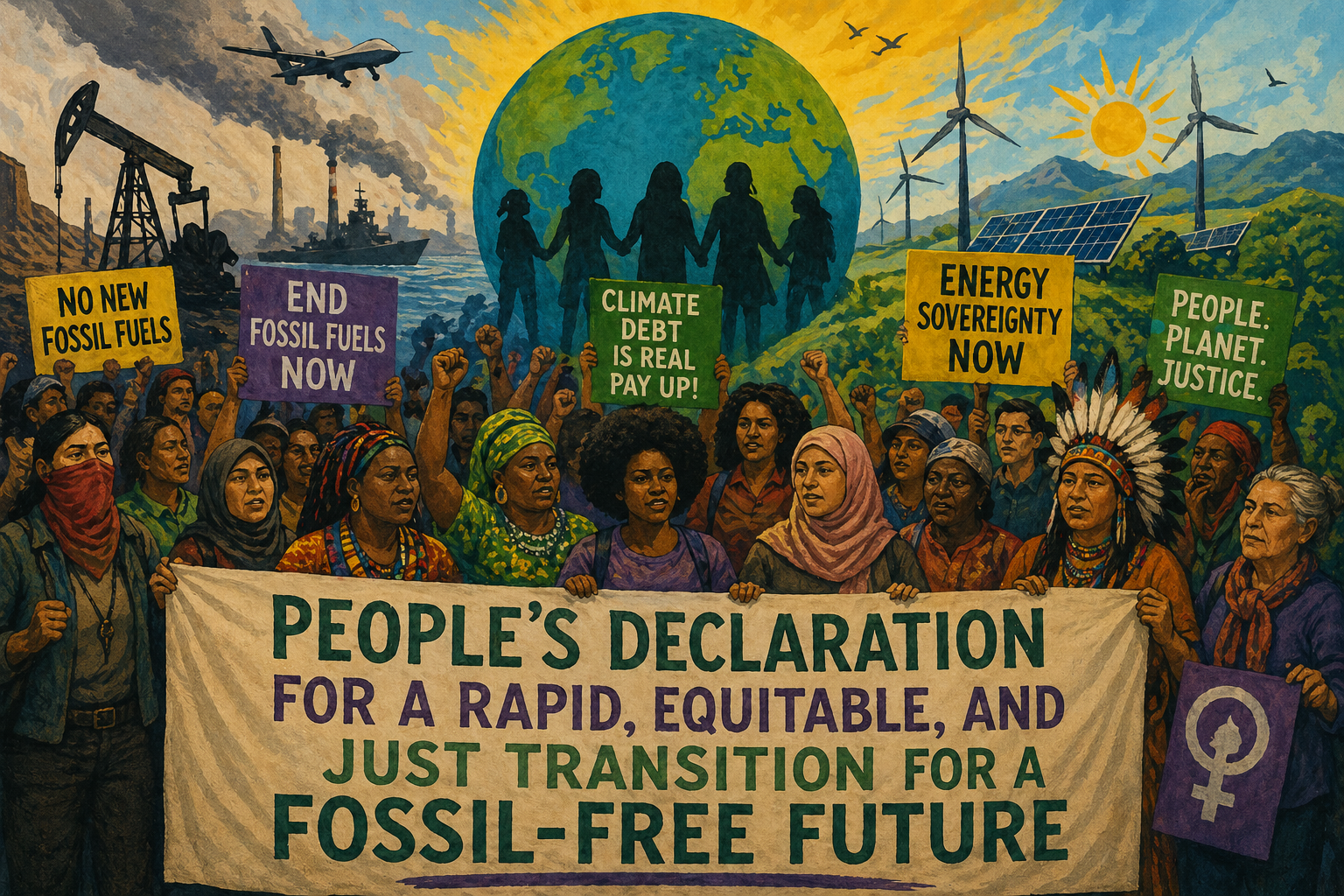
That is why today, at the Civil Society People’s Summit in Santa Marta, movements are announcing a shared declaration for a rapid, equitable, and just transition away from fossil fuels — one that directly challenges the narratives still dominating international climate policy.
The declaration puts forward clear demands:
First, an immediate halt to all new fossil fuel expansion — no new coal, oil, or gas projects anywhere.
Second, a rapid and differentiated fossil fuel phase-out, with Global North countries moving first and fastest while delivering the finance required for Global South transitions.
Third, the recognition that climate finance is not charity, but repayment of climate debt — and must be public, predictable, and non-debt-creating.
Fourth, the rejection of false solutions such as carbon markets, offsets, large-scale bioenergy, and fossil gas framed as a transition fuel.
Fifth, the cancellation of illegitimate debts and the removal of structural barriers — including trade rules and investor protections — that prevent countries from exiting fossil dependency.
And finally, the shift toward decentralized, publicly controlled renewable energy systems that treat energy as a right, not a commodity.
These demands reflect a growing consensus across movements: the transition cannot reproduce the same extractive model under a green label.
Yet even as this conversation unfolds in the Global South, inequalities within the transition space remain visible. Many grassroots organizations from Africa, Asia, and the SWANA region were unable to attend because of restrictive visa processes. Their absence is not procedural — it reflects the deeper imbalance in who gets to shape global climate decisions and whose voices are filtered out of them, even inside Global South transition spaces.
Still, Santa Marta marks an important shift.
At a time when governments are expanding gas infrastructure in the name of security and corporations are rebranding extraction as climate solutions, movements gathering here are insisting on something different:
The transition away from fossil fuels is not a technical pathway.
It is a political struggle.
And the Global South is no longer waiting to be invited to define it.
📚 People Summit declaration 📜 👇💪
People’s Declaration for a Rapid, Equitable, and Just Transition for a Fossil-Free Future
https://fossilfreerising.org/declaration