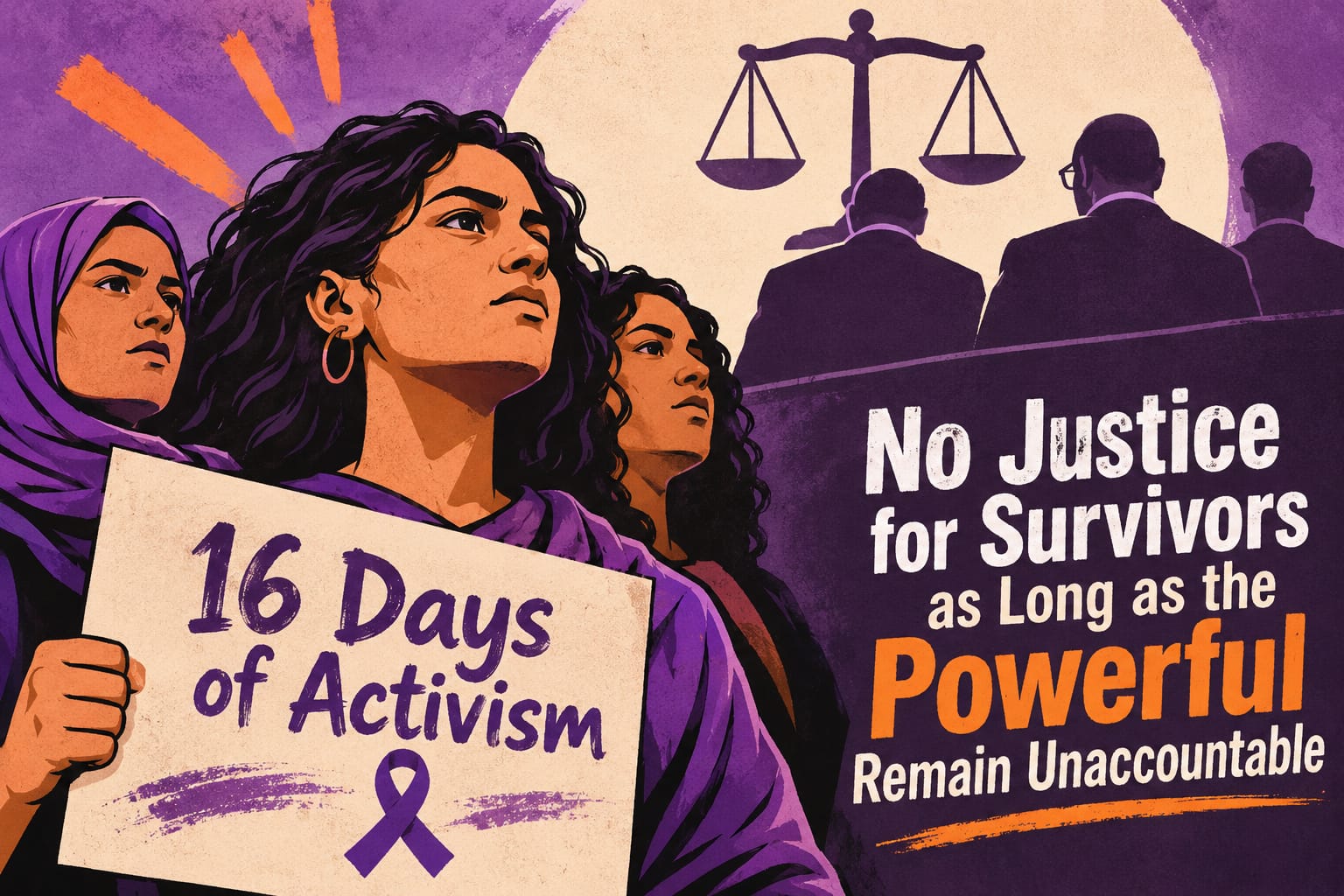
No Justice for Survivors While the Powerful Remain Beyond Accountability
Opening editorial for the 16 Days of Activism against Gender-Based Violence, 25 November – 10 December 2026
Every year, between 25 November, the International Day for the Elimination of Violence against Women, and 10 December, Human Rights Day, the 16 Days of Activism against Gender-Based Violence calls attention to violence against women and girls as a human rights violation that women endure everywhere. The link between these two dates is more than symbolic: it is a reminder that women’s rights are an integral part of human rights, and that violence against women is neither a private nor a family matter. According to the latest estimates from the World Health Organization and its UN partners, nearly one in three women worldwide, some 840 million, have experienced intimate partner or sexual violence in their lifetime, a figure that has barely changed since 2000.[1] In 2024 alone, around 50,000 women and girls were killed by intimate partners or family members, almost one every ten minutes.[2] These figures make clear that violence is not confined to particular societies, nor is it the product of a particular culture from which other societies and cultures are somehow immune. It is a global structure, sustained by entrenched imbalances of power.
As with other international days and annual campaigns, the 16 Days adopts a theme each year that foregrounds a particular form of violence or a particular means of confronting it. This year, the UN Secretary-General’s UNiTE campaign has chosen the theme “Ensure Justice. Protect Survivors. End Impunity.”[3] In other words: guaranteeing access to justice within a system that believes survivors and ensures that perpetrators do not escape punishment.
While we consider this theme vitally important, since it addresses one of the most serious obstacles to confronting violence, we insist that it must not remain a slogan, nor be reduced to a single step completed once a survivor discloses abuse or files a formal complaint against her abuser. The United Nations itself acknowledges that fewer than a third of women who experience violence seek help of any kind, that fewer than 10 per cent go to the police, and that only 22 per cent of countries report providing legal aid in cases of violence against women and girls.[4] In the Arab region, we know well that access to justice is not simply a matter of a woman’s financial means, nor of a legal provision allowing her to file a complaint. It depends on an entire system of laws and practices that may place the very decision to file a complaint in the hands of other family members rather than her own. Ending impunity likewise requires a review of legislation to ensure not only that perpetrators are punished, but that the punishment is proportionate to the crime. That means abolishing mitigating excuses, and ending the practice of allowing families to waive their personal right to prosecution in cases where women are killed by a relative, cases in which the perpetrator and those entitled to demand his punishment often belong to the same family circle. It also requires guaranteeing the independence of the judiciary, so that perpetrators with financial or political influence cannot evade justice.
Experience across the region shows that such laws are not immutable. Feminist movements won the repeal of provisions that exempted a rapist from punishment if he married his victim: in Morocco in 2014, and in Tunisia, Jordan and Lebanon in 2017, after years of struggle and tragedies for which women paid with their lives. Yet the fight is far from over. Laws in the region still grant husbands a “right to discipline” their wives, retain mitigating excuses for so-called “honour crimes”, and make women’s decisions and freedom of movement conditional on the consent of a male guardian. Access to justice therefore begins long before the complaints office. It begins with laws that do not discriminate; with police, prosecutors and judges equipped to treat survivors with dignity; and with public services, from shelters and free legal aid to health and psychosocial care, that make disclosure a real possibility rather than a perilous gamble.
Nor can justice be separated from funding. Even as the United Nations champions the protection of survivors, UN Women reports that one in three organizations working to end violence against women have suspended or shut down programmes because of funding cuts,[5] that 89 per cent of the women’s rights organizations it surveyed say these cuts have severely reduced survivors’ access to support services, and that 59 per cent are witnessing rising impunity and the normalization of violence.[6] All this is happening while global military expenditure reached a record of more than US$2.7 trillion in 2024.[7] The very states that are cutting aid earmarked for protecting women are the ones expanding their arms budgets, and that is itself a political choice that produces and perpetuates violence.
While we understand the context of violence in Arab countries, particularly the obstacles that prevent women from accessing justice and holding abusers to account, we also emphasize that violence is not perpetrated by individuals alone. It extends to states and institutions, not least the international institutions that operate within the United Nations’ own system of global governance. When we analyse the violence endured by women in the Arab region and across the Global South, the economic, political and social violence produced by austerity, the seizure of resources, systematic impoverishment, militarization, displacement and genocide stands out as violence inscribed on women’s bodies and daily lives. Among its foremost perpetrators are international institutions such as the International Monetary Fund and the World Bank, alongside UN member states, and these perpetrators routinely escape punishment and accountability. Ironically, this year’s UN campaign itself calls for accountability not only for perpetrators but also for institutions that fail to act.[8] We therefore remind the United Nations that when it adopts a theme calling for an end to impunity, it and its affiliated institutions must be the first to abide by it, rather than embody its very opposite.
Although the International Criminal Court issued arrest warrants in November 2024 for the occupation’s Prime Minister, Benjamin Netanyahu, and his former defence minister, Yoav Gallant, the United Nations itself has allowed Netanyahu to enter its premises and attend sessions of the General Assembly. Despite the horror of the genocide in Gaza, where more than 38,000 women and girls were killed between October 2023 and December 2025, an average of at least 47 every day according to UN Women;[9] despite the continued killing of women after the ceasefire was announced;[10] despite the conclusion of the Human Rights Council’s Independent International Commission of Inquiry in September 2025 that Israel has committed genocide in the Strip;[11] and despite the war on Lebanon, the incursion into Syrian territory and the attacks on Iran in flagrant violation of the UN Charter, the occupying state has been neither suspended nor held to account. Instead, impunity is entrenched by the dominance of the United States and its use of the veto to block ceasefires, the entry of humanitarian aid and any accountability for these crimes.
As discussions on the margins of the World Bank Group and IMF Annual Meetings in Bangkok (12–18 October 2026) made clear, the policies of international financial institutions deepen women’s precarity and marginalization by imposing austerity measures and economic restructuring that cut public spending on education, health and social protection in order to service debt and loan interest, with direct consequences for women’s access to their rights. According to UN Trade and Development (UNCTAD), 3.7 billion people now live in countries that spend more on interest payments on public debt than on health or education.[12] When the state withdraws from these services, the need for them does not disappear; it is shifted onto women’s shoulders in the form of unpaid care work. With it, the doors of shelters, legal aid and health services close, and without these services any talk of “access to justice” is meaningless. Women are also displaced and dispossessed of their land as a result of war and militarization, the marginalization of agriculture, and land acquisitions by foreign corporations and their investments. Austerity, in this sense, is not a neutral economic policy but a form of structural violence, with known perpetrators who never stand before any court.
Women’s social realities must not be separated from the geopolitical realities that continue to inflict violence on them in so many forms. If perpetrators are truly not to go unpunished, the questions are these: How will the United Nations reform its systems to ensure accountability for the occupation’s many crimes, when the occupation does not even recognize its authority? How will the United Nations free itself from US domination of its decisions and from the steady erosion of its legitimacy as guardian and guarantor of international peace and security? How will it stand as a guarantor against the overreach of international financial institutions into states and their sovereignty, and put an end to the draining of the Global South through loans, debt and the exploitation of its natural resources for the benefit of multinational corporations? And how will it put an end to wars waged in the interests of arms manufacturers, wars that threaten the security, safety and very future of life on the planet?
Answering these questions cannot wait. In our view, ensuring justice for survivors and ending impunity require, at a minimum:
First, comprehensive legal reform that abolishes mitigating excuses in the killing of women, prohibits the waiver of the personal right to prosecution in such cases, criminalizes all forms of violence, including economic and digital violence, and guarantees women’s autonomy in deciding whether to seek legal redress.
Second, sustainable public funding, protected from austerity, for protection services, including shelters, free legal aid, and health and psychosocial support, together with direct and flexible funding for women’s rights organizations.
Third, independent assessments of the human rights and gender equality impacts of IMF and World Bank programmes, steps towards the cancellation of unsustainable and illegitimate debt, and a democratic reform of the international financial architecture.
Fourth, the enforcement of the International Criminal Court’s arrest warrants, a comprehensive arms embargo on the occupying state, and accountability for crimes committed against women in Palestine, Lebanon and Syria.
Fifth, reform of UN decision-making mechanisms to end the ability of any single state to obstruct justice through the veto.
The United Nations, and we as feminist movements, must find real answers to these questions if violence against women is to be confronted at its roots and women’s rights are to be guaranteed. The justice demanded of a survivor in the interrogation room must be demanded, in equal measure, of states and institutions in the chambers of the Security Council and the corridors of international financial institutions. Throughout these sixteen days, we will keep naming every perpetrator, whether an individual, a state or an institution, because justice that exempts the powerful is no justice at all.
[1] World Health Organization, “Lifetime toll: 840 million women faced partner or sexual violence”, news release, 19 November 2025. https://www.who.int/news/item/19-11-2025-lifetime-toll–840-million-women-faced-partner-or-sexual-violence
[2] UNODC and UN Women, Femicides in 2024: Global Estimates of Intimate Partner/Family Member Femicides (November 2025). https://www.unodc.org/unodc/en/press/releases/2025/November/137-women-and-girls-killed-every-day-by-intimate-partners-or-family-members-in-2024.html
[3] UN Women, 16 Days of Activism 2026 concept note, “UNiTE to End Violence Against Women and Girls: Ensure Justice, Protect Survivors, End Impunity”. https://www.unwomen.org/sites/default/files/2026-08/unite_2026_concept_note_en.pdf
[4] Ibid.
[5] UN Women, At Risk and Underfunded: How Funding Cuts Are Threatening Efforts to End Violence Against Women and Girls (October 2025). https://www.unwomen.org/en/news-stories/press-release/2025/10/one-in-three-organizations-have-suspended-or-shut-down-programmes-on-ending-violence-against-women-due-to-funding-cuts
[6] UN Women, 2026 UNiTE concept note, op. cit.
[7] Stockholm International Peace Research Institute (SIPRI), Trends in World Military Expenditure, 2024 (April 2025).
[8] UN Women, UNiTE to End Violence against Women campaign page, 2026. https://www.unwomen.org/en/what-we-do/ending-violence-against-women/unite
[9] UN Women, “More than 38,000 women and girls were killed in Gaza between October 2023 and December 2025”, press release, 17 April 2026. https://www.unwomen.org/en/news-stories/press-release/2026/04/more-than-38000-women-and-girls-were-killed-in-gaza-between-october-2023-and-december-2025-un-women
[10] In October 2026, UN Women reported that 277 women and girls had been killed in Gaza since the ceasefire took effect in October 2025 (Anadolu Agency via Bernama, 9 October 2026). https://bernama.com/tv/news.php?id=2617959
[11] Independent International Commission of Inquiry on the Occupied Palestinian Territory, including East Jerusalem, and Israel, report released 16 September 2025.
[12] UNCTAD, A World of Debt 2026. https://unctad.org/news/rising-debt-costs-are-stalling-development