

By Doha Yahyaoui
During the Days of Activism against Gender-Based Violence, it is hard to speak of “women in Tunisia” as though all women lived with the same fear, had the same protection, or faced violence from the same social and political position. Violence against women is not one experience with one face. It takes many forms and works on many levels, shifting with women’s positions, identities and circumstances. Yet it is present in every space and touches all women, to different degrees. Some women face violence in the private sphere, some in the street, some at work, and some pay the price for being present in public life. Other women, migrant and Black, face a violence that is more layered and more complex: violence based on colour and on gender; the violence of poverty and legal precarity; the violence of public policy; and the violence of an official discourse that has turned them from rights-holders into a security crisis and a demographic threat to be contained and removed.
A whole system draws its legitimacy and stability from violating human rights, and above all the rights of Black migrant women. It makes them into an enemy within and blames them for the country’s economic and social crises. It then presents the violation itself to the public as a legitimate defence of the security of the state and of society. Repression stops being a burden on the regime’s legitimacy and becomes a source of it. Nor has it stopped there. Its fire has spread to those who stand in solidarity, men and women alike, and the act of solidarity has itself become grounds for prosecution and punishment. In Tunisia today, solidarity is a crime.
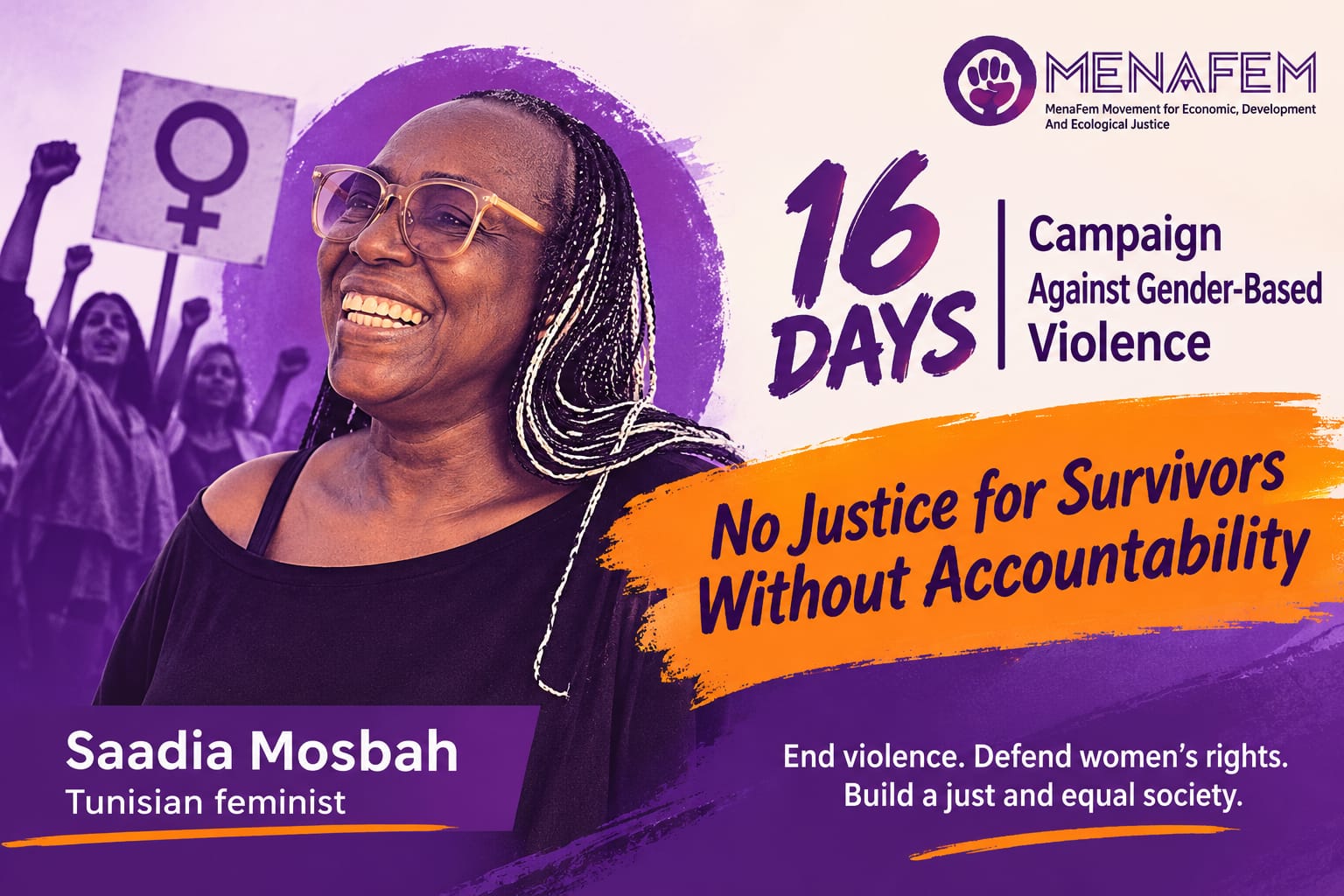
Where gender-based violence, racial violence, the violence of policy and the criminalisation of solidarity meet, the case of Black feminist Saadia Mosbah stands out as one of the clearest signs of the period Tunisia is living through. Racism, autocratic rule, a system of injustice, the criminalisation of civic and political work, and the persecution of human rights defenders all come together in it.
Saadia Mosbah is a Black Tunisian feminist and a defender of the rights of Black people in Tunisia. She chose to make the fight against racism a political and human rights project, and she devoted her life to it and to a Tunisia that is safe for everyone. After the revolution, in 2013, she founded the association Mnemty, and she became one of the most uncompromising voices for equality and against racial discrimination. In 2018, thanks to her struggle and that of all who defend the rights of Black people, Organic Law No. 50 on the Elimination of All Forms of Racial Discrimination was adopted in the name of the people.
From Official Incitement to a Prison Cell: How Saadia Mosbah Paid for Her Solidarity with Her Freedom
After the President of the Republic’s racist speech of 21 February 2023 about migrants from sub-Saharan Africa, Tunisia saw a dangerous rise in incitement and violence against Black migrants, both men and women. In the years that followed, migration became ever more firmly framed as a security issue. Organisations working on migration and against racism were subjected to pressure, investigations and prosecutions. Saadia Mosbah chose to confront a political and security discourse that was growing more hostile to Black people arriving from sub-Saharan Africa, and she paid for her solidarity with her freedom.
Saadia Mosbah was arrested on 6 May 2024. After nearly two years of pre-trial detention, abuse and oppression, she was sentenced on 19 March 2026 to eight years in prison and a fine of more than 120,000 dinars. The sentence was upheld on appeal in June 2026.
She was charged with financial offences, much as almost everyone who has chosen to oppose the regime has been. The aim was to destroy her credibility, to dismantle her standing in society, and to kill off the very meaning of opposition and struggle. The regime deliberately uses money-laundering charges, among the most legally complex offences there are. They rest on many precise constituent elements, and none of these elements was present in the cases brought against Saadia or against any of the other activists.
In prison, the punishment does not stop at the loss of liberty. It reaches into the details of daily life. Saadia Mosbah says she is denied the right to choose her books, and that books sent to her are held back for months without any justification. Like the other women prisoners, she suffers from thirst during the hot months, and she lives with a deep fear of dying in prison. And yet, in the face of all this, she says: “Even if a thousand doors were shut on me, I would still win for my cause.”
The regime in Tunisia no longer needs to declare its racism in order to practise it. It is enough to cast a particular group as permanently suspect and as a threat to national security. Defending that group then becomes a potential crime, the associations that support it become targets of surveillance and harassment, and every activist who speaks out is branded with charges of treason, corruption and conspiracy.
Dragged Through the Mud: The Smear Campaigns and Digital Siege That Came Before Prison
To understand the injustice done to the Black feminist activist Saadia, we have to look closely at the context. Eight years in prison do not capture what one woman has been put through over years of her life. Before prison, Saadia faced smear campaigns, online attacks, incitement and attempts to destroy her credibility. These campaigns targeted her appearance and her record, and they paved the way for detention, then trial, then sentence. Read through a feminist lens, this sequence shows that the punishment did not fall only on an activist for her positions. It fell on a woman who chose to take up a public, oppositional position, to speak on an extremely dangerous issue, and to refuse the social role expected of women, and of Black women above all: to stay out of sight and, most of all, to stay silent.
By a feminist lens I do not mean only that Saadia is a woman. I mean that the way she was attacked cannot be separated from her being a woman in a political sphere that is still governed, to varying degrees, by patriarchal power. Saadia Mosbah was subjected to a systematic attack on her reputation, her appearance and her public image. Again and again the debate was dragged away from her ideas and positions and onto her person: inquiries into her nationality, her body, her career, and doubts cast on her patriotism. When that woman is Black, colour becomes an added vulnerability, used to humiliate and to strip ideas of their legitimacy. What set the case of Black feminist Saadia Mosbah apart was that her identity itself was part of the battle with the regime. Saadia sums this up herself, from her cell, when she says that her cause has a colour.
This compounded vulnerability must be at the heart of how we read the case of Saadia Mosbah. She did not face the regime only as a feminist and human rights defender. She did not face racism only as a Black woman, or patriarchy only as a woman. She faced all of these forces at once, at a political moment when migration, colour and civic work had all become security files. A feminist lens also means looking at the context, the pattern of targeting, the position of the person targeted, and whether a campaign of defamation and incitement came before the legal proceedings. In Saadia’s case, the sentence comes within a wider campaign against civil society and against the organisations working on migration and anti-racism. We look at the whole trajectory. It began when she became the target of sweeping smear campaigns, when she was placed under digital siege, and when she was presented to the public as a suspect figure and held up to all activists as a lesson. Most dangerous of all, it continued when standing in solidarity with her became a risk for others.
The Test of Feminist Solidarity in Tunisia
In one of its most painful dimensions, the case of Black feminist Saadia Mosbah reveals a crisis deeper than the repression or targeting of civil society. It also reveals a crisis in the Tunisian feminist movement’s ability to turn accumulated violations into a real political cost for those in power. The issue is not a total absence of solidarity. Feminists and organisations did issue positions, statements and expressions of support. But the question we must ask boldly is this: did the scale of this feminist solidarity, its political force and its persistence match the repression faced by migrant women and by the women who stand with them? Did the feminist movement manage to make Saadia Mosbah’s case central to its struggle against violence, authoritarianism and racism?
In this sense, criticising the feminist movement is not an accusation of failure. It is a call to strengthen its capacity to build power at a moment when women’s rights are in serious retreat. Today the feminist movement needs the courage to face its narcissistic wound. It failed to confront the regime’s assault on one of the fronts of intersectional feminist struggle in Tunisia. The regime dared to sentence her to eight years, knowing full well that the movement would not change the equation.
More troubling still, Saadia’s case comes at a moment when violence against women in Tunisia has become part of a political and social climate in which protections are shrinking and official discourse is ever more able to produce violence and justify it. How can the feminist movement confront femicide, sexual violence, harassment and rape, yet fail to treat anti-migrant discourse seriously as a direct extension of that same violence? How can we hold that women’s bodies must be protected from patriarchal control, yet fail to take equally seriously discourses that go as far as treating migrant women’s bodies and wombs as a demographic or security matter, a field for intervention and control? In recent years, Tunisia’s public and political sphere has seen extremely dangerous parliamentary and media rhetoric about migrant women, including statements widely regarded as degrading to women and as fuelling discrimination and hatred. This has happened within a wider context in which official and political discourse has stoked hostility towards Black migrants, and especially towards women, cast as capable of changing the country’s demographic make-up through pregnancy and childbirth.
From a feminist perspective, the most dangerous part of this shift is that control over women no longer appears only as direct prohibition or coercion. It appears in the way their bodies are being redefined as a matter of “state security”, of demographic composition and of “the migration problem”. When a migrant woman’s womb becomes a subject of political debate, we are witnessing a dangerous move from the securitisation of borders to the securitisation of bodies: from controlling people’s movement to trying to control women’s capacity to bear children.
Confronting the securitisation of Black women’s bodies is not an issue that belongs to “other women”. It lies at the heart of the feminist struggle. It is an act of resistance against a system that sees the body of a Black migrant woman not as a body that belongs to her, but as a “breach” in the border and a reservoir of incoming “danger” to be monitored and controlled. When her pregnancy and childbearing are said to threaten the demographic balance, her right to motherhood is erased. Pregnancy turns from a personal experience into a potential crime against the nation, and the mother is treated not as a rights-holder but as a breeding instrument in the service of an “imagined enemy”.
This is exactly where the feminist movement should have been most present, refusing to let women’s bodies and wombs become the political, demographic or moral property of any authority. The paradox is that when this discourse targeted migrant and Black women, it did not produce the feminist anger needed to break the cycle of violence in which we are all caught. All women will pay the price for this later. All women, without exception.
The danger grows when we set this against the daily reality of migrant women and girls, and against the spread of racist discourse into institutions, where it undermines the rights to health, education, housing, work, safety, and protection from sexual and physical violence. Here, precisely, we must ask another question. Why have migrant women’s rights to health, safety, protection from violence, reproduction, motherhood and the protection of their children not become a constant and visible part of the Tunisian feminist movement’s struggle against a racist, authoritarian and misogynistic regime? Why was the discourse that incites against migrant women, or that makes their bodies and wombs an object of politics, not treated as a direct threat to everything the feminist movement has built through its struggle against control over women’s bodies, and why did the movement not rise up against it?
At many moments, the Tunisian feminist movement has stood before this rollback of rights fully aware of its danger. But it has not always been able to turn that awareness into collective action equal to the scale of the historical moment. Perhaps the problem is that the feminist movement itself has entered a phase of defending past gains rather than fighting to redefine the balance of power. While we try to protect what remains of our texts, laws and gains, the social and political reality around us is changing fast, and violence is being reproduced in a new language: sometimes in the name of security, sometimes of sovereignty, sometimes of protecting society, sometimes of patriotism. It is precisely in this space that those in power have been able to advance. They no longer always need to abolish women’s rights by explicit legislation. It is enough to leave institutions powerless, to allow incitement against a particular group, to make access to justice, health, education or protection harder, and to weaken the organisations that historically held them to account. The rollback of rights then becomes a lived reality whose political, social and cultural effects will be hard to undo.
Criticising feminist solidarity in Saadia’s case should therefore not end in self-flagellation, or in handing out certificates of good conduct among organisations and movements. It should lead to a deeper, strategic question: what must be done to build genuine feminist solidarity?
History will not ask only what the feminist movement said in this period. It will ask what it managed to prevent, whom it managed to protect, and whether it succeeded in turning anger into real political power capable of bringing change. We must prove ourselves worthy of our sisterhood with Saadia Mosbah, and carry on from where she was stopped.